



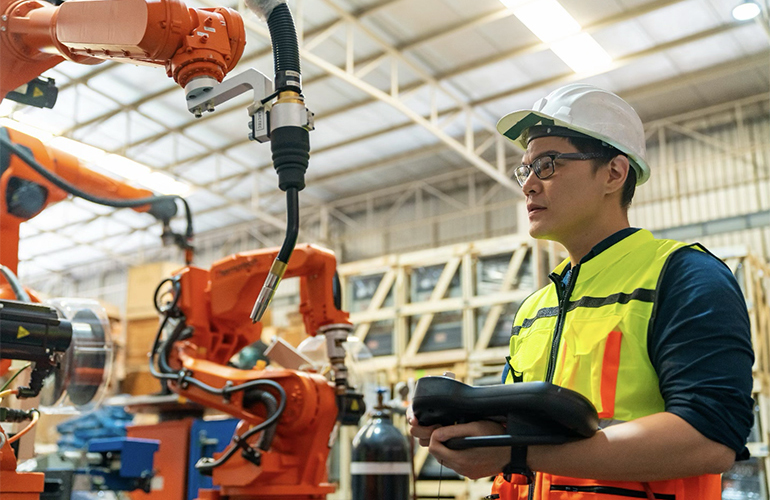
Image courtesy of ADI
The closer robots get to people, the more essential it becomes for them to perceive, hear, and respond instantly.
Creating a humanoid robot is among the most challenging tasks in modern robotics. On its own, such a system must handle movement, balance, vision, and responsiveness through an intricate network of joints, sensors, and data processing. This challenge intensifies when the robot operates in spaces shared with people.
As humans, we perform most actions instinctively. We gauge our center of gravity and make adjustments to run, jump, or sidestep a collision. We absorb enormous amounts of sound and visual data at once, in real time, and use those inputs to guide our reactions. All of this occurs in mere fractions of a millisecond.
A humanoid robot must replicate this level of environmental awareness using a collection of sensors, then analyze those signals rapidly enough to define a safe operating zone and take appropriate action to avoid endangering anyone nearby.
“Building trust between humans and robots is essential for safe interaction. Any robot working alongside or near people must be equipped to handle our inherent unpredictability. The robot also needs to clearly communicate its intentions to those around it, preventing unsafe human behavior caused by misunderstandings,” explains Geir Ostrem, Analog Devices Fellow in the Automotive Business Unit at ADI.
And as workforce shortages worsen and more robots enter shared environments to boost productivity, a central question emerges: what does it take for a humanoid robot to work safely and effectively alongside people?
Vision
Situational awareness for humanoid robots begins with vision, particularly in settings where people and equipment are in constant motion. A humanoid robot must see and interpret its surroundings to react swiftly and correctly—whether that means grabbing an object or stepping away from a person. Standard human vision can be mimicked using RGB image sensors, while depth perception can be achieved through time-of-flight, structured light, or stereo vision techniques.
Simply having visual input isn’t sufficient; processing that information quickly and precisely is crucial. Cameras and visual sensors are typically positioned far from the central computer, meaning all that visual data must travel across the robot through lengthy cables. Cables add weight and limit movement flexibility, so maximizing the efficiency of each cable is critical.
In a humanoid robot, a central processor acts as the brain, with vision sensors in the head or torso linked directly to this core computer. For tasks requiring lower latency in fast control loops—such as driving a motor for rapid movements—dedicated smaller processors can be placed closer to the sensor or actuator, handling local computation, reducing wiring complexity, and ensuring functional safety while relaying data to the main processor.
Already widely adopted in the automotive sector, ADI’s Gigabit Multimedia Serial Link (GMSL) technology transmits video data in real time through a single stream capable of carrying multiple gigabits per second. In humanoid robots, this supports redundancy and rapid, local processing of visual data, allowing these systems to recognize and interpret their environment using physical AI that processes visual information directly on the robot rather than relying on the cloud.
Audio
Vision by itself isn’t enough, though; if a robot is to collaborate effectively with humans, it needs intelligent hearing as well. “The ability to communicate in natural language and offer a conversational user interface is an extremely powerful way to interact with a robot,” says Ostrem.
It’s equally important that a humanoid robot can recognize acoustic events happening in its surroundings. If something falls to the floor behind a robot, it must be able to pinpoint the source of the sound and understand what that sound signifies, Ostrem notes. Classifying acoustic events is a task well-suited for local, physical AI.
Just like visual data, audio signals must travel from multiple microphones to the robot’s central computer for analysis, which means latency remains a concern.
“For sound event localization and detection, having deterministic latency from the microphone to the computer is absolutely critical,” says Ostrem. “This involves beamforming and mapping the acoustic field, which requires highly accurate knowledge of the relative delays between different microphones.”
“This is an area where ADI’s A2B audio bus excels, because the time it takes for a signal to travel from a microphone to a computer using A2B is entirely deterministic.”
A proven automotive technology, A2B is a low-latency audio transport solution that supports sound source localization and simplifies audio connectivity across the system by enabling multiple microphones to be daisy-chained on a single bus—carrying power, audio, and control signals over just two wires.
“When you look at a robot, the sheer volume of wiring needed for all the sensors is one of the biggest challenges,” says Ostrem. “A2B lets you implement advanced audio functionality with remarkably few wires.”
Image courtesy of ADI
Battery/Power
All of these sensors, processors, and connectivity components require power to function. Humanoid robots carry their own energy source in the form of battery packs. Most humanoid robots operate on lithium-ion batteries rated at 48, 60, or 72 volts—smaller than those used in vehicles, but posing many of the same dangers such as overheating or thermal runaway.
ADI provides technologies like electrochemical impedance spectroscopy (EIS) for detecting unsafe changes in battery chemistry at an early stage, allowing batteries to be replaced before a failure occurs.
“EIS lets you examine what’s happening deep within the battery’s chemistry,” Ostrem explains. “If something goes wrong with the battery, or if it becomes unsafe in any way, you can identify the issue ahead of time—before it turns into a hazard. When a robot is operating near humans, if that battery is heading toward thermal runaway, you absolutely want to ensure that battery is well away from any person when the problem actually occurs.”
And all of this hinges on the audio, visual, and other internal sensors being able to detect problems, relay them quickly, and take action to reduce any safety risks to people nearby.
Conclusion
As humanoids take on increasingly complex roles, the demands for safety, sensing, and interaction will only increase. Ostrem believes the future lies in more capable AI at the edge—in terms of reaction speed, safety, and battery longevity.
ADI has already mastered sensing and perception, connectivity, and battery management in the automotive domain. The logical next step is applying those technologies to emerging fields like humanoid robotics.
“In many ways, humanoid robots are where automobiles were decades ago,” says Ostrem. “The architecture isn’t fully established yet, and there’s significant opportunity for industry collaboration around standardizing interfaces to foster the ecosystem surrounding humanoid robots.”
To learn more, visit
Sponsored content by Analog Devices
