



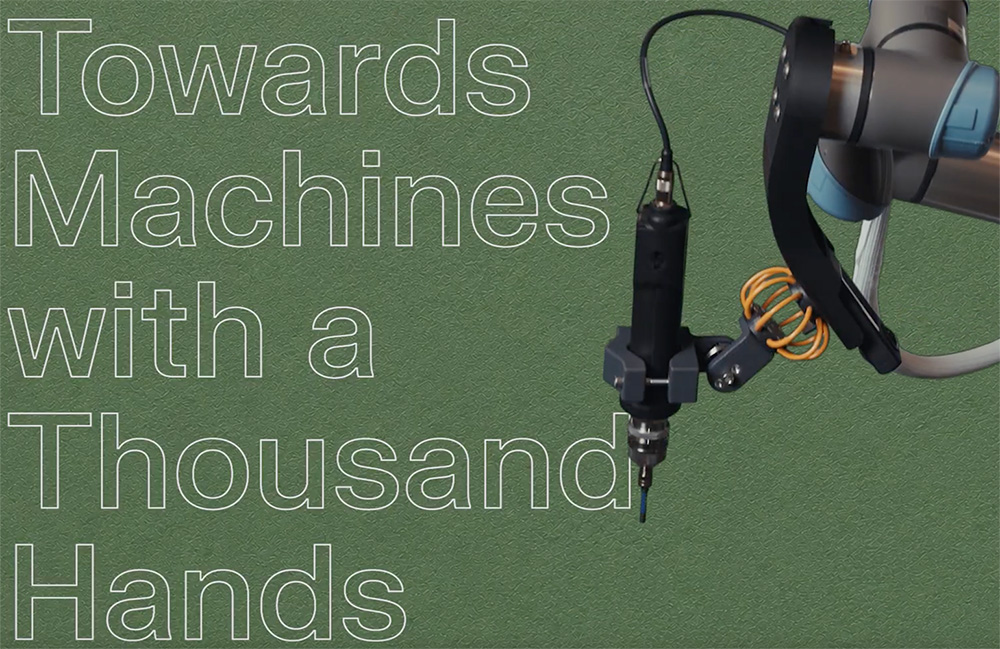
**Generalist’s GEN-1: The One Model Blueprint for a Thousand Robot Hands**
The landscape of robotics is shifting. We are moving past the era of single-purpose machines and toward a new age of general-purpose intelligence. At the forefront of this revolution is Generalist, a company pioneering an “embodied foundation model” known as GEN-1. Their latest breakthrough? Proving that a single, unified AI model can master an astonishing variety of robot end effectors—from sophisticated five-fingered hands to custom-built industrial tools—unifying them under one intelligent “brain.”
### A Universal Mind for a Universe of Hands
Generalist’s GEN-1 is not just another robot controller; it’s a foundation model trained on a massive and diverse dataset. By ingesting over half a million hours of real-world robot interaction data across more than 9,000 variations of end effectors, GEN-1 has been exposed to a staggering range of physical interactions. This diverse training allows it to learn universal principles of physics, contact, and manipulation, rather than hard-coded instructions for a single tool.
The company’s core thesis is elegant in its simplicity: **the hand is just an interface.** Whether it’s a power screwdriver spinning at impossible speeds, a compliant tong grasping a fragile object, or a metal spatula pushing a heavy load, each tool is a “different language” for the robot to speak to the physical world. By training GEN-1 to understand all these languages, the model develops a “general physical intelligence”—a commonsense understanding of how objects behave and how forces interact with the world.
### From Theory to Practice: Adaptation and On-The-Fly Learning
The true power of this approach is demonstrated in its adaptability. Generalist doesn’t just train on a static set of tools; it learns how to adapt. Through a process of fine-tuning, the company can measure precisely how the model’s “knowledge” shifts to accommodate a new end effector, treating the weight changes in the neural network as a quantifiable “task update.”
Even more impressively, GEN-1 can adapt in real-time. In one remarkable test, the model was mid-task with one tool when the end effector was physically swapped for a completely different one. Without missing a beat, the model perceived the new tool, recalibrated its understanding of the sensor data, and immediately found a new strategy to achieve its goal. This proves that the model isn’t just memorizing actions; it has learned a flexible, transferable strategy for interacting with the physical world.
### The Cambrian Explosion of Robot Form
Generalist envisions a future that mirrors the Cambrian explosion of biological life, where a vast array of specialized forms emerge to solve different problems. Today’s robots are often locked into their physical form, but with a general intelligence like GEN-1, that constraint disappears. Robots will no longer be defined by their hands but by the intelligence that controls them.
A suction pad, a five-fingered gripper, a brush, or a plasma welding nozzle are all just different interfaces for the same underlying intelligence. The “toolbox” of the future will contain a thousand hands, each optimized for a specific task, and the robot’s core intelligence will be smart enough to choose and switch between them with ease. This isn’t about replacing human capability; it’s about extending it into new realms of manipulation and creation, empowering us to shape the physical world in ways previously confined to science fiction.
***
### FAQ
**Q: What is the GEN-1 foundation model?**
GEN-1 is a robotics foundation model developed by Generalist. It is a large AI model pretrained on vast amounts of real-world robot interaction data, designed to control and manipulate physical objects. Its core innovation is learning universal sensorimotor policies that are not tied to a specific robot design.
**Q: What does “supporting a range of end effectors” mean?**
It means GEN-1 can be installed on and control many different types of robot “hands” or tools. This includes everything from complex multi-fingered robotic grippers to simple, custom-made industrial tools like screwdrivers, tongs, spatulas, and peelers.
**Q: How is one model able to work with so many different tools?**
GEN-1 is trained on a massive, diverse dataset that includes data from thousands of different end effectors. This teaches the model the underlying physics of interaction—such as geometry, contact, friction, and force—rather than specific motor commands for a single tool. This allows it to generalize its intelligence to new, unseen tools.
**Q: What are the benefits of this approach?**
The primary benefit is unprecedented flexibility and adaptability. Robots become more general-purpose and can be quickly re-tasked or re-equipped for new jobs. It also allows robots to switch tools on-the-fly to use the best tool for a specific subtask within a larger operation, significantly expanding their potential applications.
**Q: Is this model ready for commercial deployment?**
While this represents a major technological milestone, the article focuses on the model’s capabilities and research direction. Widespread commercial deployment would depend on further real-world testing, safety validation, and integration into specific robotic platforms.
***
### Conclusion
Generalist’s GEN-1 model represents a paradigm shift in robotics. By decoupling intelligence from hardware, it challenges the long-held notion that a robot’s capability is fixed by its body. Instead, it proves that a single, general intelligence can master a “Cambrian explosion” of diverse physical forms. This move towards a toolbox of a thousand hands is more than a technical achievement; it’s a vision for the future of robotics. It promises machines that are not just stronger or faster, but fundamentally smarter, more adaptable, and capable of extending human potential in the physical world in ways we are only beginning to imagine. The age of the generalist robot is dawning.
