




Image courtesy of ADI
Vision has become a core sensing technology in today’s robotics. As robots grow more autonomous, perceptive, and scalable, the methods used to transmit image data have advanced alongside them.
Early robotic vision systems depended mainly on USB and Ethernet camera connections, drawing from PC and industrial networking standards. These solutions supported early development and quick prototyping. Now, Gigabit Multimedia Serial Link™ (GMSL™), initially created for automotive camera systems, is emerging as a superior option that fits the design requirements of next-generation robots.
This article explores how robotic vision connectivity has developed, looking at why older interfaces are hitting their limits and how GMSL is transforming system architecture.
Early Robotic Vision: USB as the Entry Point
USB cameras were among the first widely used vision solutions in robotics. Their advantages were clear: affordable pricing, wide availability, and built-in compatibility with PCs and embedded systems. USB connections let early robots send image data to CPUs or GPUs with little hardware integration work.
However, USB was designed primarily as a short-range, host-focused connection, not as a reliable, multi-camera sensor network. Reliability also became a major obstacle for real-world deployment.
The limited cable distances, unpredictable latency, and heavy CPU usage made USB fine for prototyping but a poor fit as robotic systems became more sophisticated.
Ethernet and GigE Vision: Extending Range, Increasing Complexity
To address USB’s shortcomings, many robotic systems moved to Ethernet-based vision, particularly GigE Vision. Ethernet provides greater cable lengths, established infrastructure, and a standardized connection, allowing cameras and software from different manufacturers to work together.
At the same time, Ethernet-based cameras usually need an onboard processor to package image data and handle network protocols.
For robotics tasks that rely on real-time perception, such as avoiding obstacles or precision manipulation, this extra latency and unpredictability can cause issues. Combining multiple cameras over Ethernet adds further system complexity, often demanding extra hardware and increasing the overall footprint and power draw.
Growing Requirements of Modern Robotic Vision
Today’s robots are increasingly using multiple high-resolution cameras positioned throughout their bodies, supporting functions like autonomous navigation, skilled manipulation, human–robot collaboration, and safety. Key trends shaping new connectivity demands include:
- More cameras, with eight (or more) image sensors per robot
- Distributed camera positioning, needing long, durable cable runs through moving or mobile platforms
- Low-latency sensor fusion, merging RGB vision with LiDAR, radar, and IMU data
- Precise synchronization, particularly for stereo and surround-view perception
These trends call for connectivity solutions that are predictable, scalable, energy-efficient, and physically durable – qualities that traditional industrial interfaces don’t inherently provide.
GMSL for Vision Connectivity: Designed for Cars, Suited for Robots
GMSL transmits uncompressed image data, bidirectional control signals, and power through a single cable, using either coaxial or shielded twisted pair wiring.
GMSL was originally built to satisfy the strict demands of automotive camera systems, where real-time performance, electromagnetic resilience, and extended cable reach are essential. These same traits translate naturally to robotics.
Predictable, Low-Latency Data Transfer
GMSL carries raw image data straight to a centralized computing platform, such as an embedded GPU or FPGA. This dedicated point-to-point connection for each camera avoids the delays and buffering found in USB and Ethernet. The result is microsecond-level predictable latency, which is vital for real-time perception and control.
Streamlined Camera Modules
GMSL-based cameras generally need only an image sensor and a serializer, removing the requirement for a local processor. This shrinks camera size, lowers power consumption, and reduces heat generation, enabling more compact and widely distributed vision setups.
Extended Reach and Durability
GMSL supports cable lengths well beyond what USB allows, while preserving high signal quality with extremely low bit error rates, even in electrically noisy surroundings. This makes it ideal for robots working in factories, warehouses, hospitals, and outdoor environments. GMSL devices carry ASIL-B certification, offering robust link monitoring and diagnostics, strong EMI/EMC performance, and high dependability.
Scalable Multi-Camera Setups
With choices for single, dual, or quad-channel serializers and deserializers, GMSL makes it straightforward to combine multiple sensor streams directly on the GMSL devices. This lets designers scale up without introducing extra components, cabling, or system complexity. This is especially valuable for surround-view and multi-modal perception systems, particularly in autonomous mobile robots and humanoid robots.
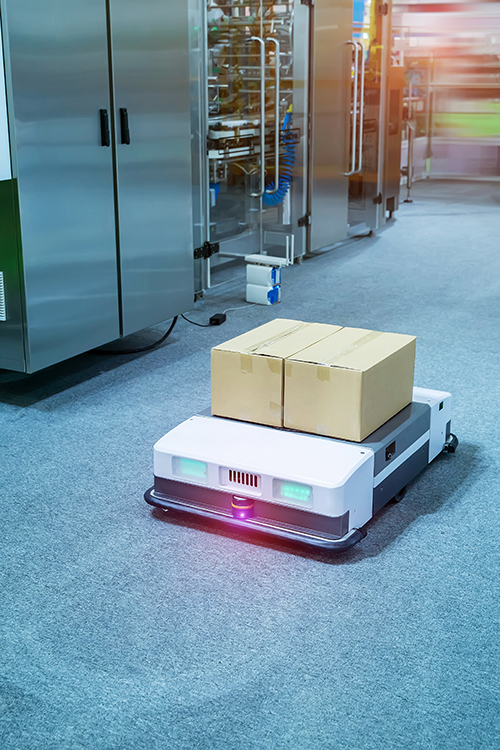
Image courtesy of ADI
Connectivity as a Strategic Design Decision
As robots become more complex and autonomous, connectivity decisions directly affect performance, reliability, and future scalability. The shift from USB and Ethernet to GMSL reflects a broader change in robotics: vision is no longer an add-on feature, but a fundamental system capability.
Call to Action: For a more detailed technical look at how GMSL delivers these benefits, including camera deployment strategies and system-level design factors, read Kainan Wang’s Building High Performance Robotic Vision with GMSL on Analog Devices’ website
Sponsored content by Analog Devices
