



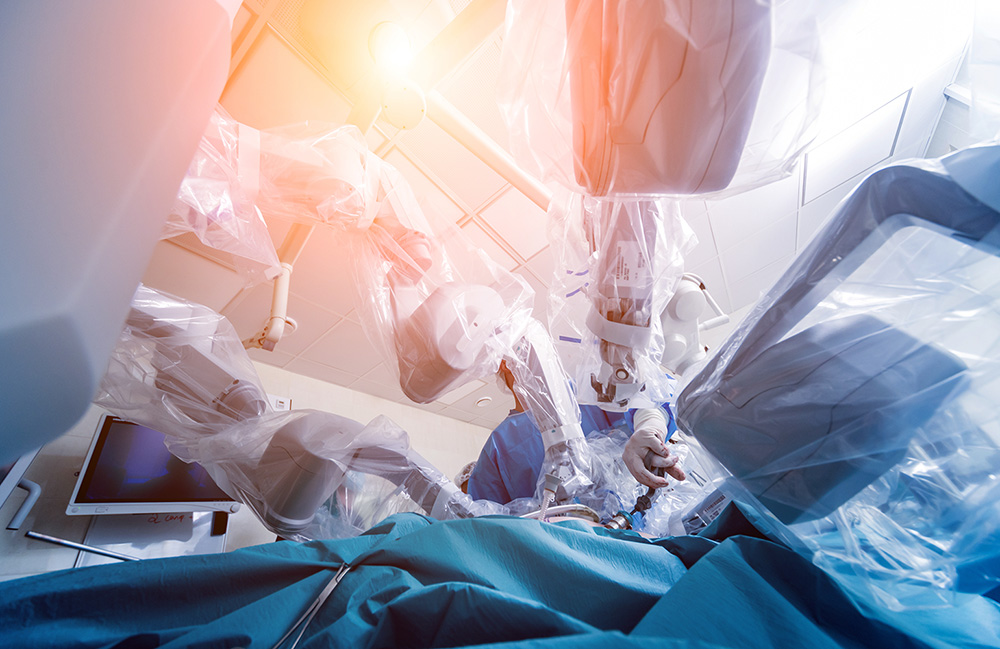
Johnson & Johnson created OTTAVA for operations like gastric bypass. Image: Adobe Stock
Johnson & Johnson has shared findings from the initial clinical trial of its experimental OTTAVA robotic surgery platform. This forward-looking, multi-site study assessed how safe and effective the system is for performing gastric-bypass surgeries.
According to J&J, the group of 30 patients achieved the study’s main safety and effectiveness goals within 30 days after their procedures. Every surgery was carried out entirely using the OTTAVA robot, with no need to switch to a traditional manual technique. Patients lost an average of 30 pounds (13.6 kilograms) by the 30-day mark.
“These findings offer promising early signs that the OTTAVA Robotic Surgical System is both safe and effective for Roux-en-Y gastric bypass procedures,” said Erik Wilson, M.D. Dr. Wilson serves as chief of minimally invasive and elective general surgery at UTHealth Houston, leads bariatric surgery at Memorial Hermann-Texas Medical Center, and was the principal investigator for this trial.
“Advancing innovation in bariatric surgery plays a vital role in improving patient outcomes, and I’m excited to share these first clinical findings,” Wilson continued.
The company combined these clinical results with earlier preclinical testing to back its request to the U.S. Food and Drug Administration (FDA) for De Novo classification. J&J is seeking approval for a range of general surgical procedures in the upper abdomen, including gastric bypass, gastric sleeve, small bowel resection, and hiatal hernia repair.
Headquartered in New Brunswick, N.J., the company unveiled these results at the 2026 American Society for Metabolic and Bariatric Surgery (ASMBS) Annual Meeting (Abstract 4153).
OTTAVA’s development faced setbacks due to the COVID-19 pandemic. The FDA issued an investigational device exemption (IDE) for the system in late 2024, and the platform carried out its first procedures one year ago.
J&J aims at soft-tissue surgery with its newest platform
Johnson & Johnson built OTTAVA as a versatile soft-tissue surgical robot capable of supporting a wide variety of procedures spanning several medical specialties. The company plans to run multiple clinical trials to validate its use across these areas.
The system features a unique design with four robotic arms built directly into a standard surgical table, eliminating the need for a separate overhead boom or mobile carts.
During the study, OTTAVA was set up and operated successfully in operating rooms at six different hospitals. The ORs varied in size from roughly 243 to 694 square feet (22.5 to 64.4 square meters).
At five of the six locations, OTTAVA performed surgeries in rooms that had never before been used for robotic procedures — including spaces traditionally seen as difficult for robotic systems because of limited room.
“Our advancement with OTTAVA is grounded in thorough preclinical research, careful clinical data gathering, and close partnership with the surgeons who operate it — particularly the investigators in the FORTE clinical study,” said Peter Schulam, M.D., Ph.D., chief scientific officer for MedTech at Johnson & Johnson. “These outcomes further demonstrate how an innovative design makes a meaningful difference where it counts most: in actual operating rooms, with real patients.”
“At every stage — from lab work to preclinical testing and now human trials — we’ve seen that this system can help more hospital ORs support robotic surgery,” he added. “These findings confirm that the innovative design can fit into current hospital setups and overcome practical obstacles to wider use.”
A closer look at the FORTE study of OTTAVA
In the United States alone, more than 40% of adults live with obesity. Johnson & Johnson noted that metabolic and bariatric surgeries are proven, long-lasting treatment options for managing weight loss.
Many of these operations, including Roux-en-Y gastric bypass, are being performed with robotic assistance more and more often. Roux-en-Y gastric bypass is a key procedure for treating obesity, with recent studies showing it delivers the strongest and most lasting results for severe obesity.
The surgery is technically challenging compared to other bariatric operations, involving both restrictive and reconstructive steps that typically extend across multiple areas of the abdomen and require a diverse set of surgical techniques.
The Safety and Performance of the OTTAVA Robotic System: A Prospective Multi-Center Evaluation (FORTE) Study (NCT06709261) is a single-arm, open-label clinical trial carried out at six sites across the U.S.
The study’s goal is to assess the safety and effectiveness of OTTAVA for 30 days following Roux-en-Y gastric bypass surgery. J&J included FORTE study data, along with supporting preclinical results, in its FDA De Novo classification application.
The company emphasized that the OTTAVA Robotic Surgical System is still in development and has not yet received authorization to be marketed or sold in any region.
Editor’s note: This month’s Robotics Summit & Expo is being held alongside DeviceTalks Boston. Sign up now to attend.

