



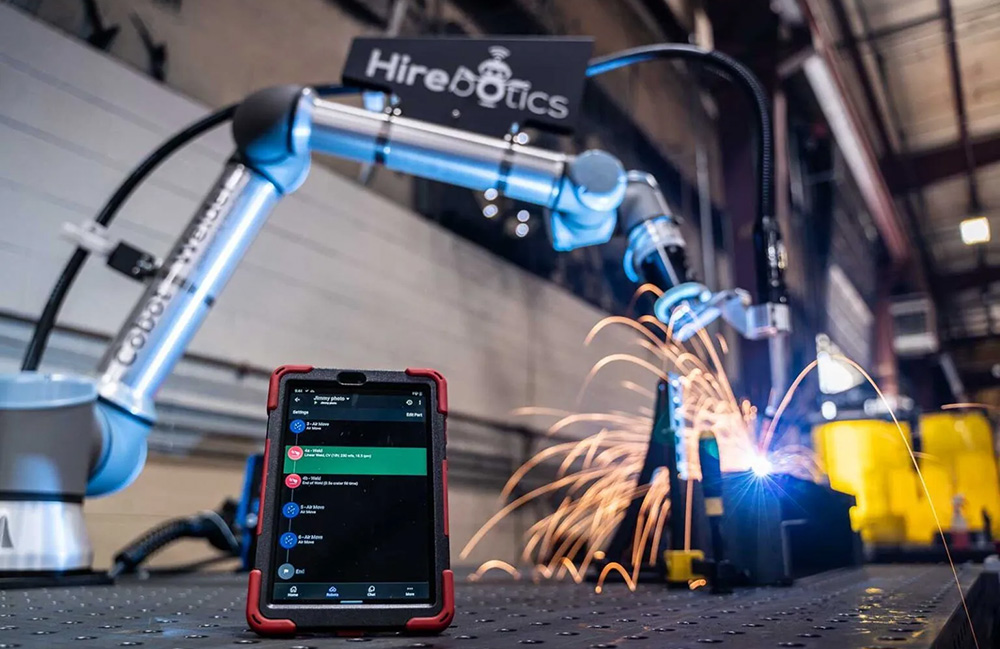
Hirebotics’ Beacon is a cloud-based automation platform that lets fabricators teach, run, and monitor welding, cutting, and painting cobots without programming. | Source: Hirebotics
We’ve been covering collaborative robots — commonly known as cobots — for over ten years, but their adoption in real-world applications has never been higher. Cobots now make up 18% of all robot units sold in North America, according to the latest report from the Association for Advancing Automation (A3). About 90% of all cobot orders come from industries outside of automotive, including food and consumer goods, semiconductors and electronics, and life sciences.
The metal fabrication, palletizing, and data center construction sectors are also embracing robots at an unprecedented rate, says Matt Bush, co-founder and newly appointed CEO of Hirebotics, a Nashville-based cobot solutions company focused on metal fabrication and related fields.
Bush sat down with The Robot Report to discuss why force- and power-limited robot arms are becoming essential tools in manufacturing, welding, and construction. He also shared what sets Hirebotics’ approach to automation apart and what he anticipates for these industries in the coming months and years.
Why did Hirebotics focus on metal fabrication and construction?
Can you walk us through Hirebotics’ history and explain what led you to zero in on applications like metal fabrication and construction?
Bush: Rob Goldiez, who stepped down as CEO earlier this year, and I officially founded Hirebotics in 2015 to tackle a challenge we were dealing with firsthand: finding enough workers to staff our manufacturing operations. We asked ourselves, “What if robots could be hired just like people?” At the time, collaborative robots and cloud technology were both on the rise, so we tackled the problem by developing a cloud-connected cobot solution.
We’d both worked across a broad range of manufacturing industries and applications since the mid-1990s, so we’ve experienced the labor shortage problem up close. That hands-on experience shaped our approach to automation. We think about it from the operator’s perspective, not just from an engineering standpoint. How will it address the operator’s real challenges?
Automation used to be complicated and expensive. Programming slowed down production. To strip away that complexity and accelerate output, we built systems that fabricators could actually use without needing engineers or writing code.
We began with machine tending and assembly, and in partnership with Red-D-Arc, introduced BotX — the first rental welding cobot. We used our existing technology for the initial BotX systems, but it wasn’t ideal and wasn’t as user-friendly as we wanted. So we created Beacon, a mobile app that put programming directly in the hands of welders, and in 2021, we launched the Cobot Welder powered by Beacon.

Matt Bush, the co-founder and CEO of Hirebotics. | Source: LinkedIn
What has changed since cobots were first introduced?
Cobots have come a long way since they first hit the market. What have been the most significant improvements you’ve observed?
Bush: We keep a close eye on cobot advancements, particularly how growing payloads, better safety sensors, improved ease of use, and greater openness will benefit different workflows in metal fabrication and neighboring industries. Then we refine our cobot solutions to serve clients in this space.
For us, the biggest change has been the move toward accessibility and “productized” turnkey solutions. I remember seeing the first cobots at a trade show back in 2014. They were just bare arms — you had to figure out how to use them and what to add to get the job done.
Now, most of the displays at booths run by companies like Universal Robots are turnkey, ready-to-go solutions that have been customized to meet customer needs right out of the box. We like to think we helped drive that shift by demonstrating what a standardized, purpose-built product layered on top of a cobot could offer the market.
How are cobots being used today?
In which areas are you seeing the most cobot adoption right now?
Bush: Cobots are being deployed across a wide variety of tasks: machine tending, pick-and-place, and increasingly palletizing. Welding has seen tremendous growth, especially since 2021, but we’re also moving into “miserable” or “dull, dirty, and dangerous” jobs that are tough to staff — like powder coating, where workers have to wear protective suits in summer heat.
We’re also seeing a major push into construction and large-scale infrastructure. Several of our customers are welding the materials that go into major infrastructure projects, such as bridge girders, structural beams for buildings, and key components in AI data centers.
Cobots excel at long welds and especially welds that require multiple passes, freeing operators to focus on inspections, layout, and fit-up work.
When it comes to welding, our cobot solutions can handle up to 90 in. [228.6 cm] per minute — significantly faster than a typical human welder.
How closely are robots working alongside humans?
Within metal fabrication and construction, are you seeing more teamwork between humans and robots? Are workers in these industries getting past the fear that robots will take their jobs?
Bush: We’re definitely seeing more teamwork between humans and robots. In these
Rather than replacing workers, robots often serve as a force multiplier, and employees are taking notice. In practice, a single human welder can oversee two or three robotic helpers, leading many businesses to actually expand their hiring after introducing automation.
In fact, our earliest welding customer significantly expanded their welding department because the collaborative robots allowed them to accept large-volume jobs they previously couldn’t handle. This enabled their human welders to concentrate on custom, high-value fabrication work. Robots excel at dull, repetitive jobs — they fall short when it comes to creative thinking or evaluating quality work, which remains a human strength. This shift also makes the trade more appealing to younger workers who are comfortable with technology.
We’re also seeing remarkable flexibility at different scales. While traditional robotic cells are standard on high-volume automotive lines, cobots are bridging the gap for shops dependent on manual welding. We now have systems handling parts up to 40 ft. [12.1 m] in size, and we’re witnessing expansion in marine manufacturing — such as large ships — and agricultural equipment production, where rural labor shortages are especially acute.
What challenges come with adopting robots?
What are the biggest challenges for small and midsize companies adopting robotics?
Bush: The biggest challenge — or really, misconception — is the belief that robots completely solve the labor shortage. In practice, companies often swap one problem for another: they can’t find welders, and then they struggle to find robot programmers.
Our priority is eliminating this obstacle. We engineer systems that operators can use directly, without needing engineers. Instead of traditional robot teach pendants, we use a smartphone or tablet interface. The goal is to make automation straightforward, with very little training needed.
Other companies like Hirebotics offer similar capabilities, but our approach centers on working within the operator’s comfort zone and providing support right inside that same interface whenever assistance is needed. This keeps users connected to the device and enables them to communicate directly with the Hirebotics team about whatever issue arises — whether equipment-related or related to a common process challenge.
Are certain sectors adopting cobots faster than others?
Bush: Metal fabrication, palletizing, and data center construction are at the forefront. Data centers are frequently built in rural locations where locating skilled welders is tough, if not out of the question. We currently have robots deployed at multiple sites for a major data center provider to address this challenge.
What makes Hirebotics stand out?
What should manufacturers and contractors consider when investing in cobots?
Bush: First, ensure the system is built for operators. You don’t want to rely on hard-to-find programmers. Second, evaluate the quality of support. Manufacturing and construction operate 24/7. You need a platform where bug fixes and updates are pushed automatically over the cloud so you’re not dealing with fragmented software versions.
Ask, “How do you access their support — is it a phone hotline, email, or something integrated directly into the interface? Can you browse their support resources, or are they hidden behind a paywall where you can’t preview them?”
What do you see as major differentiators for your company?
Bush: While most competitors still rely on the robot teach pendant and depend on the robot manufacturer’s proprietary programming language, Hirebotics lets an actual welder who understands good weld quality “teach” the robot by physically guiding the arm and using a simple, cloud-connected mobile interface on a device they already know well.
Since our beginning, every robot we’ve delivered has been cloud-connected, and since 2021, all our systems have run on Beacon. This provides a unified interface where a welding robot and a painting robot look the same in the app and share a consistent teaching experience, despite being built on completely different core robot platforms with vastly different teaching methods from the original manufacturer.
This cloud connectivity also transforms support. When an operator encounters a problem, they use the support tool built into the app. Our AI assistant, “Jake,” resolves roughly 85% of questions on the spot. If he can’t resolve it, the actual product development team steps in.

Hirebotics looks at what’s next for cobots
Looking ahead, what trends will shape the future of cobots?
Bush: AI, especially physical AI, will play a major role. As these technologies progress, robots will become more adaptive and need even less precise programming. We’re also monitoring the development of humanoid robots and anticipate some market consolidation as the industry matures.
At present, we estimate the market penetration is only around 4% to 5%, so there’s still a tremendous amount of education and growth ahead.
