



Cortex 2.0 is designed to work throughout embodiments and functions. Supply: Sereact
Sereact GmbH right now mentioned it has raised Sequence B funding of $110 million to scale its Cortex 2.0 “robotic brain” and assist its entry into the U.S. market. The corporate has opened an workplace in Boston and is hiring native engineering, industrial, and software staffers.
“We bet early that you can’t build real robotics AI in a lab. You build it with a data flywheel fed by real deployments — shipping into production, living with the failures, and letting the model learn from what actually happens on the floor,” acknowledged Dr. Ralf Gulde, co-founder and CEO of Sereact. “The numbers show it worked. Two hundred systems. One billion picks. One intervention per 53,000. Nobody else is close.”
Based in 2021, Sereact mentioned it builds bodily AI for warehouses and manufacturing. Its Cortex mind runs throughout single-arm choosing cells, dual-arm returns stations, and humanoid robots, in addition to Sereact Lens, a 3D notion system for stock and high quality management.
The Stuttgart, Germany-based firm‘s current European prospects embrace Daimler Truck, Mercedes-Benz, BMW, MS Direct, Lively Ants, DeltiLog, Rohlik Group, and Austrian Submit.
Sereact begins with AI for warehouse robots
“Sereact builds AI for robots that work in the physical world,” mentioned the corporate. “Warehouses were the first deployment because no other environment provides the same combination of data points: billions of real interactions, every object shape imaginable, hard throughput constraints, and consequences when the robot gets it wrong.”
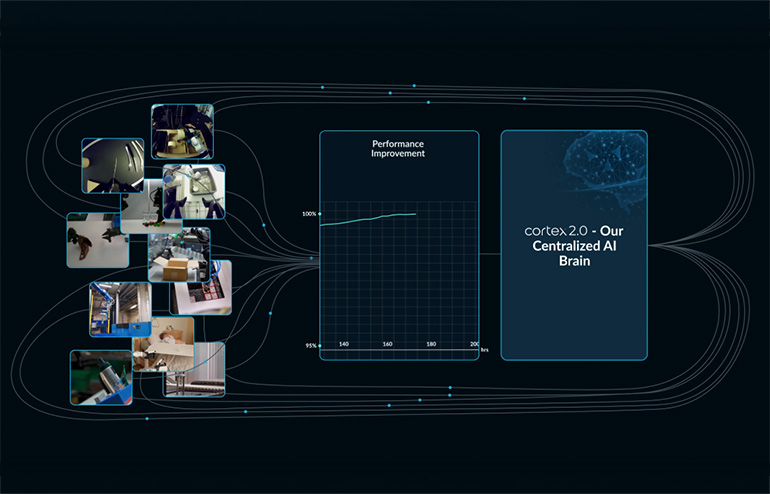
Sereact claimed that Cortex learns from picks of bodily objects in real-world circumstances throughout buyer websites that no simulation can reproduce. Except for the one in 53,000 that require distant human intervention, the robotic can deal with picks by itself, feeding knowledge again into its mannequin in a closed loop.
“Every successful pick, every failure, every recovery is captured with synchronized observations, robot state, gripper force feedback, and outcome — then filtered, prioritized by novelty and uncertainty, and used to update the model,” the corporate asserted. “Updated policies pass automated regression checks and roll out to the fleet. The loop closes. Data compounds. Coverage of the long tail expands.”
“Competitors are raising billions to train on simulated data and lab demos,” it added. “Sereact has spent five years training on real operations, at night, at peak, on the messy items that don’t look like anything the robot has seen before. It’s a gap that widens with every shift.”

Editor’s be aware: Bodily AI, warehouse automation, and humanoid robots will probably be among the many subjects mentioned on the 2026 Robotics Summit & Expo subsequent month in Boston. Register now to attend.
Cortex 2.0 anticipates outcomes earlier than it strikes
“Today’s Cortex sees and picks,” mentioned Sereact. “Cortex 2.0 thinks first, then acts.”
Cortex 2.0 augments a vision-language-action (VLA) mannequin with a world mannequin. From the present state, it generates a set of potential trajectories; runs them in opposition to a realized mannequin of physics and object conduct; and scores each for stability, danger, and effectivity. The robotic commits to the best-scored department and updates the rollout in actual time because the scene modifications, defined the corporate.
“The shift is from try-and-see to plan-and-try,” Sereact mentioned. “Today’s reactive policies, when they miss, tend to repeat the same motion and compound the failure.”
“Cortex 2.0 evaluates several outcomes first and rules out the bad ones before the arm moves — which is exactly what’s needed for the kind of work where contact matters: assembling a component under tension, placing a windshield wiper without scratching it, kitting parts that have to land in exactly the right orientation for the next station,” it added.
Cortex 2.0 plans in “visual latent space,” in accordance with Sereact. Whereas joint instructions are tied to a selected robotic’s kinematics, the pixels encode regularities about objects, contact, and movement that switch throughout embodiments.
“The robot dreams in latent space,” mentioned Marc Tuscher, co-founder and chief know-how officer of Sereact. “We give it a form of imagination — the ability to anticipate how the world will respond before it moves.”
“We don’t build robots. We don’t sell services. We ship one thing: the model that runs on any robot,” he mentioned. “Single arms, dual arms, humanoids, fixed cells — same brain across all of it. Hardware is becoming a commodity. The model isn’t.”
Sereact additionally famous that compute planning may be tuned to the duty. The know-how can present extra foresight when failure is pricey, akin to in parcel packing, kitting, or putting fragile objects. It might plan much less when restoration is reasonable, like for a regrasp on a missed decide. “Cortex 2.0 spends planning budget where it pays back,” it mentioned.
 Cortex is designed to be taught from knowledge from real-world experiences. Supply: Sereact
Corporations spend money on the info flywheel
Headline led Sereact’s newest funding, which included participation from Bullhound Capital, Daphni, and Felix Capital. Present buyers Air Avenue Capital, Creandum (lead of Sereact’s 2025 Sequence A), and Level 9 all returned for the Sequence B spherical. The corporate has raised over $140 million to this point.
“The physical AI opportunity is one of the largest we’ve seen in a generation, and we believe it will rewire global supply chains and manufacturing,” mentioned Trevor Neff, development associate at Headline.
“Behind great opportunities and great companies are great founders, and Ralf and Marc are building into that opportunity the right way: real deployments, real data, and a model that compounds and gets better with every single pick,” he added. “Customers love the product, which leads to continued expansion, only accelerating the data flywheel — this is why we are so excited to back Sereact.”
“After looking at a deluge of humanoid robotics companies, my fellow Partner Alon Kuperman and I were delighted to meet Ralf and Marc, the co-founders of Sereact, who have built an AI operating system that seamlessly retrofits into the world’s vast fleet of industrial robots already in action,” mentioned Per Roman, founding associate at Bullhound Capital.
Antoine Nussenbaum, co-founder and investor at Felix Capital mentioned: “We see Sereact as a new generation European champion, combining deep industrial know-how with world-class AI and robotics talent to tackle one of the hardest challenges in global supply chains. At its core is a powerful, compounding data moat, where every warehouse interaction makes the system smarter and harder to replicate.”
