



Six years ago, the United States-Mexico-Canada Agreement (USMCA) took effect, replacing the North American Free Trade Agreement as the primary trade framework for the three nations. As outlined in the original agreement, the three countries are now debating whether to renew it, and if so, under what terms.
The Trump Administration has signaled that unless Mexico and Canada make concessions, the U.S. will not renew the agreement. By July 1, the U.S., Canada and Mexico must agree to continue the deal. If they do, the agreement will be extended for an additional 16 years. If they don’t, the USMCA will enter annual renewal cycles until it expires in 2036.
If the three countries agree to an extension—with or without settling outstanding issues—the pact would be prolonged until 2032, and negotiations to extend it would take place once more.
In our view, it should be renewed. On the whole, the USMCA has been a net positive for all three countries, and it has helped build a dynamic, resilient North American economy.
Because the Trump administration’s tariffs have reduced trade with China, trade with Mexico and Canada has become comparatively more vigorous, even though it too has been hit with tariff hikes in 2025. That’s because the tariffs on Chinese goods are substantially higher than those imposed on Canadian and Mexican imports.
Mexico is the leading source of imports into the U.S., with Canada in second place. Mexico is also the top export market for the U.S., with Canada close behind. Mexico is America’s largest overall trading partner, with total bilateral trade reaching $873 billion in 2025, while Canada follows with $719 billion in trade. In 2025, Mexico-U.S. trade accounted for more than 15 percent of all goods exported and imported by the U.S., while trade with Canada was nearly 13 percent.
That’s the good news. The bad news is that elevated U.S. tariffs on Mexico and Canada have eroded trust among stakeholders in those countries. In particular, the North American automotive sector, long one of the continent’s most vital and deeply interconnected industries, is struggling under the weight of the tariffs, which have driven up costs, disrupted supply chains, and created uncertainty. Mexico’s transportation sector, which is tightly woven into the U.S. transportation industry, accounts for 40 percent of total trade with the U.S.
Looking for quick answers on assembly and manufacturing topics?
Try Ask ASM, our new smart AI search tool.
Ask ASM
How do manufacturers feel about the USMCA?
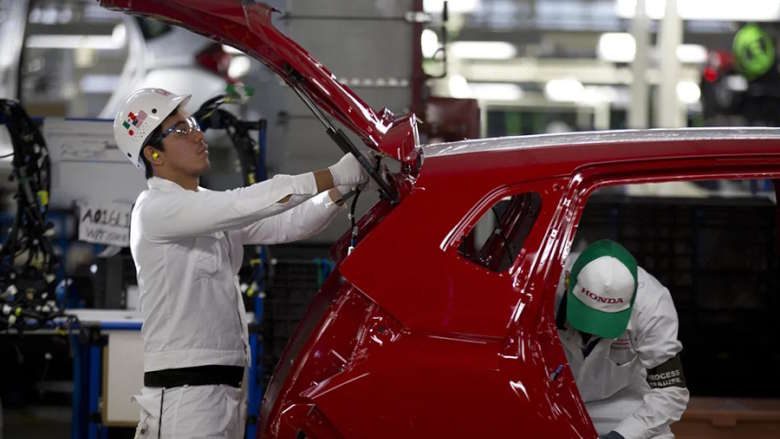
Automakers stand behind the agreement. In April, Bob Nelson, executive vice president of American Honda Motor Co. Inc., spent time in Washington, D.C. lobbying members of Congress and the administration on regional trade and its impact on American manufacturing.
“A single vehicle assembled in the United States represents an extraordinary network of workers, suppliers, and manufacturers. Components move through a highly integrated North American supply chain, often crossing borders multiple times before a finished vehicle ever reaches a customer,” wrote Nelson in an April 17 post on LinkedIn. “That system didn’t happen overnight. It was built over decades and strengthened through agreements like USMCA, which provide the certainty our industry needs to invest, hire and innovate here in America. Honda’s deep commitment to localization aligns with the goals of USMCA—last year, 99 percent of the vehicles we sold in America were sourced from North America.”
Electrical equipment makers also back the deal. In April, the National Electrical Manufacturers Association, La Cámara Nacional de Manufacturas Eléctricas, and Electro-Federation Canada—the trade groups representing North America’s electrical manufacturers in the U.S., Mexico and Canada respectively—called upon U.S. trade representative Jamieson Greer, Mexico’s secretary of economy Marcelo Ebrard, and Canada’s minister responsible for Canada-U.S. trade Dominic LeBlanc to strengthen the USMCA.
In their joint letter, the organizations argue that the USMCA has reinforced regional supply chains and created well-paying jobs in the U.S. and across the continent.
The letter credits the USMCA with helping the continent’s electrical equipment producers “significantly reduce reliance on imports of electrical products from outside of North America.” By one measure, U.S. electrical manufacturers have cut their collective dependence on materials from China by more than 49 percent since 2018, while investing over $185 billion in domestic manufacturing capacity during the same period.
The associations are urging negotiators to advance three key priorities during the upcoming review period:
- Strengthen technical standards harmonization by reinforcing the work of the Council for Harmonization of Electrotechnical Standardization of the Nations of the Americas North American Standards Developing Organizations.
- Improve rules-of-origin language.
- Eliminate policy uncertainty and potential market fragmentation by preserving the trilateral structure of the USMCA.
What do you think? Should the USMCA be renewed? Share your thoughts with me at sprovierij@bnpmedia.com.
