



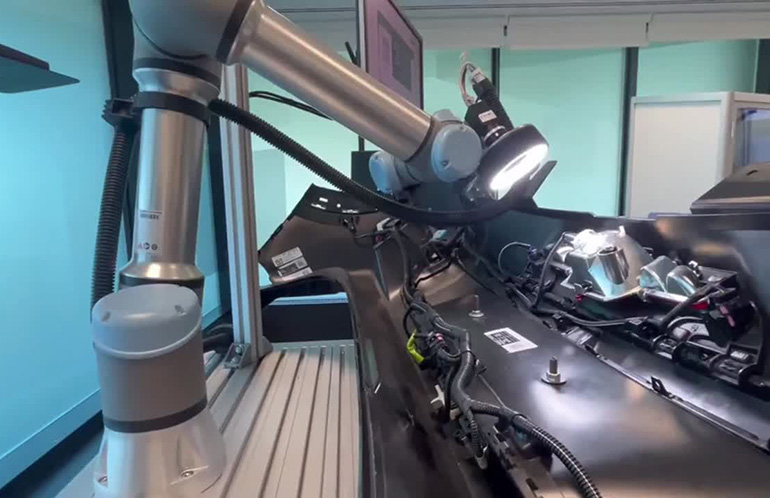
GFT combines robots, sensors, and software program to automate visible inspection. Supply: GFT Applied sciences
Though many manufacturers already use synthetic intelligence for visible inspection, most techniques solely establish defect alerts. Which means human staff should step in, which creates delays and introduces threat. GFT Applied sciences SE has now launched AI-powered robotic arms that may establish and bodily take away faulty elements from the manufacturing line.
“Auto producers have been asking the identical query for years: ‘How can we carry AI off the display screen and onto the manufacturing facility ground?’ With this launch, that query has a solution,” mentioned Brandon Speweik, head of manufacturing at GFT. “Making use of AI to real-world duties for automobile producers requires a associate who understands each the know-how and the manufacturing facility ground. That’s been GFT’s power for 35 years, and this can be a pure subsequent step.”
GFT Applied sciences gives digital transformation options, modernizes expertise architectures, and builds next-generation core techniques for trade leaders in banking, insurance coverage, manufacturing, and robotics. The Stuttgart, Germany-based mostly firm employs greater than 12,000 specialists and works intently with shoppers, bringing trade experience, software program, and a robust accomplice community in over 20 nations.
GFT defines the boundary between notion and motion
“A single recalled automobile can value producers as a lot as $500 to repair, which may find yourself costing them tens of millions,” stated GFT Applied sciences. “The power to shut the hole between perception and motion at the pace of a contemporary meeting line has turn into a crucial problem.”
The corporate has labored with automotive producers like Ford Motor Co. to modernize techniques and unlock the worth of their operational knowledge. GFT has used its in depth data of producing workflows and techniques integration to increase AI past the digital world.
Constructing on its collaboration with Google on AI-driven visible inspection, GFT stated it may assist producers enhance high quality and maintain manufacturing strains working at full velocity. It really works with a number of {hardware} suppliers, together with NEURA Robotics.
“We did this as a part of a strategic partnership with Google Cloud, specializing in what we name Business 4.0 or manufacturing modernization and transformation,” Speweik informed The Robotic Report. “With AI, our first precedence is to interrupt down knowledge silos, making a clearer image for machines to know the work setting and the way they’re performing actions.”
“It may possibly pull inputs from many alternative sources, comparable to unstructured knowledge from an inspection digicam, the conveyor belt on the meeting line, or RFID tags on merchandise as they move checkpoints,” he added. “[The system is] analyzing all of this knowledge without delay to precisely perceive what’s taking place on the road.”
The objective is to have a single platform throughout your complete store ground to gather insights, mentioned Speweik. On the identical time, fashions should be designed to keep away from false positives and to satisfy the particular wants of every producer.
“AI fashions are reaching an the place customization is changing into much less and fewer needed, and the coaching datasets are shrinking,” he defined. “They be taught context sooner, and we might have only a few hundred pictures as an alternative of 1000’s.”
A 3-robot system strikes from detection to correction
GFT Applied sciences has positioned three robots alongside meeting traces to make sure that parts like bumpers, doorways, pipes, and different elements are made precisely.
The primary robotic makes use of a digicam to examine each bit, checking for alignment, detecting defects in actual time, and guaranteeing labels and serial numbers are current and readable. The digicam is connected on to the robotic’s gripper, so it may be moved round to seize a number of angles and examine each a part of the piece.
After inspection, the second robotic arm alongside the road marks any items recognized as faulty by the primary robotic.
Ultimately, the third robotic arm designed by GFT interacts bodily with the assembly line and defective elements, lowering human involvement. Its duties embody:
- Adjusting elements: If the robotic detects a element is misaligned, it may well right its place earlier than the half strikes to the subsequent stage, stopping defects earlier than they occur moderately than simply figuring out them.
- Pulling defective elements from the road: When a defect is flagged, the robotic arm can take away the half and flag it for human overview. GFT stated this removes the opportunity of human error in defect detection and lowers the prospect that broken merchandise go away the manufacturing facility.
Each picture captured by the despatched mechanically to the cloud for storage. The manufacturing facility can evaluate them later, preserve a whole report of all inspections, and use them to reinforce the system over time.
GFT has included an AI agent into the root-cause evaluation course of. It makes use of these pictures and different datasets to establish a defect and observe it again in order that preventive measures will be carried out.
“We’re working to make AI accessible, which is why we’re so aligned with Google,” Speweik stated. “We’re working with fashions and individuals who have deep subject-matter experience in order that individuals who aren’t knowledge scientists or software program engineers can work together with the system in pure language.”
The robotic arms, agentic AI, and cloud know-how work collectively to maintain manufacturing working easily with out compromising high quality or ongoing enchancment, mentioned the corporate. A main U.S. automaker has already began implementing this technique throughout its operations.
“Pc imaginative and prescient, robotics, and automation have as many functions as your creativeness permits, on condition that they offer machines a strategy to understand and interpret unstructured visible knowledge,” Speweik stated. “This functionality can be helpful outdoors of manufacturing, because it’s being utilized in Tesla’s humanoid robots. It may be utilized to drones for search and rescue missions, and the probabilities for real-world use are countless.”
>
