



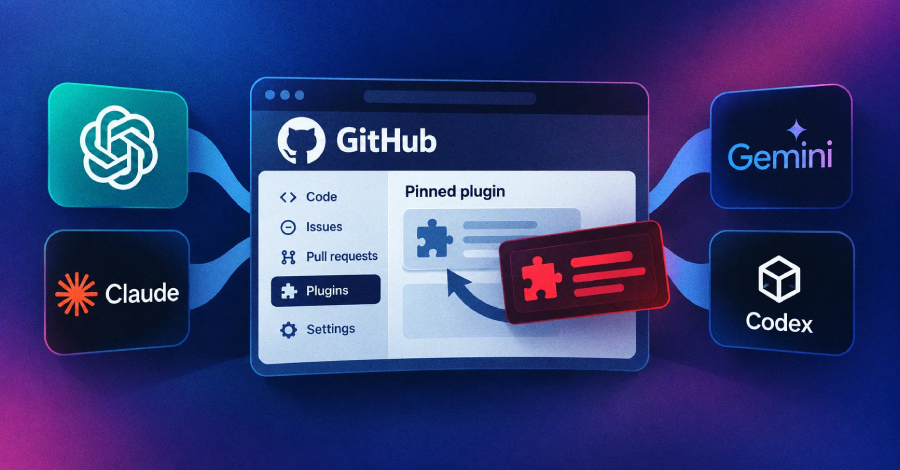
# How AI Coding Agents Can Be Tricked Into Installing Malicious Plugins
A recent discovery by cybersecurity researchers has exposed a significant vulnerability affecting four of the most popular AI-powered coding agents currently in use. The flaw centers on how these agents install third-party plugins, and it could allow attackers to silently replace trusted, reviewed plugins with malicious versions without the user’s knowledge or consent.
## Understanding the Vulnerability
AI coding agents rely on plugins — small add-ons that extend their capabilities — which are typically distributed through online marketplaces. To keep users safe, these marketplaces are designed to lock each plugin to a single reviewed version using something called a commit hash. A commit hash is a unique, lengthy string of characters that identifies an exact snapshot of a piece of code at a specific point in time. The idea is that once a plugin is reviewed and approved, it remains frozen at that exact version.
Researchers discovered that while the coding agents do fetch the correct snapshot identified by the hash, they never actually verify that the code installed on the user’s machine matches that hash. This gap in the verification process opens the door to a clever exploitation technique.
## How the Attack Works
Here is where things get tricky. In version control systems like Git, a repository allows users to create branches — named lines of code that can diverge from the main project. Researchers found that if someone creates a branch whose name closely resembles a valid commit hash, the system can become confused. The owner of a plugin’s repository could point that branch name at entirely different code than what was originally reviewed.
When the AI agent goes to install the locked plugin, it unknowingly pulls and installs the different code sitting behind thisMisnamed reference, while still reporting that the correct, reviewed version has been deployed. Because these plugins operate with the same permissions as the user running the AI agent, the malicious code gains full access to the user’s files, saved credentials, and any systems they can reach.
## Which Platforms Are Affected
The vulnerability does not affect every code hosting service equally. For example, some major platforms enforce strict rules that prevent branch or tag names from looking like commit hashes. This means that plugins sourced from those platforms are naturally protected against this particular scheme.
However, the attack remains viable on platforms and internal servers that do allow such naming conventions, which several of the affected AI agents also support.
## Patch Status Across Vendors
The researchers disclosed their findings to the relevant vendors, and the responses have varied:
– **One major AI company** has already rolled out a fix in its latest update, addressing the verification gap.
– **Another industry leader** also issued a patch, with detailed public documentation explaining the Git behavior that enabled the flaw.
– **A third vendor, backed by a major tech company,** has not yet released a fix.
– **A fourth, linked to another large tech firm,** has announced it will not be patching a related product, instead directing users toward its newer replacement tool.
It is worth noting that none of the vendors have assigned a formal CVE identifier to this vulnerability, and no public security advisory has been issued yet as of the latest reporting.
## Auto-Update Features Add Extra Risk
One especially concerning aspect is the role of automatic background updates. Some AI agents refresh their plugins without prompting the user, meaning a trusted plugin could be silently replaced with a tampered version at any time. This feature is enabled by default in certain agents, though typically only for their own built-in marketplaces hosted on more secure platforms.
Users who restrict their plugin installations to agents that pull exclusively from the secure platform are at lower risk for this specific variant of the attack. However, anyone using third-party marketplaces or alternative hosting services remains exposed.
## Frequently Asked Questions
**Q: What exactly is a commit hash?**
A: A commit hash is a unique identifier — usually a long string of letters and numbers — that pins to a specific version of code in a version control system. It ensures that the exact code snapshot remains unchanged.
**Q: Could this attack have been used in the wild?**
A: There is currently no evidence that this vulnerability has been exploited in real-world attacks. The researchers demonstrated a working proof of concept in a controlled setting.
**Q: Does updating the AI agent remove previously installed malicious plugins?**
A: It is unclear whether a patch removes a plugin that was already swapped or only prevents future swaps from occurring. Users should verify their installed plugins after updating.
**Q: Are plugins from GitHub safe from this attack?**
A: GitHub enforces naming restrictions that prevent branch names from mimicking commit hashes, which largely protects against this specific variant. However, users should stay informed about other potential exploitation paths.
**Q: What can users do right now to protect themselves?**
A: The most important step is to update your AI coding agent to the latest version available from its developer. Additionally, avoid installing plugins from untrusted or unsupported code hosting platforms, and monitor plugin permissions carefully.
## Conclusion
The discovery of this vulnerability highlights a broader truth about modern software development tools: the systems designed to automate and streamline our work must be just as rigorously secured as the code they help produce. While patches have begun rolling out for some affected tools, users of others remain exposed, relying on vendor action or migration to newer products for their protection. Staying informed, keeping software updated, and carefully vetting plugin sources are the most practical defenses available today.
Thank you for reading.
