



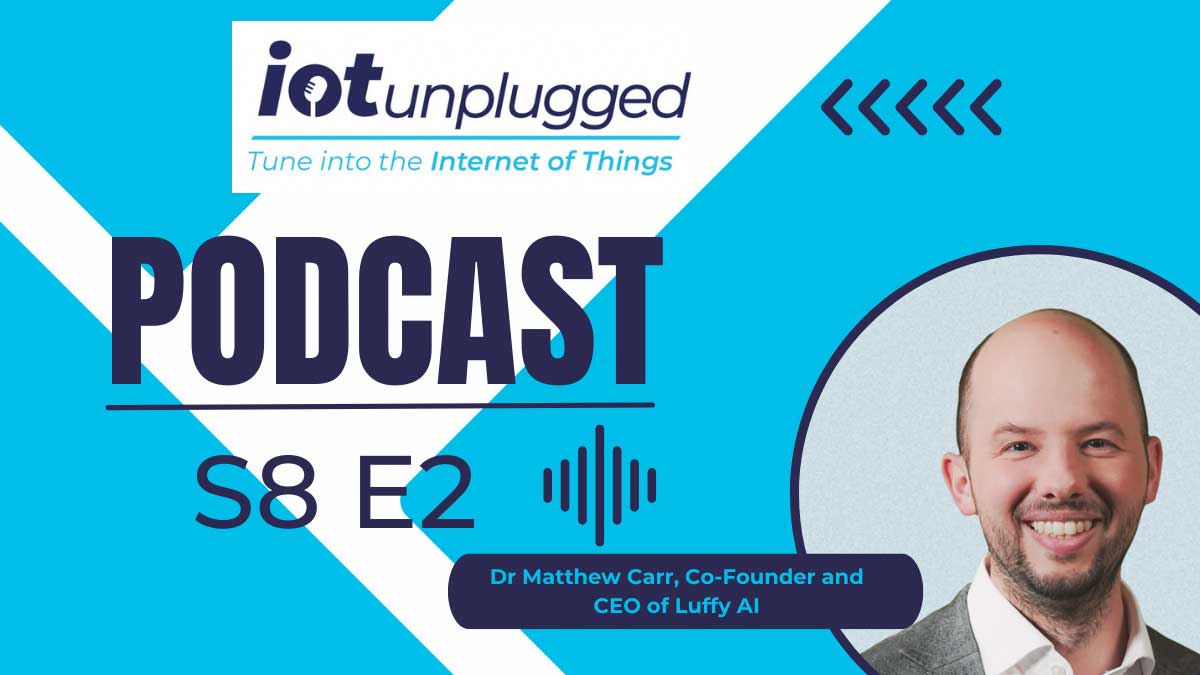
This episode of IoT Unplugged features Dr Matthew Carr, Co-founder of Luffy, discussing neuroplastic AI, a next-gen type of artificial intelligence created to learn from very little data and operate on small devices.
Carr points out that neuroplastic AI is gradually transitioning from academic research facilities to factories, warehouses, and industrial setups where it could transform the economics of industrial automation by integrating adaptive intelligence straight into machinery.
Carr’s journey into AI is unique. Having originally studied engineering and physics, his career included work on renewable energy systems before transitioning to nuclear fusion research at the Joint European Torus (JET), one of the planet’s most complex experimental reactors.
There, working among tens of thousands of sensors and extreme operating environments, he started examining the intersection of control systems and advanced data science.
This background shaped Luffy’s core idea: that most of today’s AI systems are poorly matched to the limitations of industrial settings.
“Mainstream deep learning depends on large datasets and considerable computing power,” Carr said. “But when you step into IoT and Edge devices, you typically have neither.”
In contrast, Luffy’s method draws inspiration from biology. Neuroplastic AI systems are built to adjust on the fly, tuning their internal parameters as conditions shift, instead of depending on massive pre-trained datasets.
Carr compares the concept to how animals learn: a deer can walk within an hour of being born not because it has studied data, but because its brain is wired to quickly adapt to its body.
When applied to industrial equipment, this means a motor, pump, or ventilation system could “discover” its own operating patterns after installation, automatically calibrating for efficiency and performance.
The potential impact is considerable. Projections from McKinsey & Co indicate that integrating AI into industrial Edge devices could create approximately $100bn in value, while the International Energy Agency (IEA) has noted that such systems could produce energy savings of 2% to 6% across areas like heating, ventilation, and pumping.
While these figures might seem small, they add up across enormous numbers of installed equipment. Industrial motors by themselves consume close to half of the world’s electricity.
Luffy’s technology aims to deliver these improvements without requiring new hardware. Its AI models are developed in simulation—frequently leveraging existing “digital twin” programs already used in engineering design—and then placed as lightweight software, sometimes needing only 10 kilobytes of memory.
After being installed into a device’s microcontroller, the system continues to adapt. Unlike standard AI, which usually needs regular retraining in cloud environments, neuroplastic models constantly fine-tune at the edge, cutting down on both data transmission and energy consumption.
In initial trials, the company has tested applications covering drone flight control and industrial manufacturing. In one instance involving injection moulding, Carr reported that the system boosted energy efficiency by almost 10% while decreasing the need for manual adjustments.
In another test, a drone using the technology managed to keep flying despite suffering damage, compensating for shifts in weight and balance in real time. Importantly, these capabilities require significantly lower computational resources.
Carr claims efficiency improvements of 100 to 400 times relative to conventional deep learning models, enabling systems to function on hardware as limited as a fraction of a Raspberry Pi processor core. This shift could challenge existing assumptions about AI deployment.
Instead of depending on cloud infrastructure or dedicated chips, manufacturers might be able to enhance current equipment simply through software updates.
“There’s a notion that adding AI means adding more powerful compute,” Carr said. “We’re demonstrating that it can fit into what’s already in place.”
The organization is currently collaborating with major industrial partners on uses including logistics systems, wastewater pumping, and heating and cooling networks.
Its long-term vision is to develop a collection of adaptable AI controllers that can be applied to various types of equipment.
Adoption is still in its early phases, and integration hurdles remain, especially concerning compatibility and cybersecurity.
However, Carr makes the case that the benefits go beyond energy savings. Self-optimizing systems could lower maintenance demands, reduce downtime, and streamline commissioning processes—particularly in industries where thousands of distributed assets need to be overseen.
Going forward, he envisions wider consequences for robotics and the next wave of industrial design. More efficient AI could enable entirely new categories of machines that were previously unfeasible due to processing limitations.
For the time being, though, the emphasis stays on incremental improvements to existing infrastructure. “If we can make the hardware we already operate even slightly more efficient,” Carr said, “the cumulative impact is immense.”
To hear their full discussion, listen on Spotify, Apple Podcasts, and via the link below.
There’s also plenty of other content on our sister website, Electronic Specifier! Or feel free to join the conversation by commenting below or visiting our LinkedIn page.
