



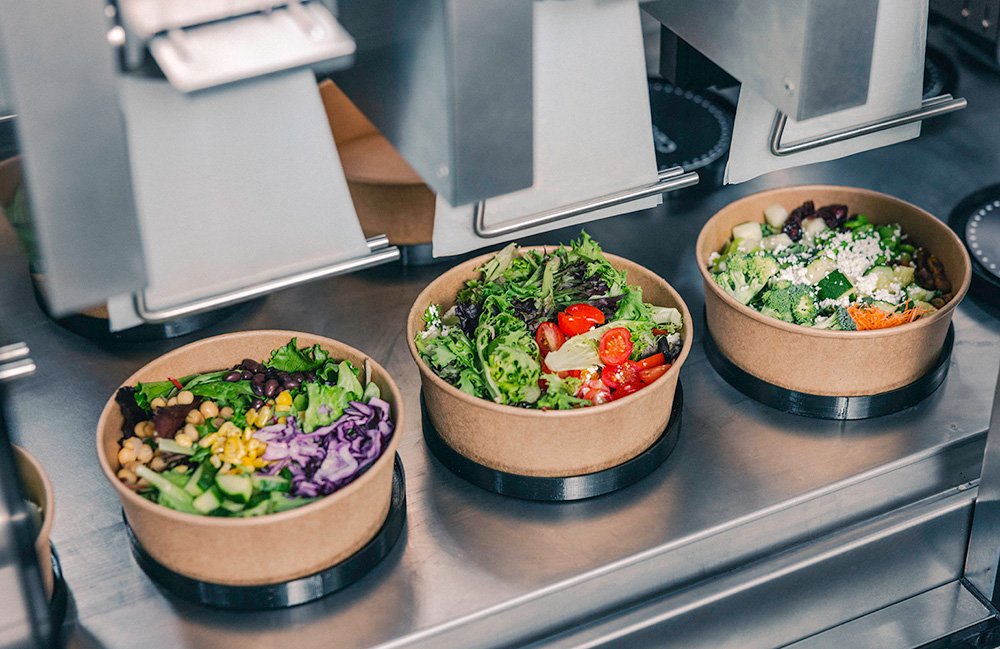
Now under the Appetronix umbrella, Cibotica showcases Remy—an automated salad and bowl assembly line compatible with a variety of ingredients. | Image: Appetronix
Appetronix has officially announced its acquisition of Cibotica, a company specializing in ingredient dispensing and portioning technology. This strategic move opens exciting new possibilities for Appetronix, which has primarily focused on building fully autonomous, standalone restaurant concepts.
The deal brings Cibotica’s flagship product—an automated bowl and salad assembly system—into Appetronix’s restaurant operations. Financial terms of the acquisition remain undisclosed.
“What Cibotica has accomplished is remarkable—they’ve built incredibly modular equipment,” said Nipun Sharma, CEO of Appetronix, in an interview with The Robot Report. “It integrates seamlessly into existing restaurant setups and automates a large portion of the tasks currently performed by staff. They’ve already done the heavy lifting, and our infrastructure is perfectly positioned to leverage their technology. Now, we can extend these solutions to everyone.”
Currently, Appetronix operates robotic pizza kitchens through its collaboration with Donatos, including a fully autonomous location at John Glenn Columbus International Airport in Columbus, Ohio, with another site set to open this spring. By incorporating Cibotica’s dispensing technology, the company says it’s now better equipped to launch robotic food concepts across multiple cuisines and formats that demand precise ingredient portioning.
Robotics could ease pressure on the restaurant industry
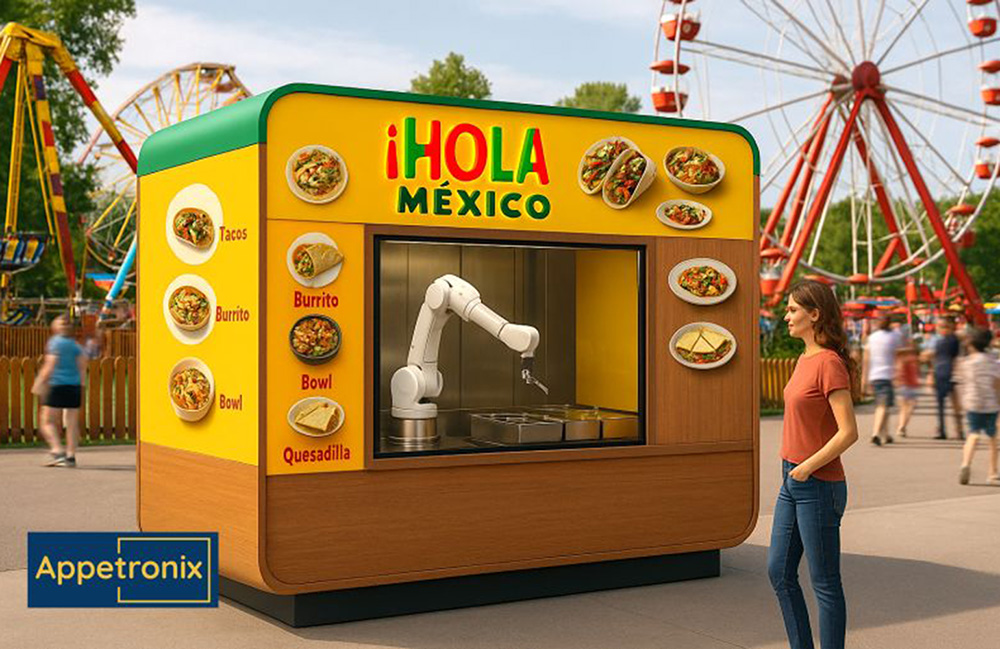
Appetronix plans to roll out compact, standalone micro-restaurants offering various cuisines in high-traffic venues like theme parks. | Image: Appetronix
“Over the past decade, anyone involved in the restaurant industry will tell you that labor has been the biggest challenge,” Sharma explained. “There’s only so much you can do with a single oven if there’s no one around to operate it.”
Rising labor costs, combined with increasing ingredient prices driven by tariffs and inflation, have further strained restaurants in recent years.
“The restaurant sector is incredibly vulnerable, and we’re confident that robotics and automation will play a transformative role,” Sharma stated. “Ultimately, people want their food prepared safely, delivered quickly, and—most importantly—tasting amazing.”
To address these challenges, Toronto-based Appetronix has focused on developing compact, standalone, fully autonomous kitchens. According to Sharma, this approach is far more effective than retrofitting automation into traditional kitchens.
“Many companies are trying to automate existing kitchen setups, which is commendable. But they haven’t significantly improved speed, reduced costs, or eliminated labor dependency,” Sharma noted. “They’ve made things slightly more convenient, but that doesn’t move the needle economically.”
Powered by AI and robotics, Appetronix’s kitchens forecast demand based on historical traffic patterns, estimate ingredient shelf life, and determine when restocking is needed. “We project that once we deploy this system to our operators, they’ll only need one employee for about three to four hours per day to manage the machine,” said Sharma.

Cibotica designs modular automation for traditional kitchens
Appetronix and Cibotica are both Canadian robotics companies serving the food service industry, so they’ve naturally crossed paths over the years. “I’ve always been impressed by what they’ve achieved with limited resources—just like us,” said Sharma. “They’ve built an exceptionally powerful product.”
Although Appetronix initially avoided automating existing kitchens, its perspective shifted as it engaged more closely with customers.
“We deliberately chose not to automate legacy kitchens because the market seemed smaller, and integrating new equipment into existing setups is notoriously difficult,” Sharma explained. “Yet our current and prospective customers kept asking, ‘Can you automate our current kitchen?’ And we’d always reply, ‘No—we’ll just build you a new one.’ That was an opportunity we kept turning down.”
Sharma described Cibotica’s smart, modular technology as the ideal solution for retrofitting automation into existing kitchens.
“With the expertise, products, and patents Cibotica has developed—and what they’ve accomplished in just the past few years is truly impressive—we can now integrate their platform and approach existing customers with a new offer: ‘While we’re building your new restaurant, we can also automate your current operation,'” Sharma said.
What’s on the horizon for Appetronix?
Going forward, Sharma said Appetronix will pursue a dual strategy: automating existing kitchens while continuing to develop fully autonomous new ones. “This keeps customers happy in the short term while ensuring long-term sustainability,” he noted.
The company is also open to future acquisitions. Sharma revealed that Appetronix is actively working on improving portion control and temperature management, and is even exploring laser-based food cutting—a technique impractical in human-staffed restaurants but perfectly suited to 100% autonomous kitchens.
“I strongly believe in not reinventing the wheel,” Sharma said. “We’re in discussions not only with hardware firms but also with software companies whose maintenance and data infrastructure capabilities align with our AI development goals. Whenever an opportunity arises to accelerate our progress, we’ll pursue an acquisition.”
“Our core philosophy is simple: we don’t sell robots—we sell food. And we aim to deliver the best-tasting food available,” Sharma added. Appetronix plans to expand into new food categories and establish restaurants in diverse locations, including theme parks, airports, gas stations, supermarkets, and office buildings.
