



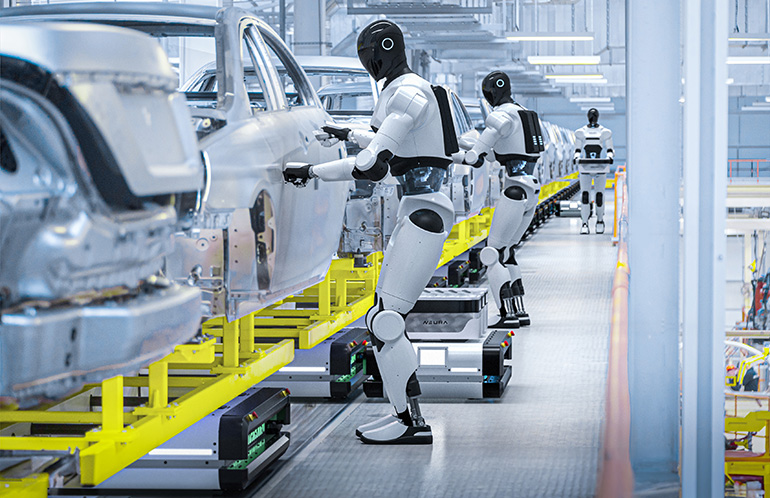
4NE1 humanoid robots and MAV mobile robots in a concept automotive assembly line. Source: NEURA Robotics
Physical AI continues to attract strong investor interest. NEURA Robotics GmbH announced today that its Series C funding round could total as much as $1.4 billion. The company noted that backing from prominent global technology leaders will fuel its push to develop “cognitive robots” at a faster pace.
NEURA’s stated mission is to create systems that “continuously learn, collaborate, and operate across real-world environments through a shared intelligence ecosystem called the Neuraverse.” The company says it brings together robotics, artificial intelligence, sensors, edge computing, and large-scale infrastructure into a single cohesive architecture.
“The future of AI won’t be confined to screens,” said David Reger, founder and CEO of NEURA Robotics. “It will move, interact, learn, and work alongside us in the physical world. We’re convinced that physical AI and cognitive robotics will rank among the most significant technology shifts of the coming decades, reshaping industries from manufacturing and logistics to healthcare, services, and home robotics.”
 Submit your session idea for the 2026 RoboBusiness
Neuraverse and NEURA Gyms set to grow
Established in 2019, NEURA Robotics said it is developing the software, AI, and data infrastructure required to deploy intelligent machines at scale. The company provides lightweight robotic arms, mobile robots, and humanoid robots, along with sensor kits, tailored for manufacturing and supply chain use cases.
“Going forward, people won’t just ask what AI can say,” Reger remarked. “They’ll ask what AI can physically accomplish.”
To support this shift, NEURA is building the Neuraverse, which it describes as an open physical AI ecosystem enabling robots to learn across different deployments. The company is also growing its worldwide network of NEURA Gyms — purpose-built, large-scale training environments that blend real-world sensor interaction, simulation, and multimodal learning pipelines.
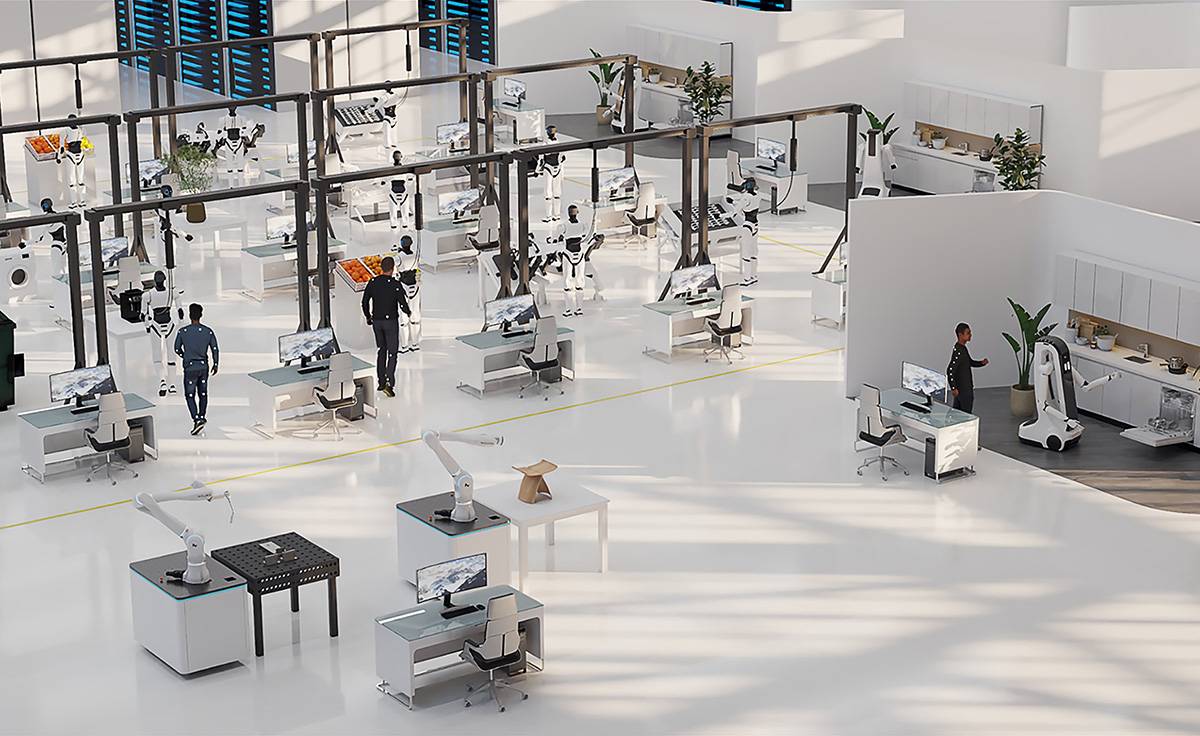
NEURA Gym provides a training environment for multiple robots. Source: NEURA Robotics
NEURA Robotics cultivates a global partner network
As part of its long-term vision, NEURA — headquartered in Metzingen, Germany — is expanding its decentralized robotics and AI ecosystem alongside international partners.
“Many assumed that globally significant AI infrastructure companies could only come from Silicon Valley,” Reger added. “We believe the next wave of AI leaders can emerge anywhere in the world, provided there is sufficient vision, engineering expertise, and speed of execution. With this funding round, NEURA stands firmly among the global frontrunners in the robotics race, alongside the top players in the U.S. and China. Ultimately, this isn’t just about robotics — it’s about building technologies the world will rely on.”
In January 2026, the company revealed a collaboration with Robert Bosch GmbH to develop software for humanoid robots. In April, it teamed up with Dassault Systèmes to bridge the “sim-to-real” gap in robotics. Additional strategic partners include Schaeffler, Kawasaki, Delta Electronics, Qualcomm Technologies, Amazon, and NVIDIA.
“Physical AI marks the next major leap in computing, extending intelligence into real-world settings,” said Nakul Duggal, executive vice president and general manager of the Automotive, Industrial and Embedded IoT, and Robotics Group at Qualcomm. “Robotics is one of the most demanding edge AI applications, where systems must perceive, reason, and act instantly, reliably, and on-device — especially in safety-critical scenarios.”
“By pairing our leading-edge AI capabilities, high-performance computing, and connectivity with NEURA’s Neuraverse platform, we’re helping speed up the rollout of intelligent machines that can operate safely and efficiently alongside people across a range of industries,” he added.
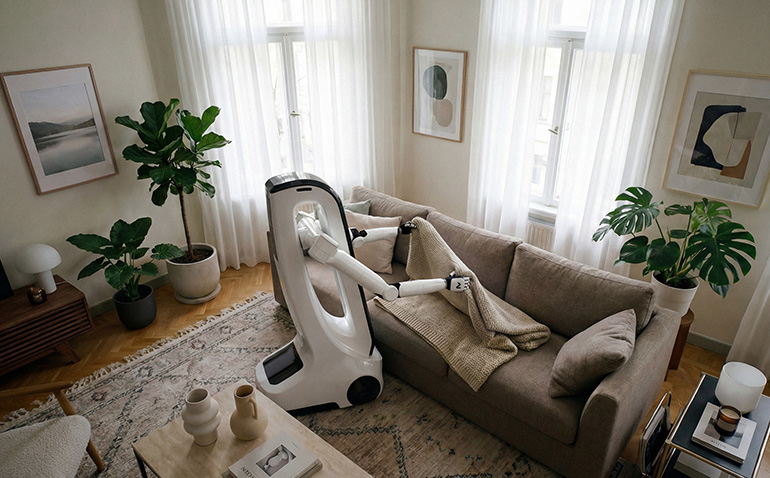
The MiPA mobile manipulator could find household use. Source: NEURA Robotics
Investors bet on a future shaped by AI and humanoids
Participants in NEURA Robotics’ Series C round include Tether, Qualcomm, Amazon, NVIDIA, imec.xpand, Bosch, Schaeffler, the European Investment Bank, Lingotto Horizon, InterAlpen Partners, and others.
“As robotics moves past scripted automation and into genuine autonomy, the underlying infrastructure must evolve too,” said Paolo Ardoino, CEO of blockchain firm Tether. “Autonomous machines need the ability to process data locally, make decisions, and carry out transactions without depending on centralized intermediaries.”
“QVAC delivers that edge-first intelligence to the platform, while WDK manages the secure financial layer — together enabling machines to perform tasks, track outcomes, and function independently,” Ardoino explained. “NEURA Robotics shares that same vision.”
NEURA stated that its current order book and strategic deployment pipeline together surpass $1 billion. The company added that the fresh funding will accelerate:
- Worldwide rollout of cognitive robots and humanoids, spanning Europe, the U.S., China, and Japan
- Growth of the Neuraverse platform
- Expansion of NEURA Gyms — large-scale, real-world training facilities for cognitive robots
- Scaling of manufacturing and deployment infrastructure across Germany and India, targeting millions of robots by 2030
- Development of next-generation physical AI systems
“Beyond our traditional core business, Schaeffler is strategically pursuing new growth areas, including humanoid robotics. Our eight product families and decades of manufacturing expertise give us a strong position in this field,” said Klaus Rosenfeld, CEO of Schaeffler. “We’re proud to support NEURA as both a technology partner and an investor on their path to success. Together with a robust ecosystem of partners, we will fundamentally transform how humanoid robots are developed and deployed in the industries of tomorrow.”
