



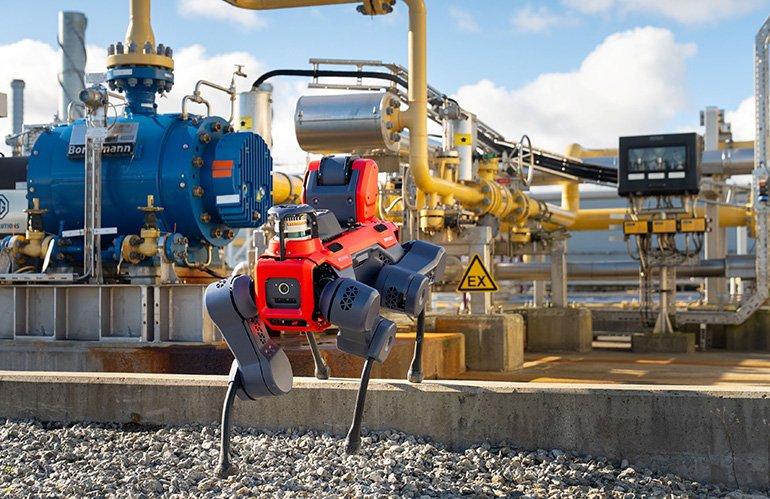
# The FIRST-EVER Walking Robot Certified to Operate in Explosive Atmospheres
### A New Era of Autonomous Inspection in Dangerous Industrial Sites
The oil and gas, petrochemical, and energy industries have long faced a difficult challenge: how to inspect critical equipment in environments where a single spark could be catastrophic. Human workers still need special protective gear, gas detectors, and permits just to walk through many of these areas. Fixed cameras and rolling robots can’t handle the terrain — stairs, narrow walkways, and uneven surfaces are everywhere.
A Swiss robotics company has developed a solution that was once considered nearly impossible. The new four-legged robot, engineered over a four-year period with more than a dozen patents, is designed to navigate hazardous industrial zones autonomously without putting people at risk.
## Why Legged Robots in Explosive Zones?
Most robots used in factories roll on wheels or tracks. But hazardous industrial sites aren’t flat, clean environments. They have staircases, curved piping, catwalks, and tight corridors that are difficult for wheeled machines to traverse. A four-legged design offers the agility and adaptability needed to move through these complex spaces.
The real breakthrough, however, isn’t just the movement — it’s the safety engineering. Getting any electronic device certified for use in explosive atmospheres is extremely difficult. Every component, from motors to batteries to sensors, has to be proven incapable of igniting flammable gases or dust — even if it malfunctions.
## How Engineers Solved the Ignition Problem
The biggest question the engineering team had to answer was: what could realistically go wrong on a walking machine that might produce a spark or heat source? They systematically studied every component and every potential failure scenario.
Key safety features include:
– **Sealed, nitrogen-filled chambers** that protect the AI computer and inspection instruments.
– **Flameproof enclosures** around all 12 leg motors and the battery pack.
– **Non-metallic outer shells** that prevent accidental electrical conduction.
– **Conductive feet** that safely ground any static electricity.
– **Automatic thermal cutoffs** that shut systems down if temperatures rise unexpectedly.
– **Energy barriers** for charging and data transfer, so no live connections are exposed to hazardous areas.
The robot’s software continuously monitors its own health before, during, and after each mission, and the hardware has been tested against shock, vibration, corrosion, and extreme weather conditions.
## What the Robot Actually Does on Site
Once deployed, the robot navigates industrial facilities entirely on its own. It uses a combination of thermal cameras, visual sensors, microphones, and gas detectors to scan equipment for signs of trouble — overheating components, gas leaks, unusual sounds, and visible wear.
Every reading is automatically logged and linked to the specific piece of equipment it corresponds to. This creates a structured, repeatable record that maintenance teams can use to track equipment health over time. Rather than relying on a human’s memory or handwritten notes, companies get consistent, data-rich inspection reports.
The inspections feed directly into existing maintenance systems like SAP and Yokogawa, automatically generating work orders so that issues are addressed quickly. The entire platform is built and operated under strict international information security standards.
## Real-World Testing by Major Companies
Before being offered to customers, the robot was tested in real plant environments by global leaders in energy and chemicals, including major firms in the oil, gas, and petrochemical sectors. Tests covered both onshore and offshore operations, spanning hundreds of missions.
The robot does not require any modifications to existing facilities. It handles steep stairs, tight spaces, and challenging terrain without any special setup.
## The Economic Case for Autonomous Inspection
Equipment failures in large-scale industrial operations are enormously expensive. Unplanned downtime across the world’s biggest companies costs over a trillion dollars annually. In the oil and gas sector alone, a single hour of unexpected shutdown can run into hundreds of thousands of dollars. At the same time, workers in extraction roles face significant safety risks.
By taking over routine inspections in the most dangerous areas, a robot like this keeps humans out of harm’s way while providing more consistent and thorough data than manual rounds can offer.
—
## Frequently Asked Questions (FAQ)
**Q: What makes this robot different from other inspection robots?**
A: Most inspection robots are wheeled or stationary, which limits where they can go. This robot walks on four legs, allowing it to climb stairs, navigate narrow walkways, and move through rough terrain that wheeled machines can’t handle. Additionally, it is the first legged robot to receive full certification for use in explosive atmospheres.
**Q: What does “explosive atmosphere” certification mean?**
A: It means the robot has been independently tested and certified to operate safely in environments where flammable gases, vapors, or dust are present. The certification guarantees that the robot cannot produce an ignition source under any foreseeable operating condition, including component failures.
**Q: Which industries can benefit from this robot?**
A: The primary target industries are oil and gas, petrochemicals, and energy production. However, any facility with hazardous zones — including certain manufacturing plants, refineries, and offshore platforms — could potentially benefit.
**Q: Does the robot require facility modifications?**
A: No. The robot is designed to work in existing plant layouts without any structural changes. It navigates using its own sensors and can handle stairs, ramps, and uneven surfaces independently.
**Q: How is the inspection data used?**
A: Inspection findings are automatically organized by asset and linked to the plant’s existing maintenance software. This allows teams to prioritize repairs, track equipment degradation over time, and prevent minor issues from turning into costly shutdowns.
**Q: Is the system secure?**
A: Yes. The entire platform — from the robot to the cloud-based operations software — is developed and maintained under ISO 27001, which is the international standard for information security management.
—
## Conclusion
The introduction of a walking robot certified for explosive atmospheres represents a significant leap forward in industrial automation. By combining legged mobility, rigorous explosion-proof engineering, and industrial AI, this technology opens up inspection capabilities in areas that were previously accessible only to human workers — areas that are both dangerous and essential to monitor.
As major energy and chemical companies continue to deploy these systems at scale, the benefits extend beyond cost savings. Worker safety improves, maintenance becomes more predictable, and facilities gain a richer, more reliable stream of operational data. What was once thought to be an insurmountable engineering challenge has become a field-ready product, and it points toward a future where robots routinely operate in the most demanding environments on Earth.
Thank you for reading
