



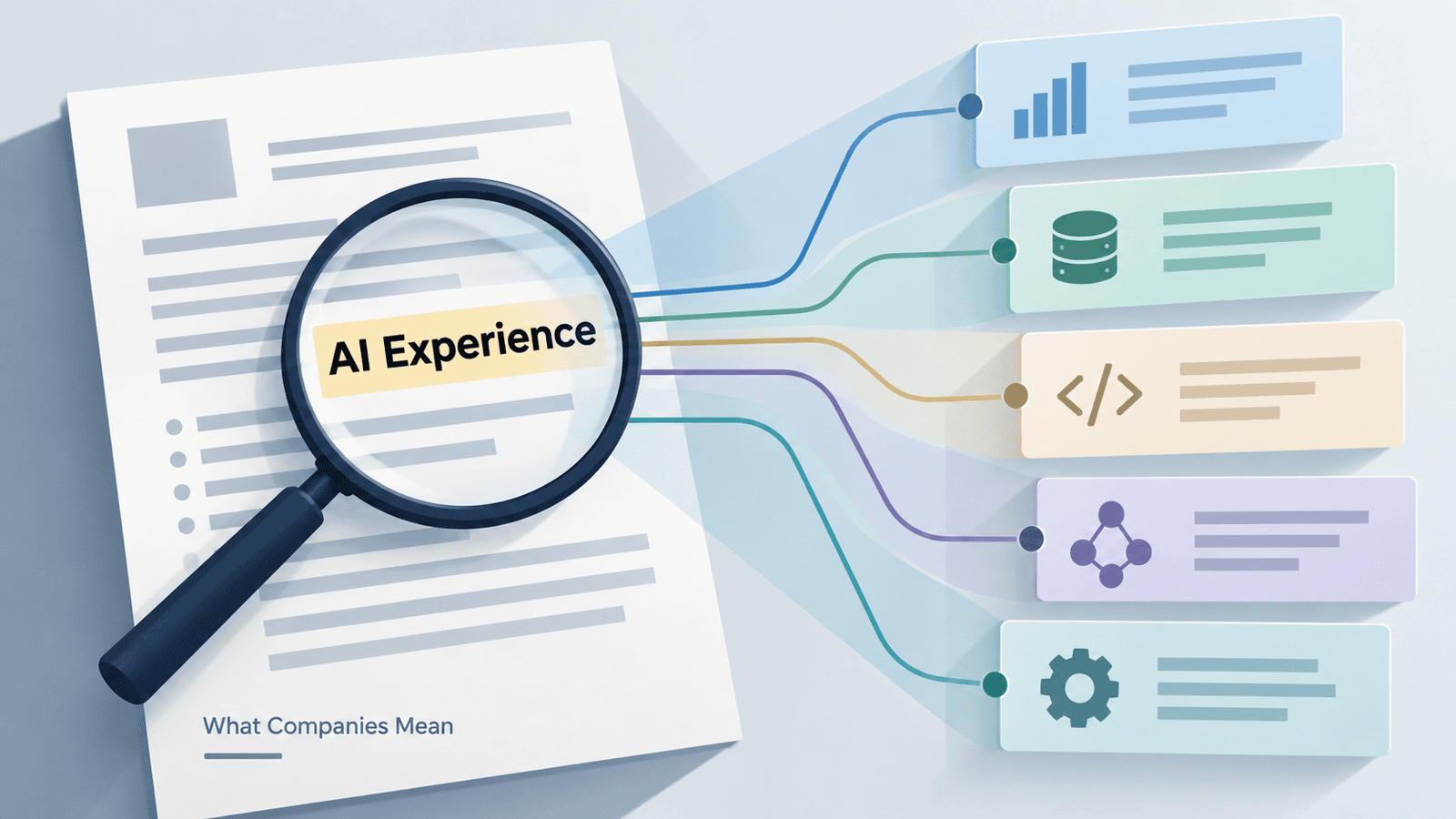
# Decoding the Job Market: What Employers Really Mean by AI Skills
If you have been searching for data-related roles recently, you have likely noticed “AI experience” popping up in job requirements. But this phrase is surprisingly slippery. A biotech firm and a retail chain might both list it, yet they could be looking for completely different skill sets. In many cases, it is less about a strict technical checklist and more about signaling an ability to work with modern technologies.
This guide helps you translate vague job descriptions, understand how your current background fits, and figure out exactly what employers are looking for.
## The Four Ways Companies Use the Term
When a company asks for AI experience, they generally fall into one of four distinct categories. Identifying which one applies to a role changes how you should present yourself.
**1. Familiarity with AI Tools**
This is the most common meaning at the entry and mid-level. It usually means the employer wants someone comfortable using AI-powered platforms, such as automated forecasting dashboards or large language model interfaces for drafting reports. They are not expecting you to build the tools. Instead, they want someone who can use them effectively and apply statistical judgment to evaluate the outputs before incorporating them into daily workflows.
**2. Conceptual Machine Learning Awareness**
You will often see this in tech-adjacent analyst roles. The company needs someone who understands the vocabulary and logic of machine learning. This means knowing the difference between a classification problem and a regression problem, understanding concepts like overfitting and feature importance, and being able to speak intelligently with the data science team building the models. You do not need to write the code yourself.
**3. Applied Model Building**
This is what most candidates assume the term means, but it is actually much rarer. Roles that genuinely require this are usually titled Data Scientist or Machine Learning Engineer. They will spell out their expectations in the job description, using phrases like “experience building predictive models” or “deploying models to production.” If the listing simply says “AI experience” in a bullet point with no further detail, it almost certainly belongs to category 1 or 2.
**4. Domain-Specific AI Knowledge**
In specialized industries, AI refers to niche applications. Healthcare organizations might mean clinical natural language processing or medical imaging analysis. Legal firms might mean contract review automation. Financial services might mean fraud detection frameworks. If the job description makes the industry explicit, your domain expertise might be more valuable than broad AI credentials.
## The Statistician’s Hidden Advantage
Your statistical training is the foundation of nearly everything called “AI” in a business context. The gap between a traditional statistician and an AI practitioner is mostly vocabulary and tooling, not underlying reasoning.
You do not need to overhaul your resume. Instead, translate your existing skills. Variance, bias, and model fit directly explain why machine learning models fail. Regression analysis is the conceptual bedrock of most supervised learning algorithms. Hypothesis testing and experimental design are precisely the skills companies need to verify whether an AI system is performing reliably. When your resume mentions “building predictive regression models to forecast demand,” a hiring manager looking for AI experience will recognize that you understand supervised learning and model evaluation.
## Reading Between the Lines of the Posting
Treat a job description like a dataset: look at what the evidence actually supports rather than the headline.
Headline requirements are often aspirational. A long list of twelve desired skills means no single candidate will match perfectly, and “AI experience” buried at the bottom carries far less weight than you might assume. Instead, focus on the daily responsibilities. If the day-to-day work involves analyzing business performance and presenting findings to stakeholders, it is an analytics role requiring tool familiarity. If the duties involve designing, training, and deploying models, it is a true machine learning role.
Pay close attention to modifiers as well. “AI experience preferred” is a nice-to-have. “AI experience required” with no elaboration usually means basic tool usage. “Hands-on machine learning experience required” with specific tools listed means you will need to build and deploy models.
## How Seniority Changes the Meaning
The level of the position significantly changes what “AI experience” means in practice.
* **Junior Roles:** The employer wants adaptability. They are looking for candidates who are comfortable exploring new tools, willing to learn internal systems, and not intimidated by AI outputs.
* **Mid-Level Roles:** They want informed collaboration. You should be able to work alongside engineering teams, contribute to conversations about model evaluation, and bridge the gap between technical data science work and business stakeholders.
* **Senior Roles:** They seek strategic judgment. At this level, they need someone who knows when AI is and isn’t the right solution, can communicate the limitations of these systems to leadership, and helps the organization avoid the real costs of deploying technology carelessly.
## Three Myths Worth Ignoring
**Myth: You must list every AI tool you have ever touched.**
Listing tools without context often backfires. Hiring managers remember candidates who demonstrated good judgment, not candidates who simply had access to software. Focus on the problems you solved and the reasoning behind your process, then mention tools as supporting context.
**Myth: You are disqualified if you haven’t built a machine learning model from scratch.**
For the majority of roles using this vague phrase, you are not disqualified. What actually gets candidates rejected more often is an inability to think critically about data quality, model assumptions, and interpreting results. Those are statistical skills—and they are exactly what companies need but often fail to name correctly in their postings.
**Myth: You need a certification before applying.**
Credentials can help in specific contexts, but most hiring managers at the analyst level are evaluating your reasoning during the interview. Being able to explain when an AI system might be wrong—and why—is far more convincing than any completed online course.
## Frequently Asked Questions
**Q: Does “AI experience” always mean I need to write code?**
No. In many business-focused roles, it simply means you are comfortable using AI-assisted platforms and can apply critical thinking to evaluate their outputs.
**Q: My background is in traditional statistics. Am I too outdated for AI roles?**
Absolutely not. The foundational logic of AI is statistical reasoning. Your understanding of data integrity and model evaluation is highly relevant and often exceeds what many tech-focused candidates possess.
**Q: How can I figure out which type of AI a company wants before the interview?**
Look at the job responsibilities rather than the headline requirements. If the tasks involve business analysis and communication, they want tool familiarity. If they involve model deployment and software engineering, they want hands-on builders.
## Conclusion
The phrase “AI experience” in a job posting is a starting point for a conversation, not a rigid technical specification. By understanding the four distinct ways companies use this term—tool familiarity, conceptual awareness, applied building, and domain expertise—you can accurately position your existing skills. Whether you excel at using smart dashboards, understanding algorithmic concepts, or applying AI within a specific industry, your background is more relevant than you might think. Read the posting carefully, connect your experience to the actual problems they need solved, and the right opportunity will become clear.
Thank you for reading
