



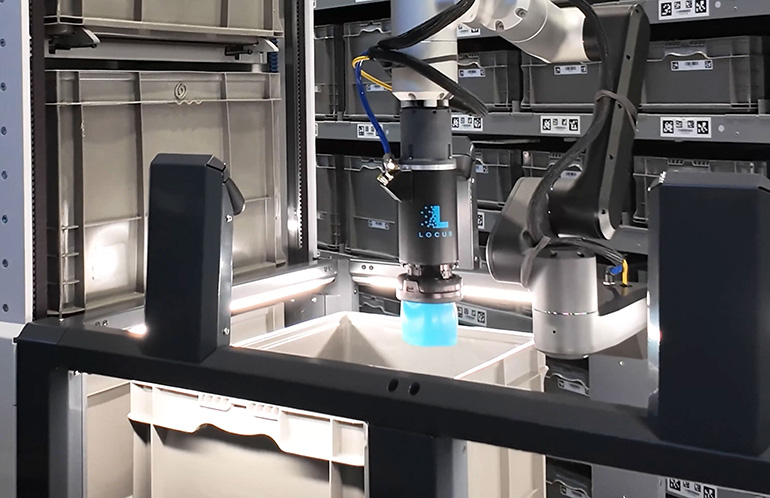
Nexera’s NeuraGrasp can handle items that were once tough to pick, like porous polybags. Source: Locus Robotics
Locus Robotics, which introduced the Locus Array mobile manipulator last month, announced today that it has acquired Nexera Robotics to expand the range of products its robot can manage. Nexera’s patented NeuraGrasp will take the place of the suction cup gripper on Array, significantly boosting its fulfillment capabilities, according to the companies.
“The cutting edge of warehouse robotics today is AI-powered mobile manipulation at enterprise scale,” said Rick Faulk, CEO of Locus Robotics. “Efficiently grasping millions of different SKUs with both speed and precision is where the next decade of value will be created. Nexera has developed something technically important in that area, and merging it with Locus Array positions us at the leading edge of advancing mobile manipulation across the industry.”
“We’ve accomplished a lot with Array, especially in perception and grasping intelligence, but we recognized that we needed to advance the gripper technology because suction has its limitations,” said Gina Chung, chief strategy officer at Locus, in an interview with The Robot Report. “Since last year, the team identified Nexera Robotics as a promising technology that we could integrate onto Array to unlock a wide range of benefits around manipulation capabilities.”
Locus Robotics earned a 2026 RBR50 Robotics Innovation Award for Array. Check out this year’s honorees, who will be recognized at the ticketed RBR50 gala dinner at the Robotics Summit & Expo in Boston next week.
Hamid Montazeri, senior vice president for software and AI at Locus, will take part in the opening keynote panel on “Building the Next Era of Robot Autonomy” at the Robotics Summit. Registration is now open.

NeuraGrasp is built for adaptability
Instead of attempting to tackle robotic grasping of diverse products using only a suction cup or a claw gripper with manual programming, Nexera Robotics said it created NeuraGrasp to deliver flexibility and dependability in robotic pick-and-place tasks. NeuraGrasp pairs a soft, flexible membrane with built-in sensing, computer vision, and artificial intelligence.
The Vancouver, Canada-based company said it has demonstrated that NeuraGrasp can dynamically handle a broad variety of items, from small containers to porous polybags and fabric goods.
“We developed NeuraGrasp to address the manipulation challenges that have limited robotic picking for years,” said Roy Belak, CEO of Nexera Robotics. “Joining Locus Robotics gives us the platform, scale, and customer base to bring this breakthrough technology into the high-speed fulfillment environments it was designed for, where speed, reliability, and real-world adaptability are most critical.”
“We wanted a single gripper to handle everything. Other approaches are constrained by suction or the need for tool switching, which most customers don’t want,” Chung said. “Nexera has already completed millions of picks, so the integration process should be straightforward. Locus will support Nexera’s existing customers on a case-by-case basis.”p>
With NeuraGrasp, Locus Array will be able to autonomously pick items such as loosely bagged clothing, irregularly shaped pharmaceutical packages, contoured products, small electronics and industrial parts, and consumer goods weighing up to 5 lb. (2.2 kg), like a bottle of detergent. Locus said this covers the majority of e-commerce SKUs.
“While robotic picking arms have existed for some time, Locus Robotics is among a small group of vendors to natively embed robotic picking at the core of the automation, signaling a move toward fully automated picking,” said Rueben Scriven, a research manager specializing in logistics automation at market intelligence firm Interact Analysis.
“Item manipulation has been one of the biggest obstacles to successful robotic picking,” he explained. “Over the years, we’ve seen major progress in machine vision and path planning. But the actual manipulation and gripping of items — and therefore the SKU coverage — has remained a significant challenge. Having robust end-effectors is becoming a key competitive advantage.”
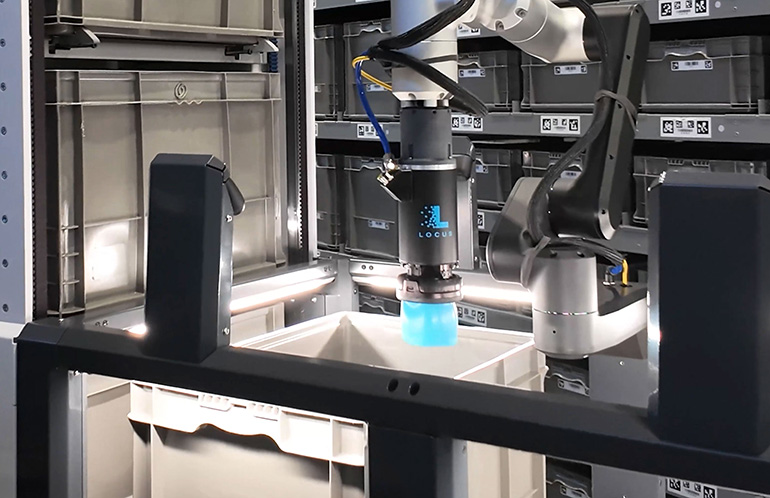
Nexera Robotics is integrating NeuraGrasp into the Locus Array mobile manipulator. Source: Locus Robotics
Locus Array gains the ability to handle more items
Locus Array was officially launched at MODEX 2026, where it was a top-three MHI finalist for Best New Innovation out of more than 200 submissions. The mobile manipulator is currently operating in customer deployments, with additional sites underway.
Teams from both Locus and Nexera are working to integrate the NeuraGrasp end effector into the Locus Array platform. They said they expect the combined technology to become available in the coming months.
“While Array can’t pick surfboards, shoeboxes with flip lids, or books that can open, it will handle 90% to 100% of most customers’ SKUs,” Chung stated. “We already have AI-driven picking intelligence that doesn’t rely on preprogrammed SKU libraries, and some of NeuraGrasp’s perception capabilities need to be incorporated into our manipulation stack.”
As with its Locus Origin and Vector autonomous mobile robots (AMRs), Locus Array with NeuraGrasp will use the LocusONE software platform to coordinate fulfillment workflows across picking, replenishment, sorting, and packout.
“LocusONE provides a unified tech stack for all our AMRs,” said Chung.
Furthermore, Origin and Vector robots can help human workers manage oversized or heavy products that Array robots are unable to handle. Two deployments are currently in progress, and a round-the-clock rollout plan for Array is already in place.
Locus Robotics also noted that its purchase of Nexera Robotics will greatly expand its potential market reach.
“This is completely new for our customers,” Chung explained. “They were aware that we had a new solution on the horizon and are thrilled about achieving significantly broader inventory coverage right from the start.”
“Over the next few months, we’ll showcase to customers at Locus Park how NeuraGrasp can handle nearly any SKU, limited only by the robot arm’s weight capacity. It doesn’t require a large contact surface and can grip perforated polybags, beanies, or mesh bags—items that were once considered impossible to pick,” she continued. “We’re even inviting customers to send us sample SKUs to our Locus headquarters so we can test them firsthand.”
Nexera extends Locus’ presence nationwide
Established in 2021, Nexera Robotics will become a fully integrated subsidiary of Locus Robotics. All of Nexera’s staff and leadership will transition into roles at Locus.
“Nexera provides us with a West Coast base of operations,” Chung stated. “This acquisition gives Locus access to cutting-edge R&D capabilities, seamless integration of AI and hardware, and comprehensive SKU handling.”
Through its robots-as-a-service (RaaS) model, Locus Robotics currently operates over 17,000 robotic systems across more than 360 sites globally and has completed more than 7 billion picks to date. Headquartered in Wilmington, Massachusetts, the company serves more than 150 clients spanning retail, healthcare, third-party logistics (3PL), and industrial sectors.
“Locus Robotics ranks as the world’s fourth-largest mobile robot vendor by revenue and holds the second position specifically in the order fulfillment segment,” Scriven shared with The Robot Report.
“With 190 million autonomous miles logged inside warehouses, we possess the most advanced indoor autonomy platform in the industry,” Chung asserted. “By incorporating Nexera’s expertise, we’ll now explore additional robotic manipulation applications.”
Editor’s note: Chung will take part in a live webinar discussing breakthroughs in robotic case and individual item picking at noon EDT on Wednesday, June 3. Register now to join the session and submit your questions during the broadcast, or watch the recording later.

