



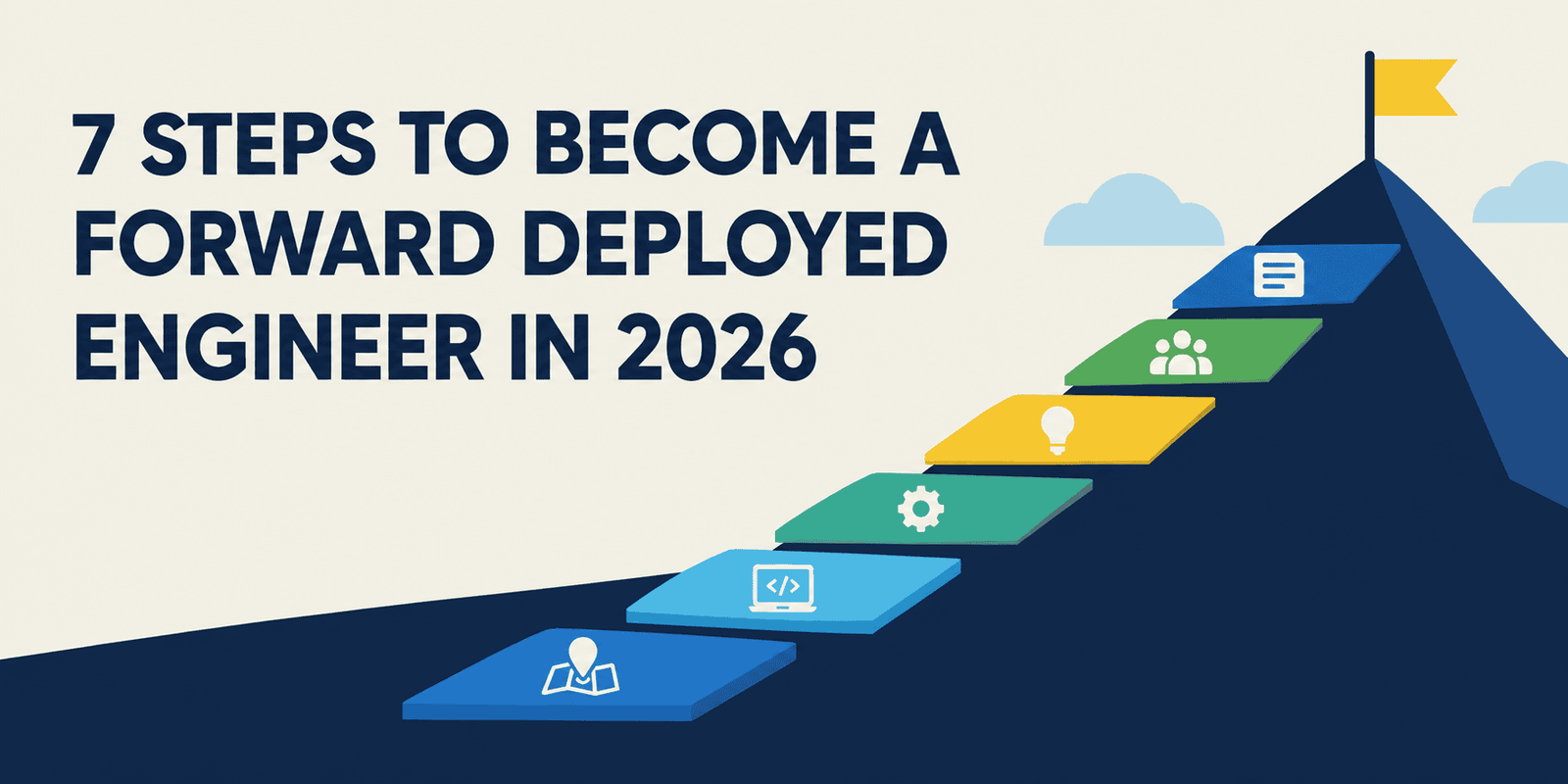
# The Complete Guide to Becoming a Forward Deployed Engineer in 2026
## The Role That’s Redefining AI Engineering
The AI industry is producing a new breed of engineering role that blends multiple disciplines into one ambitious job description. The Forward Deployed Engineer has emerged as a pivotal figure in bridging the gap between raw artificial intelligence capabilities and real-world business applications. Unlike traditional roles that focus on narrow technical domains, this position demands versatility, product awareness, and the ability to translate messy business problems into functioning software systems.
With enterprise adoption of AI accelerating rapidly, organizations need engineers who can walk into a client’s environment, assess their infrastructure and data landscape, and deliver solutions that are both technically sound and commercially viable. This guide outlines the core competencies and a structured learning path that aspiring professionals can follow to break into this exciting field.
—
## Understanding What Makes This Role Unique
A conventional software engineering role typically begins with a clearly defined technical specification. A Forward Deployed Engineer, however, often starts with an open-ended business challenge — one filled with ambiguity, incomplete data, competing stakeholders, and production constraints.
Consider this scenario: An organization has years of operational data scattered across multiple legacy platforms. Their team spends a significant portion of each day manually reviewing records, and leadership wants to know whether AI can dramatically reduce that effort without compromising data privacy or decision quality.
Answering this question requires far more than coding ability. It demands a combination of technical depth and soft skills:
– Understanding the customer’s actual needs rather than their stated requests
– Designing architectures that work within existing infrastructure
– Building systems that are secure, reliable, and maintainable
– Evaluating outcomes rigorously using real-world data
– Communicating trade-offs to both technical and non-technical audiences
This role is best described as a fusion of **software engineering, applied AI, systems architecture, and strategic consulting** — all wrapped into one position that lives at the intersection of code and business.
—
## A Practical Roadmap to Building the Required Skill Set
### Master the Foundations of Software Engineering
Every Forward Deployed Engineer starts with a rock-solid grasp of core programming principles. **Python** remains the dominant language in this space, appearing across the vast majority of relevant job postings in 2026 due to its versatility across backend development, data manipulation, automation, and AI integration.
Core competencies to develop include:
– Writing clean, modular Python code using classes, type hints, and exception handling
– Leveraging asynchronous programming and built-in debugging tools
– Understanding data structures, algorithms, and object-oriented design
– Navigating Git workflows including branching strategies, pull requests, and conflict resolution
– Working comfortably in terminal environments with shell scripts and debugging utilities
Even though the day-to-day work of an FDE may not require competitive programming, many hiring processes still include traditional coding assessments, making these fundamentals essential.
—
### Get Comfortable with APIs, Databases, and Data Integration
Enterprise environments are notoriously complex. Rather than receiving pristine datasets, Forward Deployed Engineers regularly encounter fragmented data spread across multiple platforms — relational databases, cloud storage, third-party SaaS tools, message queues, and legacy file formats.
Key areas of focus include:
– **SQL and relational databases**: Master joins, aggregations, window functions, indexing strategies, transactions, and schema design
– **API integration**: Understand REST conventions, authentication flows (OAuth2, JWT), pagination patterns, rate limiting, idempotency, and webhook handling
– **Data pipeline concepts**: Learn the basics of ETL and ELT workflows to move and transform data between systems
– **Documentation literacy**: Develop the ability to read unfamiliar API documentation quickly and devise integration strategies on the fly
The ability to connect disparate systems is what separates a prototype from a production-ready solution.
—
### Develop Deployment and Operations Competence
Writing code that works locally is only the beginning. A Forward Deployed Engineer must be prepared to shepherd applications through the entire lifecycle — from initial development through testing, deployment, monitoring, and iteration.
Essential operations skills include:
– **Containerization**: Build Docker images, write Dockerfiles, understand container networking, and use Compose for multi-service architectures
– **Cloud platforms**: Gain familiarity with compute services, object storage, managed databases, identity and access management, networking, secrets storage, and serverless functions
– **Kubernetes fundamentals**: Understand the core concepts of pods, deployments, services, autoscaling, health checks, and configuration management
– **Production practices**: Implement CI/CD pipelines, set up observability through metrics and tracing, manage feature flags, design rollback strategies, and debug production incidents
The mindset shift here is critical: your code will face real traffic, real failures, and real constraints. Engineering decisions must account for all of this from day one.
—
### Build Applied AI Engineering Capabilities
The AI component of this role has become increasingly central. Forward Deployed Engineers are expected to construct practical applications around large language models and other AI technologies — not to design new model architectures, but to integrate existing capabilities into production systems that solve real problems.
Focus your learning on these areas:
– **Understanding model behavior**: Tokens, context windows, structured output formats, function calling, embeddings, streaming responses, batching strategies, and cost management
– **Retrieval-Augmented Generation**: Building systems that combine vector databases, embeddings, and intelligent retrieval to ground AI responses in factual data
– **Agentic architectures**: Designing systems with tool use, state management, retry logic, planning layers, human-in-the-loop approvals, and guardrails
– **Rigorous evaluation**: This is arguably the most critical skill. An FDE must be able to assess system performance across hundreds or thousands of real-world cases, not just rely on impressive demo outputs
– **Safety and monitoring**: Implement guardrails against prompt injection, track model confidence, and maintain observability across the entire AI pipeline
The goal is pragmatic: use AI models as tools to deliver business value, not as academic exercises.
—
### Prioritize Security and Reliability
Enterprise clients will not deploy systems that lack proper security controls or fault tolerance. Many job postings explicitly list tenant isolation, least-privilege access, and secure data handling as requirements — signaling that these concerns extend beyond dedicated security teams.
Critical knowledge areas include:
– Authentication vs. authorization, role-based access control, and secret management
– Encryption standards, PII handling, audit logging, and data retention policies
– Prompt injection defense, tool permission scoping, and secure API design
– **Failure mode planning**: Know how your system behaves when APIs timeout, databases go offline, models return unexpected outputs, duplicate tool calls occur, or users submit extremely large inputs
Reliability engineering is not optional for an FDE — it is a core competency that distinguishes production-grade work from experimental projects.
—
### Cultivate Customer Discovery and Problem-Solving Skills
Perhaps the most distinctive aspect of the Forward Deployed Engineer role is the emphasis on human interaction. You will regularly engage with end users, engineers, managers, security teams, and executive stakeholders — often in the same week.
Developing strong discovery skills means learning to ask the right questions before writing a single line of code:
– Who is the end user, and what does success look like for them?
– What is their current workflow, and where does it break down?
– What data do they have access to, and what are its limitations?
– What technical and regulatory constraints apply?
– What does the customer *think* they need, and what do they actually *need*?
Sometimes the answer to a customer’s request for an AI chatbot is a completely different type of solution. The ability to look past surface-level requests and identify the root problem is one of the most valuable — and hardest to develop — skills in this role.
—
### Construct a Portfolio That Speaks to Enterprises
When building projects to showcase your abilities, quality and depth matter far more than quantity. Instead of creating a dozen tutorial-style applications, focus on building a small number of **complete, end-to-end systems** that demonstrate three things: integration ability, deployment proficiency, and decision-making under real constraints.
Strong portfolio project ideas include:
– An **enterprise support agent** that combines RAG with ticketing systems, database lookups, and tool execution — complete with authentication, source citations, an evaluation dataset, human approval gates for sensitive actions, failure logging, and cost tracking
– A **document processing pipeline** that ingests unstructured files, extracts structured data, validates it, stores results in a database, routes ambiguous cases to human reviewers, and exposes functionality through a well-documented API deployed in containers
– A **domain-specific solution** in an industry such as healthcare operations, financial services, logistics, or legal workflows — one that demonstrates your ability to learn a specialized field and apply technical skills to model realistic business processes
Each repository should tell a clear story: the problem it solves, the architectural decisions made, the assumptions underlying the design, security considerations, evaluation methodology, measurable performance data, known limitations, and a candid assessment of what would need to change before enterprise deployment.
—
## Frequently Asked Questions
**Do I need a formal degree in computer science to become a Forward Deployed Engineer?**
No. While a computer science background can be helpful, the role values demonstrated skills and practical experience over credentials. A strong portfolio, relevant project work, and the ability to solve ambiguous problems can open doors regardless of your educational path.
**Is certification necessary for this role?**
There is no single “FDE certification” that will qualify you for the role. Instead, focus on building a diverse skill set across software engineering, AI, infrastructure, and customer communication. Certifications in cloud platforms or specific tools can supplement your knowledge but should not be your primary strategy.
**What salary can I expect as a Forward Deployed Engineer?**
Compensation varies significantly by location, company, and experience level. Industry data suggests that average salaries in the United States fall in the six-figure range, with senior roles at AI-focused companies commanding higher packages. As demand continues to grow, compensation is expected to remain competitive.
**How much math do I need to know for the AI component?**
You do not need deep mathematical knowledge of transformer architectures or neural network theory for most FDE roles. The emphasis is on practical application — understanding how to call models, structure prompts, manage context, evaluate outputs, and integrate AI into production systems.
**Can I transition into this role from a traditional software engineering position?**
Yes, many FDEs come from software engineering backgrounds. The transition typically involves adding applied AI skills, production deployment experience, and comfort with customer-facing work. Existing engineering fundamentals provide a strong foundation to build upon.
**What is the difference between an FDE and a solutions architect?**
While there is overlap, a Forward Deployed Engineer is typically more hands-on with code, data pipelines, and system implementation. A solutions architect focuses more on high-level design and stakeholder alignment. In practice, FDEs often operate across both boundaries depending on the organization.
—
## Conclusion
The path to becoming a Forward Deployed Engineer is not about finding a shortcut or a single certification. It is about cultivating a rare combination of technical breadth, practical judgment, and communication skills that few traditional engineering programs emphasize.
The journey begins with strong software engineering fundamentals, expands through mastery of data integration and cloud infrastructure, deepens with applied AI capabilities, and culminates in the ability to walk into an unfamiliar business environment, understand a messy problem, and deliver a working solution that creates real value.
The most successful professionals in this space share a common trait: they are comfortable being generalists who can also go deep when needed. They do not shy away from ambiguity, and they view each new challenge as an opportunity to learn something unfamiliar quickly.
If this role resonates with you, start building. Choose a problem that interests you, design a system that could realistically serve a business need, deploy it properly, evaluate it honestly, and document what you learned. Repeat that process a few times, and you will have something far more valuable than any certificate — you will have proof that you can do the work.
Thank you for reading
