



`
Stay updated with ZDNET: Mark us as a preferred source on Google.
ZDNET’s main points
- ChatGPT now builds a detailed profile based on previous conversations.
- Outdated or unrelated details can skew future AI responses.
- Disabling memory might not fully delete what ChatGPT retains.
Based on a blog post published last week, OpenAI appears enthusiastic about the “upgrades” it has rolled out for how user memories are managed within the chatbot. Personally, I’m not a fan—in fact, I strongly dislike them. The only question remains: will disabling these new features actually help, or could it potentially cause more issues?
Also: ChatGPT versus Gemini for AI image creation: One small prompt change creates a major impact
For this conversation, “memories” refers to any personal information you provide to ChatGPT. When memory was first launched in 2024, it functioned as a straightforward collection of facts the AI could reference. Over time, this has grown significantly—now covering your full chat history, specific instructions, personal boundaries, and even subtle preferences inferred by the AI through past interactions and remarks.
(Disclosure: Ziff Davis, parent company of ZDNET, filed a lawsuit against OpenAI in April 2025, claiming copyright infringement related to the training and use of its AI systems.)
This article is organized into three parts. First, I will walk through the technical insights from OpenAI’s latest blog post regarding ChatGPT’s enhanced memory system. Next, I will show how you can adjust and manage ChatGPT’s memory settings. Finally, I’ll explain why this feature unsettles me—and why it should concern you as well.
Let’s get started.
A brief journey through dream logic
Before 2024, ChatGPT had zero memory across sessions. Each conversation was isolated, and information shared in one session did not carry over to others.
Also: Track emerging AI tools with our AI Model Release Tracker
With the 2024 update, OpenAI introduced memory as a core feature—but initially, it only functioned as a set of factual statements. While this still exists today, much of it seems outdated or irrelevant. For instance, these three items remain in my ChatGPT memory:
- Owns two Google Workspace accounts: one for A.com (hosting email and 57 TB of backups) and a separate one for B.com. The user wants to transfer all email accounts and routing from A.com to the B.com Workspace, while keeping A.com solely for storage under a different domain.
- Maintains a global variable called ‘veg_positions’ in their Scratch project, used primarily to avoid overlap among numerous broccoli sprites.
- Installed a Kasa smart plug at some point.
Even though these details were only mentioned once during isolated chat sessions—and many are several years old—they’re still stored in my memory.
This static list of facts lacks nuance and context. Clearly, saved memories quickly become obsolete without ongoing review. Unless manually pruned by the user, there was no built-in way to determine when information had stopped being relevant.
Also: Anthropic unveils Opus 4.8, emphasizing honesty as its standout trait
Then, in 2025, OpenAI began developing what it refers to internally as “dreaming.”
For humans, dreaming plays a role in emotional processing, memory consolidation, threat simulation, and strengthening emotional intelligence. A Scientific American piece describes dreaming as helping “regulate traffic on that fragile bridge linking our experiences, emotions, and memories.”
My own dreams often involve villagers armed with pitchforks chasing me, or me trapped in dark caves surrounded by burning skulls and an IBM mainframe or two.
In 2025, OpenAI’s dreaming feature enabled the model to silently scan your past conversations without being explicitly prompted. It began auto-organizing memories. At this stage, ChatGPT’s memory structure combined the original saved facts with Dreaming V0.
Also: Debunking five common myths about the rise of autonomous AI coding
Now, in 2026, ChatGPT’s dreaming technology has evolved to version 3. The original saved memories still exist—but they’re now either replaced or enriched by insights generated through dreaming.
As a test, I asked ChatGPT: “Do I have experience with Kasa?” It responded: “Yes. You’ve worked with Kasa KP125M Matter smart plugs, especially for energy monitoring.” As you can see above, that exact model number never appeared in my saved memory.
But the second part of its answer was completely off: “You later integrated that setup into Home Assistant, so your Kasa experience seems focused on power tracking rather than simple plug control.”
Nope—never happened. I’ve never even used Home Assistant. That Kasa plug is currently gathering dust in my electronics drawer alongside other unused gadgets.
When I contacted OpenAI’s PR team about these inaccuracies, a representative clarified: “What you’re seeing is a summary-level overview of your memory, not a complete record of every stored detail. The goal is to simplify review and editing, so it won’t necessarily include every technical detail—even if those details still influence relevant future conversations.”
Today’s Dreaming V3 doesn’t just passively scan past chats. Instead, it performs advanced data synthesis—effectively crafting an evolving profile about you (which isn’t always accurate). OpenAI states that V3 excels at retaining intricate context and managing complex, long-term, multi-layered projects across numerous sessions.
According to OpenAI, the success rate for factual task recall rose from 41% in 2024 to 82% in 2026. Accuracy over time improved dramatically—from just 9% to 75% over two years. Adherence to user preferences climbed from 31% to 71%.
Also: Your Claude agents now ‘dream’ too—here’s how Anthropic’s new functionality works
How does this kind of background processing scale efficiently? That’s central to what makes Dream V3 feasible. OpenAI has reduced computational costs by five times compared to earlier versions, making mass deployment realistic. This constant, behind-the-scenes analysis means the AI is always updating its understanding of you—reviewing timestamps on data points and, in principle, experiencing time alongside you.
Dream V3 is currently available to Plus and Pro subscribers, with plans to roll it out to all users—including free-tier accounts—in the coming weeks.
Exploring the new memory settings
I discovered the updated memory controls in the browser version of ChatGPT. At the time of writing, the macOS app still uses the older interface.
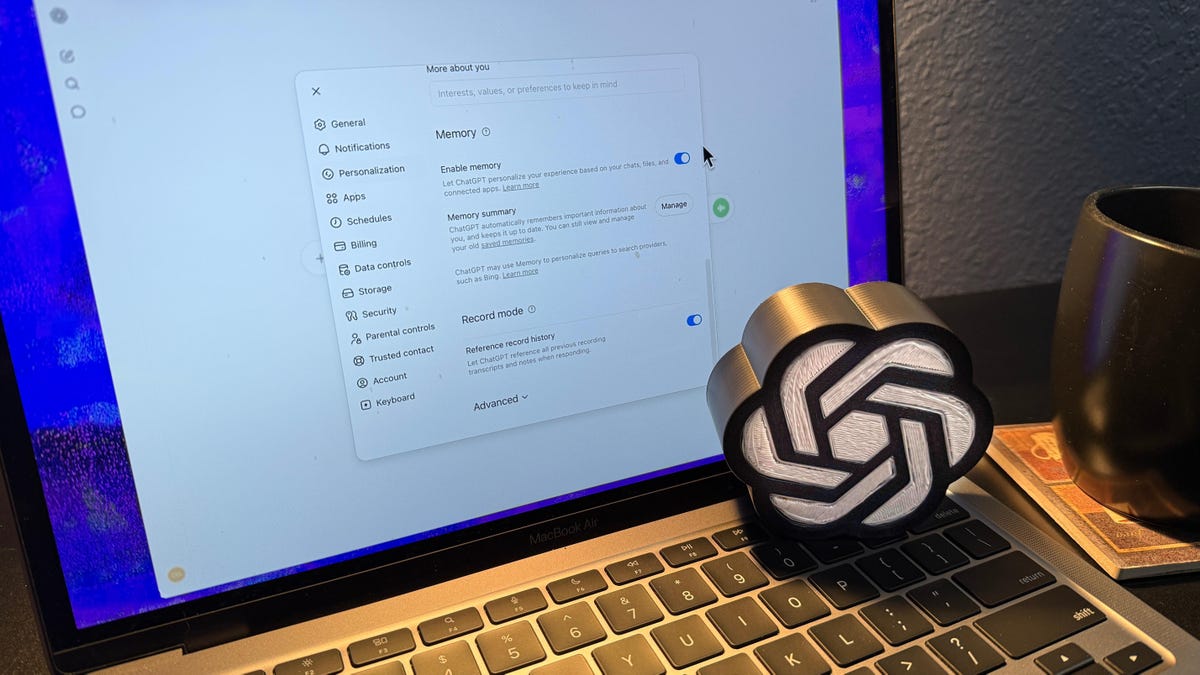
To access memory settings, navigate to Settings, then Personalization, and scroll down to the Memory section.
You can turn off the memory feature (shown at 1), but only to a certain extent. Disabling “Enable memory” won’t erase any memories already saved or clear your chat history. ChatGPT simply stops performing its nightly “dream” process for organizing memories, though all your data remains stored.
Also: Anthropic’s Mythos is advancing faster than anticipated, according to an AI safety organization
To remove your saved memories, navigate to the saved memories panel (at 2) and delete them from there. However, even that won’t fully erase everything. The only way to completely wipe that data from ChatGPT’s awareness is to delete the entire conversation containing it.
There’s another odd caveat worth noting. As stated in ChatGPT’s memory FAQ, OpenAI explains:
Disabling Memory/Personalization doesn’t turn off safety systems that may draw on limited, safety-critical context during rare, high-risk scenarios to help ChatGPT provide safer responses.
You can review OpenAI’s explanation of its safety measures. In essence, if a conversation touches on a safety concern, ChatGPT retains that information to help guide the user toward de-escalation. It doesn’t seem that the AI shares this data with others, but it’s still stored (in a somewhat vague manner).
Additionally, by selecting Manage (at 3), you can adjust the consolidated profile ChatGPT has built around you.
Also: I tested Google Drive’s new AI organization feature to sort through 14 years of digital clutter
Let’s start with the saved memories section (at 2). Here’s a sample of mine. As shown, these entries are extremely detailed (and often inaccurate or irrelevant). For instance, I’m not using Mint Linux on my Mac Studio, even though I was considering it roughly a year ago.
The new option appears under the Manage button. Since I’d rather not expose ChatGPT’s take on my personality and habits, I’m including a screenshot that OpenAI shared in its blog post.
What you see is a narrative summarizing interests and preferences. You can pick specific details and choose “Don’t mention this again” to effectively make the system forget that point. You can also include notes to fine-tune how ChatGPT understands you.
Acknowledging the memory feature
There are situations where dependable AI memory is essential. I’ve built a highly detailed set of memory guidelines that direct how Claude Code handles my Apple development projects. I maintain a separate memory framework on my OpenClaw home server that preserves context and instructions across sessions.
Also: I leveraged Claude Code to rapidly build a Mac application in just 8 hours
However, this new memory system in ChatGPT makes me uneasy. As demonstrated above, the feature clings to outdated information and then incorporates that into its replies. Even Dreaming V3, which is supposedly designed to adapt alongside you, can be mistaken. I provided the example where it asserts I use Home Assistant, even though I’ve never even installed it.
It interprets everything through a subjective filter shaped by past discussions and stated preferences. This is something I don’t just personally dislike, I find it genuinely troubling.
ChatGPT doesn’t truly know who I am, since it forms its conclusions solely based on what I present to it.
It’s like someone forming an opinion of me based exclusively from my social media activity, or my elderly Aunt Sally, who still imagines me as an eight-year-old despite the fact that I’m a accomplished professional with a graduate degree, or a childhood friend who believes I still live on junk food and can’t appreciate quality because I went through a frugal phase in the ’90s.
Also: This executive shares four strategies for thriving as an innovator in the age of agentic AI
ChatGPT now also attempts to respond based on previous chat sessions, yet not all of my conversations are personal. Much of my usage involves researching topics for articles and projects. These days, every research inquiry risks being seen as reflective of who I am and gets appended to my personal profile, even when those questions have absolutely nothing to do with my actual life, beyond a passing moment of curiosity.
And although the updated interface reveals its accumulated picture of me, I never fully know what it believes it understands about me, or what assumptions are influencing its responses. As one of my high school chemistry teachers used to say, “When you assume, you make an ass out of you and me.”
While Dreaming V3 is undeniably an impressive technical achievement in scope, efficiency, and scalability, I’d go as far as to call it an irresponsible addition. First, it operates on older conversations, many of which took place when the general understanding was that the AI only retained knowledge of the current session. Second, it’s extremely difficult to control what the AI remembers or concludes about you. And third, V3 genuinely can’t stay current with your real-life changes, despite OpenAI’s assurances that it can.
As much as AI promises to lighten the mental workload for humans, it actually adds to the burden of critical thinking when we have to filter out AI distortions and fabrications from its outputs. Now, we’re forced to cross-reference every response against our entire interaction history with the AI. But not everyone has the mental discipline to scrutinize and confirm the accuracy and thoroughness of each AI-generated answer.
Could AI deliberately omit information because its skewed perception of who we are leads it to believe we wouldn’t be interested in a particular topic or method? Could it shape its responses because it assumes we only want data presented in a specific way?
We’ve never been able to fully trust AI’s responses. That was clear from the outset, back in early 2023. But now, with this memory function—this inherently selective memory function—we should expect answers to be increasingly distorted to conform to some composite internal image of who it thinks we are, what it assumes matters to us, and how it thinks we prefer information delivered.
Also: I tasked ChatGPT with creating a free PDF editor because I was wary of letting it modify my files
Beyond all this, there are enormous privacy concerns. We tend to assume that cloud companies (and yes, Google, I’m directing this at you) catalog every detail about us for future exploitation. But this depth of profiling feels even more intrusive and alarming.
Faded and distorted memories
Consider this strange exchange. I asked, “What is the single most important thing I care about?” My answer, without question, is my wife and my small dog. Nothing else in the world comes close to how much I cherish those two.
But the AI responded with, “Preserving your ability to keep doing meaningful, independent work.” Where on earth did that come from?
Yes, I frequently discuss topics related to food health and exercise with ChatGPT because I value my well-being. I also engage in conversations around sustainability
Considering issues like how Google now uses AI-generated answers instead of showing traditional search results makes you think about these questions differently.
But here’s the most crucial point — and it’s anything but trivial. The AI stated it based that evaluation on the following factors from our discussion:
- How web publishing can withstand the impact of AI
- Building a dedicated audience and growing newsletter subscriptions
- Proficiency as a technology reporter
- Technological self-sufficiency
- Ability to work effectively in remote settings
- ZATZ Labs and WordPress-related initiatives
- YouTube content and maker projects
- Home lab setup, automation systems, backup solutions, security cameras, lighting controls, and dependable workflows
Notice that the AI never clarified that its evaluation was based solely on these discussion points. For instance, it has no awareness that I’ve been developing applications for Mac, iPhone, iPad, and Apple Watch using Claude Code. But simply the fact that the AI omitted Denise and Pixel from what it called my “most important” priorities reveals everything about how reliable ChatGPT’s conclusions really are.
They’re biased, incorrect, outdated, frequently off-topic, drawn from narrowly specific temporary situations, and could even be harmful if relied upon to narrow the scope of information provided.
And that’s precisely why this new Dreaming V3 feature unsettles me. It should send chills down your spine as well.
Would you rather use an AI assistant that retains memory of previous conversations, or one that starts fresh with every new chat? Share your thoughts in the comments below.
You can stay updated with my daily project progress through social media. Make sure to sign up for my weekly newsletter, and connect with me on Twitter/X at @DavidGewirtz, on Facebook at Facebook.com/DavidGewirtz, on Instagram at Instagram.com/DavidGewirtz, on Bluesky at @DavidGewirtz.com, and on YouTube at YouTube.com/DavidGewirtzTV.
