



Follow ZDNET: Add us as a preferred source on Google.
ZDNET’s key takeaways
- The Microsoft Surface Laptop Ultra is the top-tier RTX Spark laptop introduced at Computex.
- It comes equipped with the RTX Spark SoC: a 20-core CPU, performance on par with a GeForce RTX 5070 GPU, and as much as 128GB of unified memory.
- Even with its stunning specifications and high-end construction, several questions are still left unanswered.
During Computex 2026, Nvidia revealed its latest RTX Spark processor, an ARM-based chip boasting remarkable performance figures across a range of new devices: up to 1 petaflop of AI performance, a 20-core CPU, and up to 128GB of unified memory designed to handle creative workloads with roughly the same power as a GeForce RTX 5070.
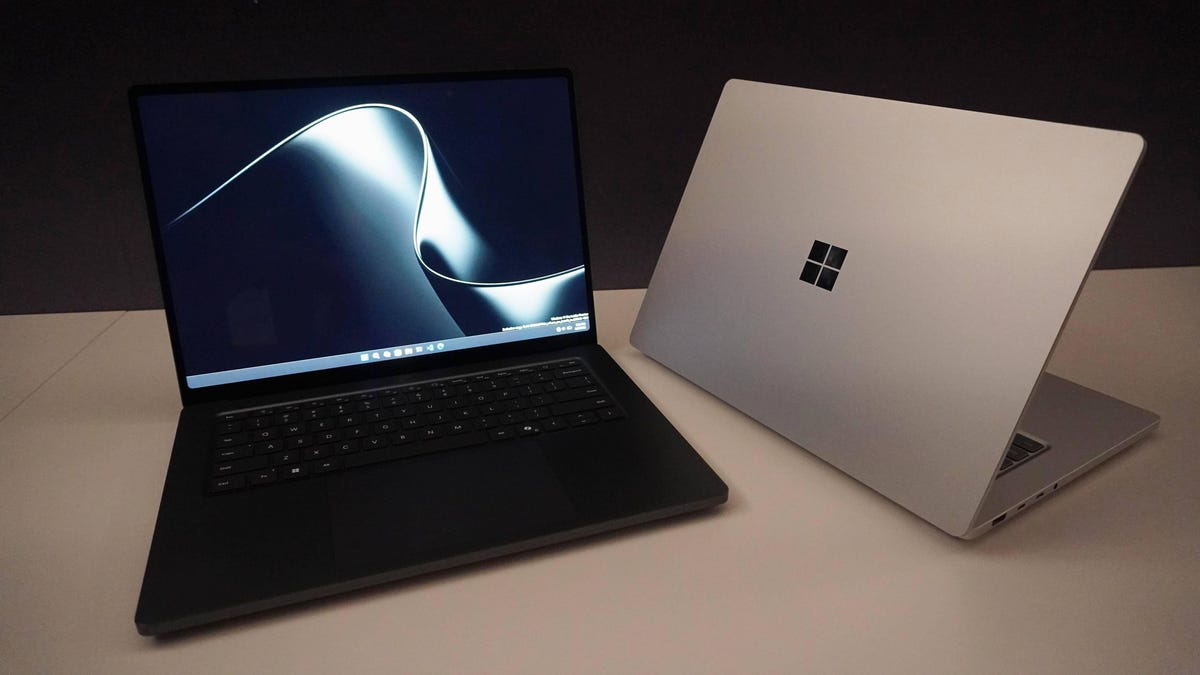
Leading the lineup is Microsoft’s Surface Laptop Ultra — the premier RTX Spark laptop and a true powerhouse that reinforces its premium identity with a bold, assertive design aimed at developers, professional creators, and AI enthusiasts.
Also: I saw the first Nvidia RTX Spark laptops – these 4 models will lead the new ultrabook boom
I got hands-on time with the new Surface Ultra in Taipei, and I have to say: it’s a monster, delivering smooth gaming and outstanding video editing performance. Of course, my testing took place in the controlled environment of a demo showfloor, and no benchmarking or real-world evaluations have been conducted yet. Here’s what caught my attention.
Flagship build
Microsoft pulled no punches with the Ultra’s specifications and premium construction. In fact, at Computex, none of the other new RTX Spark laptops were even permitted to be turned on. Only the Surface Ultra was operational, and it powered every demo across all categories.
The physical construction is rock-solid, even if it looks similar to earlier Surface laptops from the outside. The 15-inch screen is a mini-LED PixelSense Ultra touchscreen with 262ppi, a 3:2 aspect ratio, and up to 2000 nits of peak HDR brightness. It’s remarkably bright for a laptop, producing some truly stunning visuals.
In terms of design, it also draws cues from the MacBook (but what doesn’t these days?) with recessed black chiclet keys, a sturdy aluminum chassis, and an edge-to-edge glass panel. The haptic touchpad felt highly responsive and accurate during my hands-on session, and it’s well-proportioned. It also includes a full set of creator-friendly ports: two USB-C, one USB-A, HDMI, an SD card reader, and a headphone jack.
The RTX Spark is the main attraction — a “new class of GPU for AI,” according to Microsoft, featuring up to 128GB of unified memory, purpose-built to run large models and access datasets locally.
Also: The 7 coolest gadgets I saw at Computex 2026 (and when you can buy each one)
All that processing power is meant to be leveraged by creators across a variety of AI-driven tasks like video upscaling and intelligent masking, as well as running AI models with billions of parameters locally — elevating the Surface Laptop Ultra to an entirely new tier of computing capability compared to the previous generation.
Improved thermals
As anticipated, Microsoft overhauled the cooling system to manage all the heat this level of hardware will inevitably generate. To begin with, the laptop sits slightly elevated off the desk to promote airflow beneath it. Inside, there’s a dual-fan, dual heat pipe configuration that draws cool air in through the sides and expels it out the back, pushing as much air as possible through the system.
Microsoft had several Surface Ultra units running games during the demo: “Pragmata” and “Indiana Jones and the Great Circle” — both graphically intensive titles — and since they had been running for several hours, the laptops were definitely warm to the touch.
Also: Acer Swift Air 14 vs. MacBook Neo: I compared both budget laptops – this model wins
Microsoft was so assured in the effectiveness of its new thermal design that it had a smoke machine demonstration planned, but unfortunately the device malfunctioned when it was activated. A disappointment, but at least I can confirm the fans running at full speed were still surprisingly quiet.
I was also somewhat surprised to see some focus on device repairability. The back panel is detachable, providing straightforward access to both the SSD and battery, and internal components are labeled with QR codes for individual replacement.
Questions remain
Clearly, Microsoft and its partners wanted to present a unified message here. Computex was all about wowing the audience with impressive hardware and promising next-level performance, but there are still plenty of unknowns.
The biggest question on my mind concerns configuration and pricing. Sure, the RTX Spark can support up to 128GB of unified memory, but what minimum RAM configurations will be offered? I doubt we’ll see a Surface Ultra with just 16GB of RAM, for instance, as that would undermine the purpose of such a powerful processor and isn’t sufficient to handle these kinds of AI workflows.
Also: Dell’s new XPS 13 is a MacBook Neo rival that costs $599 and retains premium features
I’d guess the absolute minimum memory configuration would be 32GB, but 64GB seems more probable, which would essentially place this laptop in the $2,500-plus range at the low end. High-end configurations could climb to $4,000 or beyond.
Aside from benchmarking and performance metrics being a major unknown, battery efficiency is another open question. Everyone I spoke with expressed confidence in the Surface Ultra’s battery life, but the reality is a 3,000-nit mini-LED display is going to demand a certain amount of power, no matter how efficient the SoC is.
Availability is, unsurprisingly, another mystery. We’ll learn more about the Surface Laptop Ultra in the coming months, as pre-orders (hopefully?) open in late summer or early fall and it ships sometime after that.
