



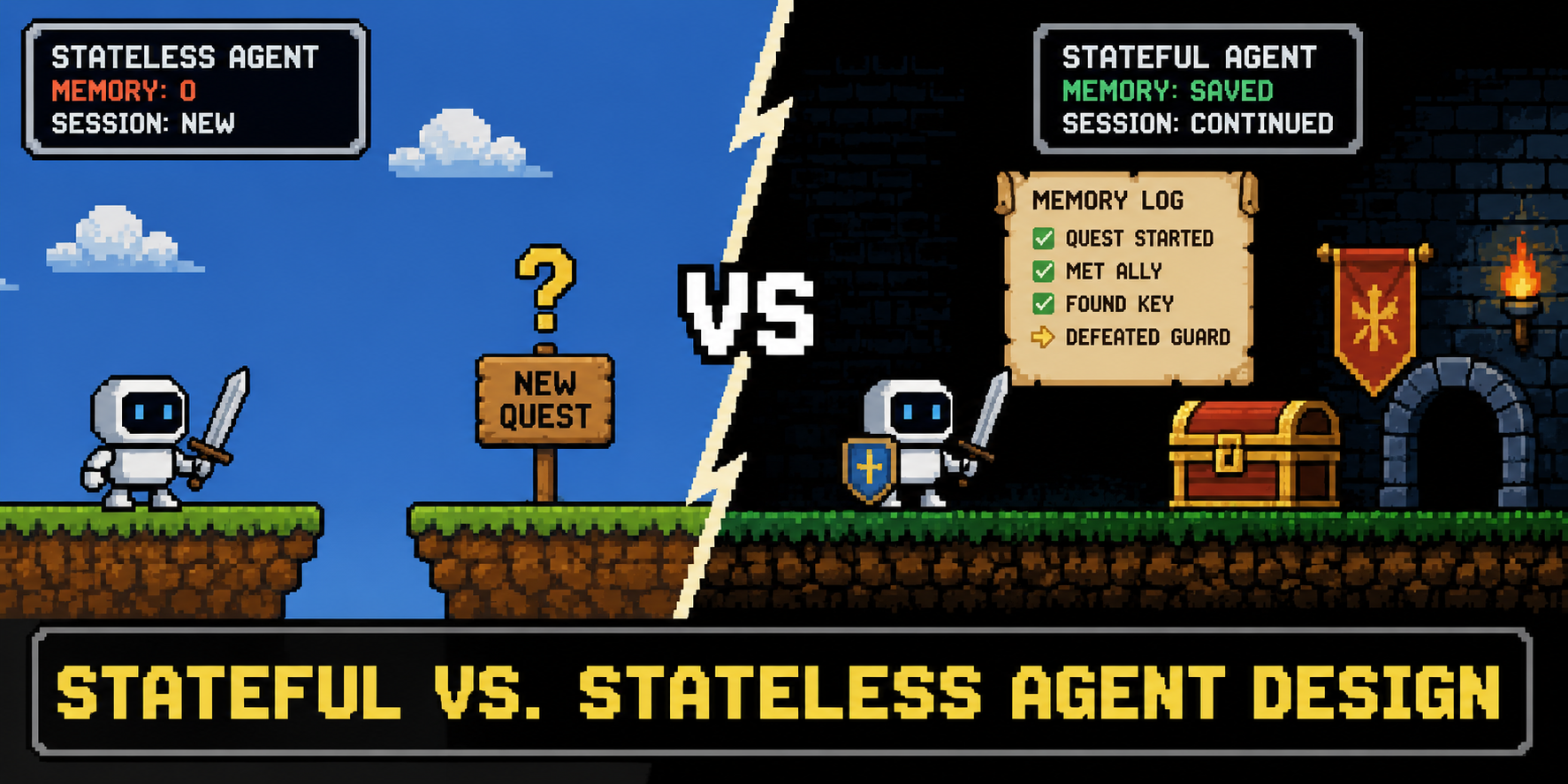
## Agent State Management: Stateless vs. Stateful Design
Modern AI agent deployments must decide how to handle conversation state—whether each interaction should be self-contained or maintain memory across turns. This article explains both approaches and their architectural implications.
### Key Differences Between Stateless and Stateful Agents
**Stateless Agents** treat every request as independent. The client sends the complete conversation history with each prompt, and the agent processes it without storing any context. This approach offers simple horizontal scaling but causes token costs to balloon as conversations grow.
**Stateful Agents** maintain conversation history in a database. The client sends only a session ID and the latest prompt; the agent retrieves historical context, appends its response, and saves the updated state. This reduces client-side complexity and token usage but introduces database dependencies.
### Stateless Agent Implementation
A stateless agent receives a prompt and optional history from the client:
“`python
def stateless_agent(prompt: str, provided_history: list = None) -> str:
“””
The agent relies completely on the client to provide context.
It retains no information from past interactions in local memory.
“””
messages = [{“role”: “system”, “content”: “You are a helpful, concise assistant.”}]
if provided_history:
messages.extend(provided_history)
messages.append({“role”: “user”, “content”: prompt})
response = client.chat.completions.create(
model=MODEL_ID,
messages=messages,
max_tokens=100
)
return response.choices[0].message.content.strip()
“`
**Limitations:** Without the client resending the entire conversation history on every turn, the agent cannot remember previous interactions. As dialogue continues, token usage grows exponentially, impacting both performance and cost.
### Stateful Agent Implementation
A stateful agent manages its own memory using a database:
“`python
import sqlite3
import json
conn = sqlite3.connect(‘:memory:’)
cursor = conn.cursor()
cursor.execute(”’CREATE TABLE IF NOT EXISTS agent_memory (session_id TEXT PRIMARY KEY, history TEXT)”’)
conn.commit()
def stateful_agent(session_id: str, new_prompt: str) -> str:
“””
The agent manages its own state using a database.
The client only sends the new prompt and their session ID.
“””
cursor.execute(“SELECT history FROM agent_memory WHERE session_id=?”, (session_id,))
row = cursor.fetchone()
if row:
conversation_history = json.loads(row[0])
else:
conversation_history = [{“role”: “system”, “content”: “You are a helpful, concise assistant.”}]
conversation_history.append({“role”: “user”, “content”: new_prompt})
response = client.chat.completions.create(
model=MODEL_ID,
messages=conversation_history,
max_tokens=100
).choices[0].message.content.strip()
conversation_history.append({“role”: “assistant”, “content”: response})
cursor.execute(”’
INSERT INTO agent_memory (session_id, history)
VALUES (?, ?)
ON CONFLICT(session_id) DO UPDATE SET history=excluded.history
”’, (session_id, json.dumps(conversation_history)))
conn.commit()
return response
“`
**Benefits:** The client only needs to send a session ID and the latest prompt. The agent handles context management, enabling natural multi-turn conversations without growing payload sizes.
### Comparison and Tradeoffs
| Aspect | Stateless Agents | Stateful Agents |
|——–|——————|—————–|
| **Client Responsibility** | Must send full conversation history | Sends only session ID and new prompt |
| **Token Usage** | Grows with conversation length | Constant per turn |
| **Scalability** | Easy horizontal scaling | Requires database infrastructure |
| **Use Cases** | Simple, single-turn tasks | Multi-turn conversations, assistants |
| **Memory Management** | Client-side | Agent-side with persistent storage |
### When to Choose Each Approach
**Choose Stateless Design When:**
– Building simple, task-specific workflows (text extraction, classification)
– Preferring lightweight infrastructure without database dependencies
– Handling mostly single-turn interactions
**Choose Stateful Design When:**
– Developing multi-turn assistants or customer service bots
– Needing persistent memory across sessions
– Managing complex workflows that may require pauses, tool usage, or human review
– Wanting to keep client payloads small and efficient
### Conclusion
The choice between stateless and stateful agent architectures fundamentally depends on your application requirements and infrastructure capabilities. Stateless designs offer simplicity and easy scaling for straightforward tasks, while stateful designs enable richer conversational experiences at the cost of additional infrastructure complexity. Understanding these tradeoffs allows developers to build agent systems that appropriately balance performance, cost, and user experience for their specific needs.
