



# How AI-Driven Job Losses Are Reshaping Local Economies — And What the Numbers Tell Us
Artificial intelligence is changing the workplace at a remarkable pace. While many companies are embracing AI to boost productivity, the technology has also been linked to a growing number of layoffs. But what does that mean for the everyday families and communities affected by these changes? New data tools are beginning to put a price tag on the human cost of AI-driven workforce reductions.
## Turning Layoffs Into Real Numbers
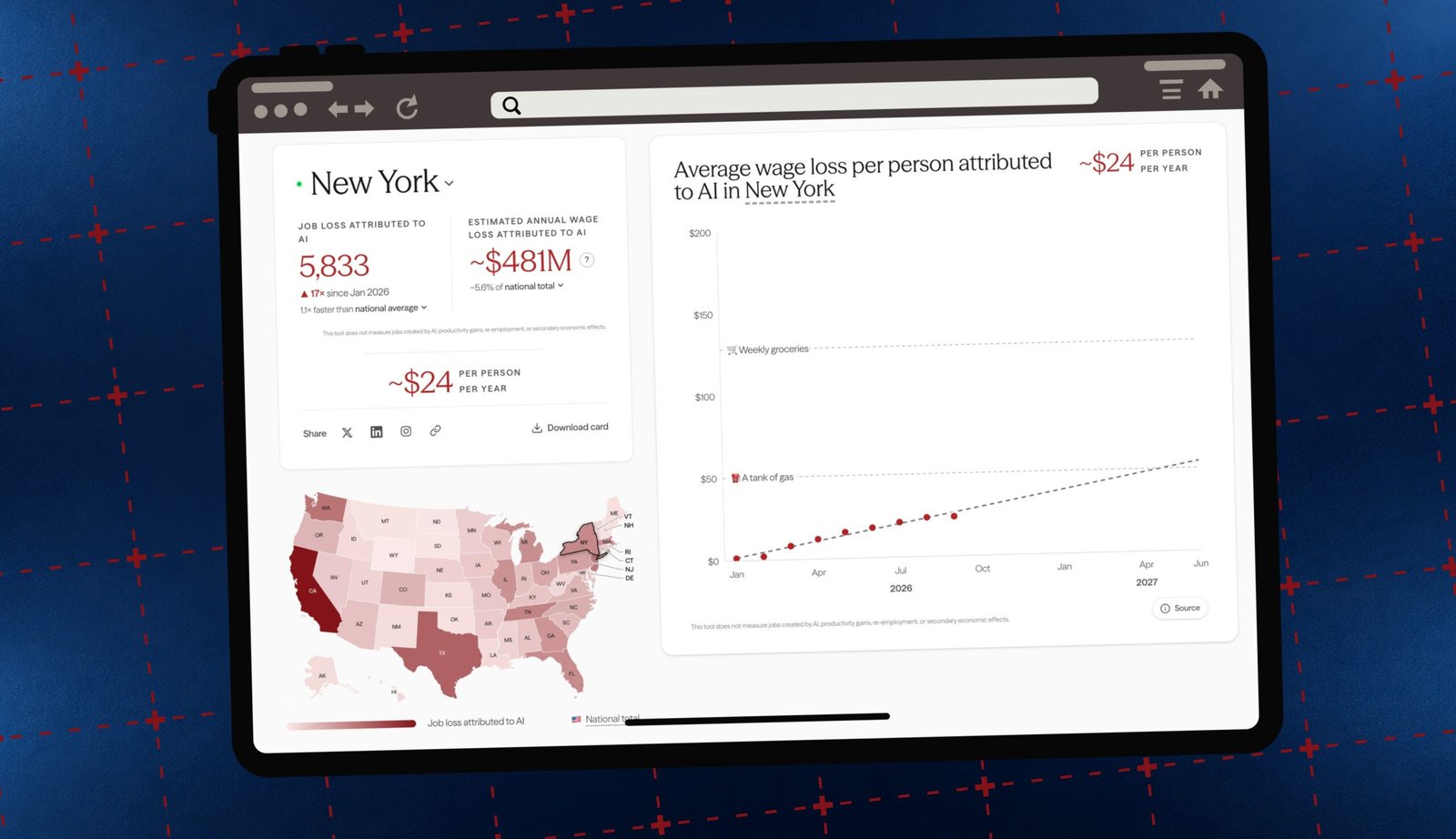
Tracking how AI affects employment is one thing — but understanding what it means for people’s wallets is another. A recently launched tracking system now estimates AI-related job losses in both job counts and dollar amounts across the United States.
The latest data shows that over 117,000 jobs have been cut nationwide and tied to AI, resulting in an estimated **$8.5 billion in lost annual wages**. On an individual level, that works out to roughly **$25 per person per year** across the country. But the numbers shift dramatically depending on where you live.
For example, one state with a large tech and media presence saw over 27,000 AI-linked layoffs, pushing the estimated per-person loss to **$56 per year**. In contrast, another state reported only 138 AI-related job losses, bringing its per-person impact down to just **$14 per year**.
## How the Numbers Are Calculated
The estimates come from combining several public data sources. Monthly layoff reports from a major workforce research firm are cross-referenced with the average annual salary for each state. Population figures from the national census help determine the per-person impact.
This approach doesn’t claim to capture every single layoff caused by AI — only those that companies have publicly acknowledged as being connected to the technology. Experts agree this is a deliberate and measured approach: it focuses on the broad, observable pattern of AI-justified workforce reductions without requiring a company to admit that it replaced an entire team with an automated system.
## Beyond the National Picture
The tracking system also breaks down the impact by individual state, making it possible to compare how different regions are faring. Areas with heavy concentrations in technology, media, and digital services are seeing a disproportionately higher share of job losses. Meanwhile, states with smaller tech sectors are experiencing relatively minor impacts.
Researchers behind the system emphasize that one person losing their job doesn’t just affect that household — it ripples through local grocery stores, small businesses, rental markets, and community services. When thousands of workers lose income across multiple industries, the economic weight becomes significant.
## Is the Full Picture Complete?
Not quite. The tracking system intentionally leaves out several important factors:
– **New jobs created by AI** — some industries are actually growing because of AI adoption.
– **Productivity gains** — AI can help remaining workers do more in less time.
– **Re-employment** — many laid-off workers do find new positions, sometimes in new fields.
– **Secondary economic effects** — the broader ripple effects of AI adoption that aren’t easy to measure.
Experts also note that predicting how AI will ultimately shape the economy still involves a great deal of uncertainty. There is no consensus on whether AI will generate enough new economic activity to offset the jobs it displaces.
## AI’s Growing Role in Freelance Work
The same tracking effort also examines how capable AI has become at handling remote freelance tasks — things like web development, video production, and content creation.
In a relatively short span, AI agents have gone from completing just a small fraction of freelance projects at a professional level to handling nearly **16% of such tasks** fully. That capability is reportedly doubling every few months, with leading AI models driving much of this progress.
However, experts caution that measuring what AI is *capable* of doing is not the same as measuring what it is *actively taking on* from human freelancers. Still, the convergence of rising AI capability and increasing job displacement has raised concerns among researchers.
## What’s Being Done?
Some states, particularly those with large technology sectors, have begun introducing legislation to ensure that major decisions like terminations are not fully automated by AI systems. The goal is to keep a human element in place when livelihoods are at stake.
At the same time, organizations behind the tracking systems stress that their purpose isn’t to blame any single company or industry. Rather, it’s to give workers, communities, and decision-makers access to real data so they can respond with informed action instead of speculation.
—
## Frequently Asked Questions (FAQ)
**Q: Are all layoffs being caused by AI?**
A: No. The data focuses only on layoffs that companies have publicly linked to AI. Many other factors — such as economic downturns, restructuring, and shifting markets — also contribute to job losses.
**Q: Does this mean AI will eliminate more jobs than it creates?**
A: There’s no clear consensus yet. AI has the potential to both displace certain roles and create entirely new ones. The long-term balance remains uncertain and is an active area of research.
**Q: How accurate are these wage loss estimates?**
A: They are estimates based on publicly available data. They use averages and national trends, so individual experiences may vary significantly. The numbers should be seen as a broad indicator rather than a precise prediction.
**Q: Can AI really do freelance work like web development and video production?**
A: AI agents have made significant strides and can now handle a portion of such tasks at a professional level. However, they are still far from replacing the full range of skills human freelancers offer, especially for complex or highly creative projects.
**Q: Are there laws protecting workers from AI-based layoffs?**
A: Some states are beginning to pass laws that limit how much AI can be involved in personnel decisions like firing and discipline. However, these regulations vary widely and are still in early stages.
—
## Conclusion
The data is clear: AI-driven job losses are not just an abstract trend — they translate into real financial impacts for real people and communities. Tracking systems that put a dollar figure on these losses help make the conversation more concrete and actionable.
At the same time, the full economic picture remains incomplete. AI is still a rapidly evolving technology, and its long-term effects on employment, wages, and economic growth are not yet fully understood. The most productive path forward is one grounded in transparent data, thoughtful policy, and a commitment to supporting workers as the landscape shifts.
Whether you’re a worker worried about the future of your career, a business owner weighing the benefits of automation, or a policymaker shaping the rules of the road, the key is to stay informed and engaged. The more we understand the real costs and benefits, the better equipped we’ll be to navigate this transformation together.
Thank you for reading
