



Follow ZDNET: Add us as a preferred source on Google.
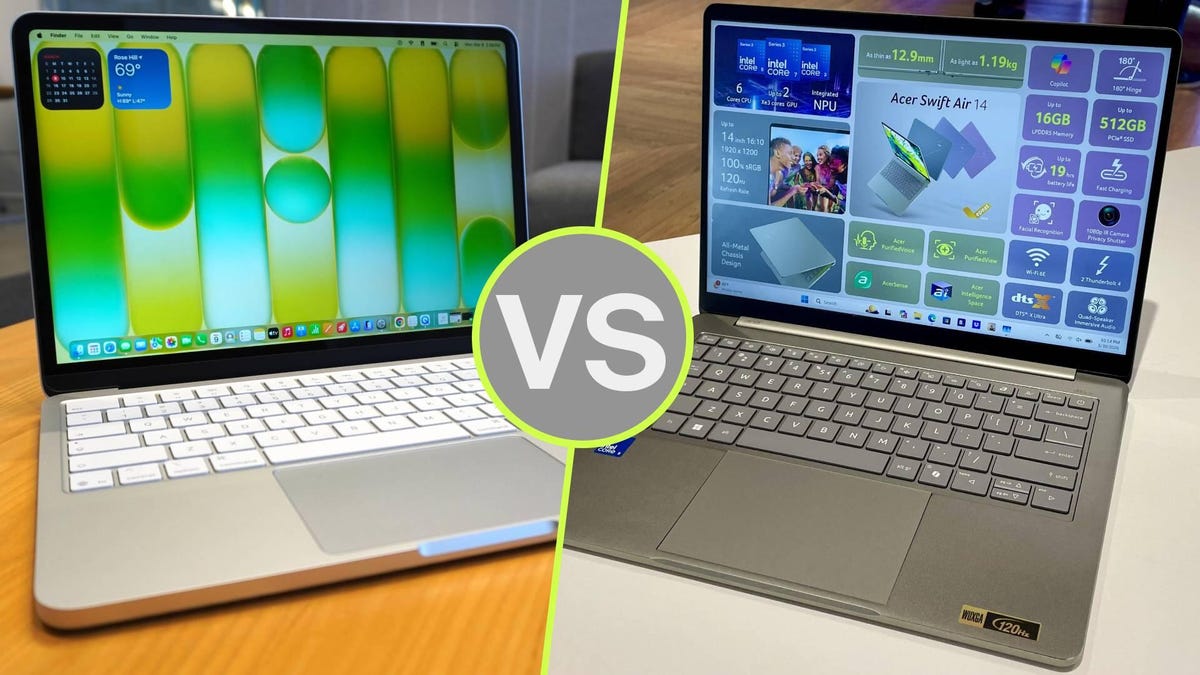
Among all the laptops unveiled at Computex 2026, Acer’s Swift Air 14 stood out by adding some welcome flair and budget-friendliness to an onslaught of incredibly powerful—and incredibly pricey—high-end machines. With a starting price of $699, the Swift Air 14 is an affordably priced laptop with competitive specifications that doesn’t feel like a budget device at all.
Also: Dell XPS 13 (2026) vs. MacBook Neo: I tested both budget laptops, here’s which one I’d pick
Expected to launch later this summer, the Swift Air 14 is just one of several Windows PCs designed as a direct answer to Apple’s MacBook Neo—the $599 machine that shook up the budget laptop market so completely that PC manufacturers had no choice but to respond within a few months.
The Swift Air 14 is available in distinctive colors, supports expandable storage (up to 1TB), and packs a sizable, fast-charging battery. How does it stack up against the Neo? Here’s a detailed comparison based on specs, keeping in mind that I’ve only had hands-on time with the Swift Air 14 and haven’t extensively tested it yet.
Specifications
Apple MacBook Neo | Acer Swift Air 14 | |
Display | 13-inch non-touch, 60Hz refresh, 2408 x 1506 resolution, 500 nits | 14-inch non-touch, 120Hz refresh, 1920 x 1200 resolution, 350 nits |
Weight | 2.7 pounds | 3.0 pounds |
Processor | Apple A18 Pro | Up to Intel Core 7 processor 350 |
| RAM/Storage | 8GB / 256GB–512GB | Up to 16GB / Up to 512GB (upgradeable to 1TB) |
| Battery | 36.5 Whr (up to 16 hours) | 70 Whr (up to 19 hours) |
| Camera | 1080p FaceTime HD camera | FHD IR camera |
| Connectivity | Wi-Fi 6E, Bluetooth 6 | Wi-Fi 6E, Bluetooth 5.3 |
| Price | Starting at $499 for students, $599 general | Starting at $699 |
1. Battery life and stamina
Winner: Acer Swift Air 14
Both machines are highly energy-efficient when it comes to power usage. But the Swift Air 14 benefits from a noticeably larger battery (70Whr versus the Neo’s 36.5Whr), which Acer says lasted up to 19 hours during its internal video playback tests. This is partly thanks to Intel’s Core 7 “Wildcat Lake” series chip, engineered specifically to power ultraportable, long-lasting laptops.
The Swift Air 14 also charges remarkably fast, reaching 50% in just 30 minutes—think smartphone-level charging speeds that give you even more usable time between charges.
Also: I got an early look at the first Nvidia RTX Spark laptops—these four models will drive the new ultrabook wave
It’s worth pointing out that the Neo’s battery is technically more efficient on paper, but the Swift Air 14 simply has a much larger capacity to work with, giving users more breathing room—especially those who are particularly good at managing their power settings. In real-world use, I’d estimate this translates to about 1–2 full workdays per charge.
2. Display
Winner: MacBook Neo
The Neo’s screen looks impressive for the money, and when stacked up against the Acer Swift Air 14, it takes the lead. It’s brighter (500 nits vs. 350), delivers higher resolution (2408 x 1506 compared to the Acer’s 1920 x 1200), and includes Apple’s liquid retina technology, producing vivid, sharp visuals that could easily be mistaken for a far pricier machine.
That said, the Swift Air 14’s display isn’t bad by any means. It offers a faster refresh rate (120Hz versus the Neo’s 60Hz), and despite the slightly lower pixel count, it’s a full inch larger (14 inches versus 13).
3. Camera and video call quality
Winner: MacBook Neo
One of the MacBook Neo’s strongest suits is how well it replicates the functionality of Apple’s Air and Pro lineups—and that extends to video calls on FaceTime, Zoom, Teams, or Google Meet. The Neo features a 1080p FaceTime HD camera that performs impressively well overall, not just for laptops in this price range. The FHD IR camera on the Swift Air 14 simply can’t match it, both in terms of raw image quality and how seamlessly it works with your smartphone.
4. Ports and connectivity
Winner: Acer Swift Air 14
The Swift Air 14 comes with a strong lineup of ports that outclasses the Neo’s selection without question. You get two USB-C Thunderbolt 4 ports (the Neo only has a single USB 3 and USB 2 port), plus a USB-A port and a 3.5mm headphone jack. In plain terms: the Swift Air 14 offers more ports, and they’re faster too. It’s a connector setup you’d expect from any typical midrange PC, while the Neo’s port arrangement feels decidedly more “entry-level.”
5. Overall value
Winner: MacBook Neo
The bottom line is this: the MacBook Neo at $499 for students is the single best laptop value proposition on the market today, bar none. If you’re a student or educator, there are very few alternatives at that price point that deliver the same quality experience, features, and build—and that’s all there is to it.
Also: Windows competitors to the MacBook Neo have arrived—but what I’m really waiting to see is Google’s response
The Acer Swift Air 14 starts at $699 and offers comparable hardware with a bit more flexibility in RAM and storage (its storage can be upgraded to 1TB—double the Neo’s maximum). But if pure affordability is your top priority, the Neo is unsurpassable. Honestly, I’d like to see the base configuration price of the Swift Air 14 come down a bit, and I’d recommend keeping an eye out for discounts if you plan to purchase when it arrives later this summer.
My recommendation
As I mentioned earlier, I haven’t had the chance to use the Acer Swift Air 14 over an extended period, but based on the time I’ve spent with it so far, I’m confident it’s a worthy rival to the MacBook Neo. It has faster and more versatile I/O, greater storage and RAM options, and a stylish range of colors. But it’s still a Windows PC at the end of the day, and 8GB of RAM on a Mac doesn’t carry the same performance limitations as 8GB on Windows.
For now, I’d still lean toward the Neo because its performance, user experience, and display quality are just exceptional for the price. The Neo is also less expensive than the Swift Air 14, which is remarkable given that it not only competes with it but actually beats it in several key areas. So far, no Windows PC manufacturer has found a way to match the Neo’s $499 student pricing.
Also: After using the MacBook Neo, it’s obvious Windows needs to overhaul its PC strategy (and quickly)
Sure, the Neo comes with some compromises—no backlighting on the keyboard, a more limited port selection—but it more than compensates with Apple’s tightly integrated ecosystem, an excellent trackpad, reliable performance, and stronger overall value.
