



Stay updated with ZDNET: Add us as a preferred source on Google.
ZDNET’s main points
- Solar generators provide critical backup during extreme weather events.
- Get your equipment ready well before a disaster strikes.
- Severe weather occurrences are rising in frequency.
Solar power stations are growing increasingly popular. They’re being adopted in households nationwide for a wide range of purposes — from cutting electricity costs by capturing solar energy to establishing a dependable power source capable of withstanding the escalating number of weather-related emergencies we now face.
Just recently, I came across reports suggesting that a powerful El Niño could be something we’ll need to deal with this year.
Also: How I increased my portable solar panels’ output by up to 30% — 11 tips from the experts
However, power stations can introduce risks that aren’t always apparent to owners. Problems like these can emerge during a crisis, making an already difficult situation far worse.
In this guide, I’ll walk you through essential steps to prepare your solar generator for a weather emergency. I’ve spent years working with solar generators — from compact units I’ve carried to remote, off-grid sites to large-scale setups capable of keeping a household running for several days.
Also: Thinking about plug-in solar? My expert guidance after installing the DIY energy solution at home
I’ve also spent my entire life as a passionate hiker, bushcrafter, and outdoor enthusiast, having completed numerous survival courses — from first aid and land navigation to urban emergency preparedness and the UK’s version of SERE (Survival, Evasion, Resistance, and Escape), known locally as Survive, Evade, Resist, Extract.
What emergency are you likely to face?
The first step is understanding the type of emergency you might encounter, as this will shape your preparation strategy. Unfortunately, the possibilities are wide-ranging and depend largely on your location:
- Midwest and Plains regions: Tornadoes, severe thunderstorms, and flooding.
- Southeast and Gulf Coast: Hurricanes, tropical storms, and flooding.
- Western states: Wildfires, droughts, and periodic winter storms.
- Northeast: Winter storms, blizzards, and occasional hurricanes.
- Coastal regions: Hurricanes, storm surges, and rising sea levels.
Understand your equipment’s limitations
Power stations are, for the most part, very reliable. I’ve spent countless days with one rattling around in the bed of a truck or propped beside my head in a tent slowly taking on water. But it’s important to remember that these are enclosures packed with large lithium-ion battery packs and capable of delivering thousands of watts of AC power — enough to be fatal.
Also: I built a custom Wi-Fi router using a Raspberry Pi for Starlink and solar management — here’s the process
Power stations are engineered to perform best at room temperature — 68°F to 77°F (20°C to 25°C) — but generally handle charging between 32°F (0°C) and 95°F (35°C) and discharging between 14°F (-10°C) and 104°F (40°C). When it comes to moisture, this is where things become hazardous, and it’s wise to treat a power station the same way you’d treat any wall outlet or extension cord. Most power stations operate best in humidity between 0% and 60% and can be stored in conditions up to 80% humidity.
They also handle water poorly, and unless the unit is specifically built to be water-resistant, any exposure to rain, spills, or flooding can damage internal parts and create a safety risk.
The Bluetti AC60P handled some serious rainfall with ease!
Adrian Kingsley-Hughes/ZDNET
But there are additional dangers to keep in mind.
Fire is a significant concern, and it’s absolutely worth considering — though debating whether your power station uses lithium-ion or the more stable lithium iron phosphate (LiFePO4) batteries becomes somewhat irrelevant when a wildfire is bearing down on your property.
Also: Is plug-in solar permitted in your state? Here’s how to find out before installing one at home
Wind poses another serious threat, capable of tearing solar panels from roofs or balconies, snapping cables, and transforming 100-pound power stations into dangerous projectiles.
Steps to take before an emergency
Every scenario is unique, but here’s my checklist of things to think about:
- Store your power station somewhere as cool and dry as possible. Some keep them indoors, others in garages or workshops, and some place them in a small outdoor shed. Elevating the power station a few feet off the ground is a smart move in areas prone to minor flooding, while placing it upstairs or in an attic exposes it to serious flood risk. In hot climates, shield the unit from direct sunlight.
- Ensure any solar panels you own are securely anchored, even if you have a basic solar generator or plug-in solar arrangement. Wind can damage both panels and wiring, and gusts reaching 50 mph can send them flying, causing property damage and serious injuries.
Also: The solar-powered backup station I rely on after years of real-world testing — and why it performs so well
- If your power station exceeds the size of small portable units, invest in a trolley to help with moving it around. I’m currently planning to weld together a cart for my “Tower of Power” to improve its portability.
Wheels really do make transporting heavy loads much simpler!
Adrian Kingsley-Hughes/ZDNET
- If you’re in an area where extended power outages are a possibility, think about pairing your solar generator with a propane or gas-powered generator for a more robust, long-lasting backup solution. Take the time to learn how your generator operates before you need it.
- Think about getting a protective cover for your power station, which will help shield it from dirt, dust, and splashes. You can even find covers designed for outdoor use.
- If there’s a chance of an incoming emergency in the coming days, make sure your power station is fully charged — using the AC wall outlet if necessary — and consider stowing away your solar panels. In this situation, it’s best to err on the side of caution.
- If the crisis never unfolds, reflect on how your preparedness plan held up during the practice run.
Also: Don’t make these 8 solar blunders that slash your power output by 50% – I found out through experience
Tip: It’s wise to secure all essential documents in one place. I’d suggest picking up a waterproof/fireproof lockbox or safe, since replacing lost paperwork can be a nightmare.
What to do when an emergency hits
Alright, the situation is getting real. The groundwork is laid, and now it’s time to move into action. Here’s how I’d approach it:
- Take advantage of every available moment to charge your power station and all your gadgets.
- Stay connected to local weather updates and news broadcasts. Watch closely for any evacuation advisories. Try to get a feel for how long the worst of the emergency could stretch. For wildfires, pay close attention to wind shifts, and when flooding threatens, make sure to relocate critical belongings — including your power station and any electronics — off the ground level.
- Once the charging is finished (or the weather threat is right at your doorstep), unplug the power station from the wall outlet (this shields it from power surges and lightning strikes).
- Be careful not to deplete your power station’s stored energy. Focus on running must-have essentials like refrigerators, medical equipment, communication devices (smartphones, radios), and lighting.
- Follow any directions issued by local authorities or emergency response teams.
- Keep in mind that once the immediate emergency passes, the dangers don’t necessarily go away. Flooding, structural damage, sewage overflows, fallen electrical lines, and damaged gas lines are just a few of the hazards that can emerge in the aftermath of a severe weather event.
What comes next after the emergency?
Well done, you made it through.
From here, there are two possible scenarios ahead.
The ideal outcome is that the emergency has blown over and life is essentially back to normal, or very close to it, with just some tidying up left to handle. Chances are things will return to their usual rhythm fairly quickly.
Also: I spent two years experimenting with wind power at home – this is why solar remains my go-to choice
The alternative is that the initial disaster has resolved, but it’s unleashed secondary chaos in its path, which could take days, weeks, or even longer to fully get under control, depending on how severe the destruction is.
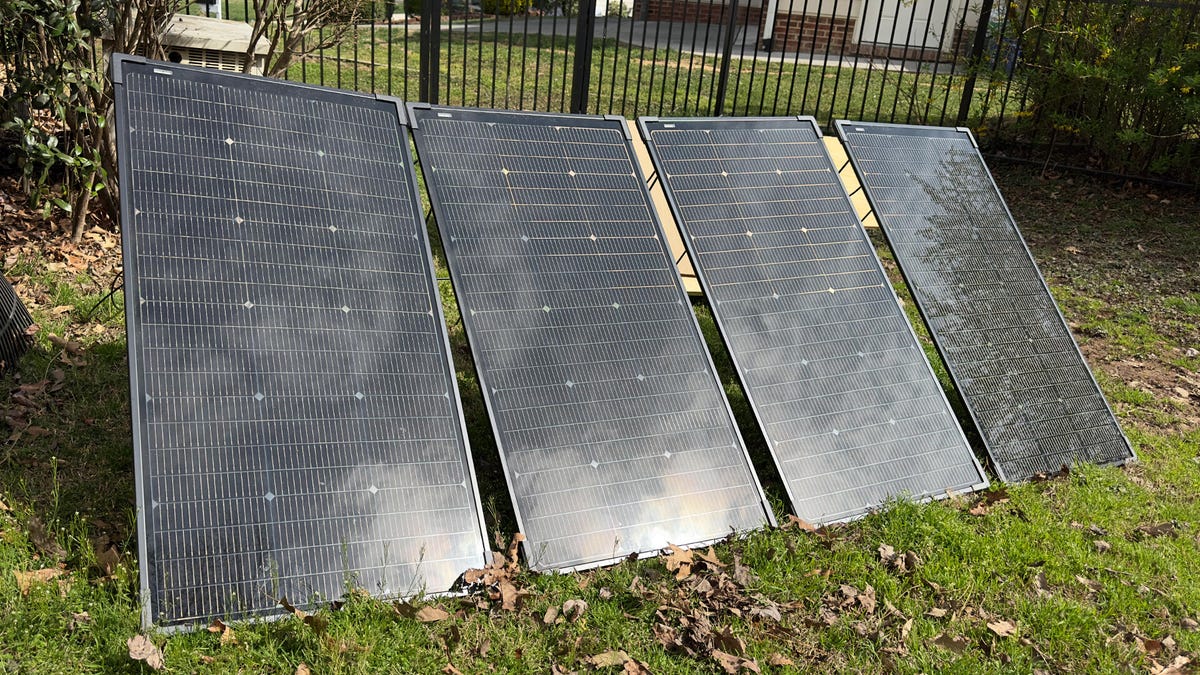
Start the solar panels back up as soon as conditions are safe.
Adrian Kingsley-Hughes/ZDNET
If your home has mostly come through unscathed, but the wall outlets aren’t delivering any AC power, your focus should be on maintaining the power station’s charge. Be smart about conserving energy, directing it toward necessities only. At the same time, you need to start figuring out how to replenish the batteries, whether that means getting the solar panels operational again or cranking up the generator.
And if you’re relying on a generator, keep in mind that fuel could be in short supply, so use it judiciously to top off batteries.
