



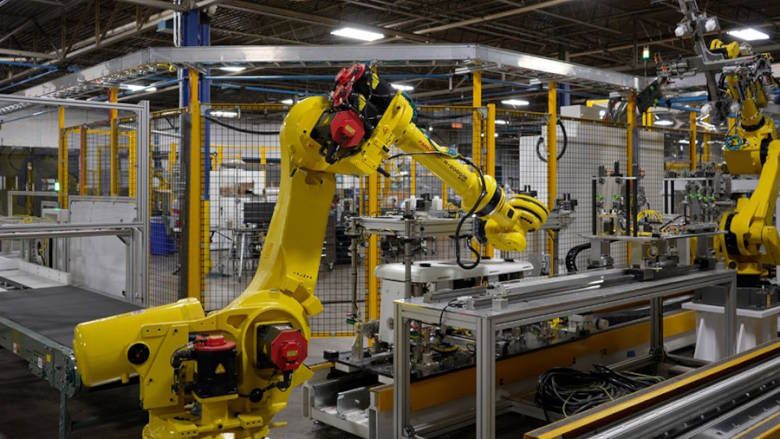
In automated assembly, every second counts. But optimizing cycle time isn’t simply about speeding up machines—it’s about cutting waste, refining workflows, and applying proven methods that boost consistency across the whole production line.
“We begin with a target volume—how many units must the system produce each year? That figure is then converted into a parts-per-minute rate, factoring in how many hours per year the automation will actually run,” explains Joseph Trudeau, senior applications engineer at The Arthur G. Russell Co.
Next, engineers assess how complex the assembly process is and how long each step takes. This usually means conducting detailed timing analyses on the most challenging stations to determine the overall system setup. Once those benchmarks are set, the appropriate machine platform is chosen to match production demands.
Electric actuators and robotic workcells are typically ideal for lower-volume tasks with cycle times of 2 seconds or more. In contrast, cam-driven systems excel in high-speed, high-volume environments—handling multiple parts at once and achieving cycle times close to 1 second.
Begin With Clear Process Insight
Improving cycle time starts with knowing exactly where time is being lost.
“Frequently, it’s testing steps—like leak checks, vibration tests, or electrical validation—that become bottlenecks,” notes Sam Kleindienst, application engineer at Edgewater Automation. “These stations are often expensive, so there’s pressure to run them as fast as possible to avoid duplicating them in parallel.”
“Settling time is the most commonly ignored factor,” he adds. “A test might theoretically complete within a certain window, but achieving reliable, repeatable results often requires extra stabilization time that’s easy to overlook.”
Need fast answers on assembly or manufacturing topics?
Try Ask ASM—our new intelligent AI search assistant.
Ask ASM
To pinpoint bottlenecks, engineers combine digital tools with hands-on expertise.
“You can run simulations, but my first choice is still a classic timing chart,” says Kleindienst. “It lets me quickly spot problem areas without investing time in full-scale simulation programming.”
An automated brake assembly line that integrates precision assembly, inspection, and material handling to maintain steady cycle times in high-volume manufacturing. Photo courtesy Edgewater Automation
Remove Bottlenecks via Line Balancing
One sluggish station can drag down the performance of the entire line.
“Tools like JaamSim simulation software are great for uncovering bottlenecks in multi-station setups,” says Trudeau.
But fixing them often means making physical or procedural changes to the system.
“Cycle time issues usually surface during testing and debugging—the early phase of equipment operation,” he clarifies. “Even with accurate sizing calculations, real-world conditions sometimes reveal shortcomings. For instance, we once used a pneumatically driven rotary indexing table that was correctly sized but still couldn’t hit the target speed. The fix? We reduced the mass of the rotating dial. Upgrading the indexer wasn’t feasible due to space constraints and would’ve delayed the project.”
In other cases, the bottleneck lies in material handling. Trudeau recalls a pallet-based system that missed its cycle time goal during commissioning.
“On a recent power-and-free pallet system with manual loading by operators, we noticed a cycle time shortfall during debug,” he says. “The issues were hard stops causing pallets to bounce and gaps between pallets slowing transfers. We swapped the rigid stops for pneumatic cushioning versions, which eliminated bounce and allowed faster pallet movement. We also added more accumulation zones and fine-tuned system timers to keep more pallets moving whenever possible.”
Streamline Part Flow and System Design
How parts move through the system—and how the system is laid out—often determines whether theoretical cycle times become reality.
“Equipment selection sets the upper limit for speed, but layout and part flow decide whether you actually reach that limit,” says Trudeau. “Robots, actuators, and cylinders all have minimum movement and response times. If the machine layout isn’t optimized, those speeds won’t be achieved.”
In multi-station lines, poor flow can cause jams and delays.
“Material handling in complex systems affects not just cycle time but also cost, footprint, and layout,” notes Kleindienst. “To prevent congestion between parallel stations, they’re often separated from the main line and spaced to allow proper queuing and exit paths—so one station’s output doesn’t block its neighbor.”
Engineers also warn against overloading part-handling systems.
Kleindienst points out a frequent error: programming robots to grab multiple parts at once without ensuring they’re properly aligned or that the end-of-arm tooling is flexible enough to reliably pick them from a single programmed position.

A consumer goods assembly line using robotics for high-speed part handling and multi-station automation to enhance cycle time efficiency. Photo courtesy Edgewater Automation
Use Automation Wisely
Not every process gains the same benefit from added automation.
“Just because you can automate something doesn’t mean you
“That’s exactly what we should aim for,” says Brian Romano, Ph.D., director of technology development at The Arthur G. Russell Co. “We prefer to call it ‘the elegant solution’—one that aligns with the customer’s budget, product lifespan, and internal support capabilities. Matching all these factors alongside the customer’s business use case helps determine the system design and overall cycle time.”
Overly complex systems can introduce inefficiencies that offset potential gains. The most effective designs balance performance with simplicity, ensuring that automation enhances cycle time, not hinders it.
Focus on Motion Efficiency
In high-speed assembly, motion and travel distances can significantly impact cycle time.
“Minimizing motion distances goes a long way to improving cycle time,” says Kleindienst.
Reducing travel distance between processes can significantly improve cycle time, because every inch of motion adds time to each cycle, he explains.
However, speed must be balanced with system performance. “Motion control axes need to be designed to a level that anticipates not only the rated speed, but the abilities to accelerate and decelerate at full load,” says Romano. “We have seen systems on other machines where the accel and decel are not considered and therefore, eat into the real cycle time.”
System tuning also plays a role.
Romano adds, “An overdamped velocity response will increase overall cycle time. An overdamped response can delay the time for a stabilized ‘in-position’ signal and increase the needed station cycle time.”

Automated forming and assembly system for consumer products used to streamline production and reduce cycle time. Photo courtesy Edgewater Automation
Use Data to Drive Continuous Improvement
Cycle time optimization does not end once a system is installed.
“The first and most typical way is to monitor the components of OEE,” says Romano. “The performance helps tell how well our machine is operating at the rated theoretical rate. The availability tells us how well our machines are synchronized… Finally, as long as the customer product is within specifications, the quality aspect shows us how well our machine processes are operating.”
Romano says engineers also rely on more detailed programming to monitor station-level performance, such as whether stations are running slower than at commissioning, photoelectric sensor signals are degrading, lighting intensity for vision systems is declining, drive current is increasing, or overall air flow is rising. This type of monitoring shifts the focus from basic process performance to overall machine health and helps identify cycle time issues and inefficiencies. These insights allow manufacturers to identify emerging issues and maintain consistent performance over time.
Design for Consistency, Not Just Speed
Ultimately, the goal of cycle time optimization is not maximum speed, but reliable, repeatable performance.
Cycle time improvements often require tradeoffs between speed, complexity and maintainability.
“This is where engineers who leave their desk, either to walk out to the floor or get on the phone with end users, really shine,” says Kleindienst. “Decisions that seem straightforward behind a computer screen are not always the best in the long-term.”
For manufacturers looking to improve existing systems, the path forward depends on the situation.
If a line is experiencing higher scrap rates, the root cause can range from raw material variability and worn tooling or fixtures to process equipment that needs maintenance or issues with vision inspection lighting, says Romano.
“In some cases, it might be time to consider another business case and perhaps another duplicate machine or one that matches the need in excess of the existing equipment,” he says.
For more information on automated assembly, read these articles:
Automated Assembly Systems: Trimming the Delivery Timeline
Manual, Semiautomatic or Fully Automatic?
Debug, Checkout and Startup
