



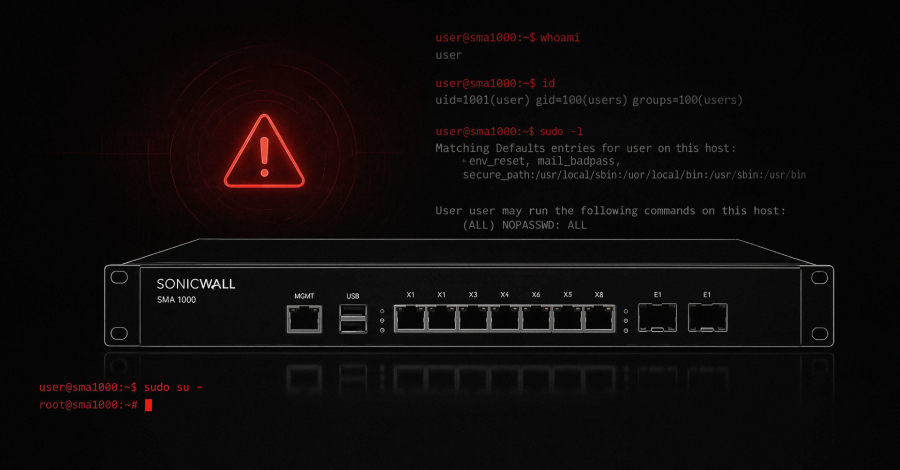
**New Article: Critical SonicWall SMA Zero-Days Actively Exploited by UTA0533 Threat Actor**
A sophisticated threat actor identified as **UTA0533** has been actively exploiting two zero-day vulnerabilities in SonicWall Secure Mobile Access (SMA) 1000 series VPN appliances since June 22, 2026, before the vulnerabilities were publicly disclosed. Cybersecurity firm Volexity detailed the campaign in a recent analysis, highlighting the advanced techniques used to gain and maintain access to compromised systems.
### The Attack Campaign
The investigation revealed that UTA0533 chained two critical vulnerabilities—CVE-2026-15409 (CVSS score: 10.0) and CVE-2026-15410 (CVSS score: 7.2)—to achieve arbitrary command execution and take over devices. The exploitation began with a pre-authentication bypass (CVE-2026-15409) that allowed unauthenticated attackers to establish a WebSocket tunnel to localhost services. This was followed by exploiting a path traversal flaw (CVE-2026-15410) in the “ctrl-service” to escalate privileges and execute code with root-level access.
### Lateral Movement and Persistence
Once inside, the attackers demonstrated persistence and control:
– **Appliance 1** saw the creation of a setuid binary (“ROOTRUN”) enabling root command execution, deployment of Java-based web shells (Suo5 and ORANGETAIL), and modification of system scripts to maintain access.
– **Appliance 2** focused on network traffic interception, using tcpdump to capture unencrypted LDAP credentials. However, this appliance was rebooted on July 2, 2026, which cleared many memory-resident artifacts.
### Exploitation Mechanics
The attacker’s pathway included:
1. Sending a crafted request with a specific User-Agent and `bmID` parameter to bypass authentication.
2. Leveraging CouchDB (a pre-installed database) to read the `product_uuid` file.
3. Using this UUID to derive the Basic authentication password for the SMA control service.
4. Exploiting command injection and privilege escalation to execute arbitrary code with root privileges.
### Critical Risk and Impact
SonicWall released patches for both vulnerabilities this week. Organizations using SMA 1000 series appliances are urged to apply updates immediately. The compromised appliances allowed attackers to access stored credentials, capture network traffic, and potentially intercept sensitive data processed by the devices.
—
## FAQ Section
**Q: What are the CVE identifiers for the exploited vulnerabilities?**
A: The vulnerabilities are CVE-2026-15409 (CVSS 10.0) and CVE-2026-15410 (CVSS 7.2).
**Q: Which SonicWall products are affected?**
A: The SonicWall Secure Mobile Access (SMA) 1000 series VPN appliances are impacted.
**Q: How can organizations protect against these threats?**
A: Immediately apply the patches released by SonicWall. Additionally, monitor for unauthorized changes to system files, unexpected setuid binaries, and suspicious network traffic.
**Q: Can virtual appliances be compromised?**
A: The attack relies on reading the `product_uuid` file, which is only present in physical devices. Virtual appliances are not impacted by this specific bypass.
**Q: What is the role of the threat actor “UTA0533”?**
A: UTA0533 is the moniker used by Volexity to track a previously undocumented threat actor observed exploiting these zero-days since June 22, 2026.
—
## Conclusion
The exploitation of CVE-2026-15409 and CVE-2026-15410 underscores the evolving tactics of advanced threat actors targeting enterprise VPN infrastructure. By chaining multiple zero-day vulnerabilities, UTA0533 achieved root-level access and demonstrated the potential for severe data breaches. Organizations must prioritize patching and robust monitoring to mitigate these critical risks. As investigations continue, further insights into the threat actor’s broader objectives may emerge, emphasizing the need for continuous vigilance in cybersecurity defense.
