



# A New Paradigm for Robot Manipulation Data: How Browser-Based Teleoperation Is Changing the Game
## The Problem with Traditional Data Collection
For years, building robot manipulation datasets has followed a painfully familiar routine. Lab-bound expert operators sit in front of expensive hardware, carefully recording demonstrations one at a time. These demonstrations are then processed offline, compiled into a fixed benchmark, and frozen permanently. The result? Datasets that barely grow after release while the models trained on them scale rapidly, creating an ever-widening gap between what the data supports and what the research community needs.
This bottleneck has stalled progress in a fundamental way. Robot manipulation models demand enormous volumes of diverse, high-quality demonstrations, yet the traditional centralized approach makes it nearly impossible to scale collection beyond a small group of specialists with access to dedicated lab equipment.
## Enter the Browser-First Architecture
A coalition of researchers has proposed a fundamentally different architecture — one where demonstration collection happens directly inside a web browser, while every computationally intensive task is offloaded to powerful backend GPU clusters. The system treats the dataset not as a static artifact that ships once, but as a living resource that expands continuously as more people contribute.
The core idea rests on deliberate asymmetry. Contributors interact with a simulated robotic arm through a browser-based interface, using whatever input device feels most natural — a keyboard, mouse, gamepad, or virtual joystick. Meanwhile, physics simulation and rendering happen on powerful NVIDIA GPUs, ensuring that the data logged always stays tightly synchronized with the underlying simulator rather than with the variable latency of a user’s browser.
This split is more than an engineering convenience. By separating the lightweight frontend from the heavy backend, the system democratizes participation while preserving data fidelity. Anyone with a web browser can contribute, and every contribution flows through a rigorous pipeline before it becomes part of the growing corpus.
## How Tasks Are Generated at Scale
One of the most interesting design choices is that the system does not rely on hand-crafted tasks. Instead, a task generation module takes a natural language instruction and decomposes it into a task specification, a scene configuration, and a set of object parameters. An image-to-3D pipeline retrieves or generates 3D meshes for each object, rescales them to physically plausible dimensions, and proposes a 2.5D layout for the scene.
A layout supervisor then steps in to validate each instantiated scene. If any constraints fail — say, objects overlapping or a target position is unreachable — the system relocates, reorients, or regenerates objects until the scene passes. Every task that ships also includes a structured success checker, which the backend re-runs independently rather than trusting a flag submitted by the frontend.
This automated pipeline means that the task space can grow organically as new language instructions are introduced, without requiring human designers to craft each scenario by hand.
## What the Released Data Looks Like
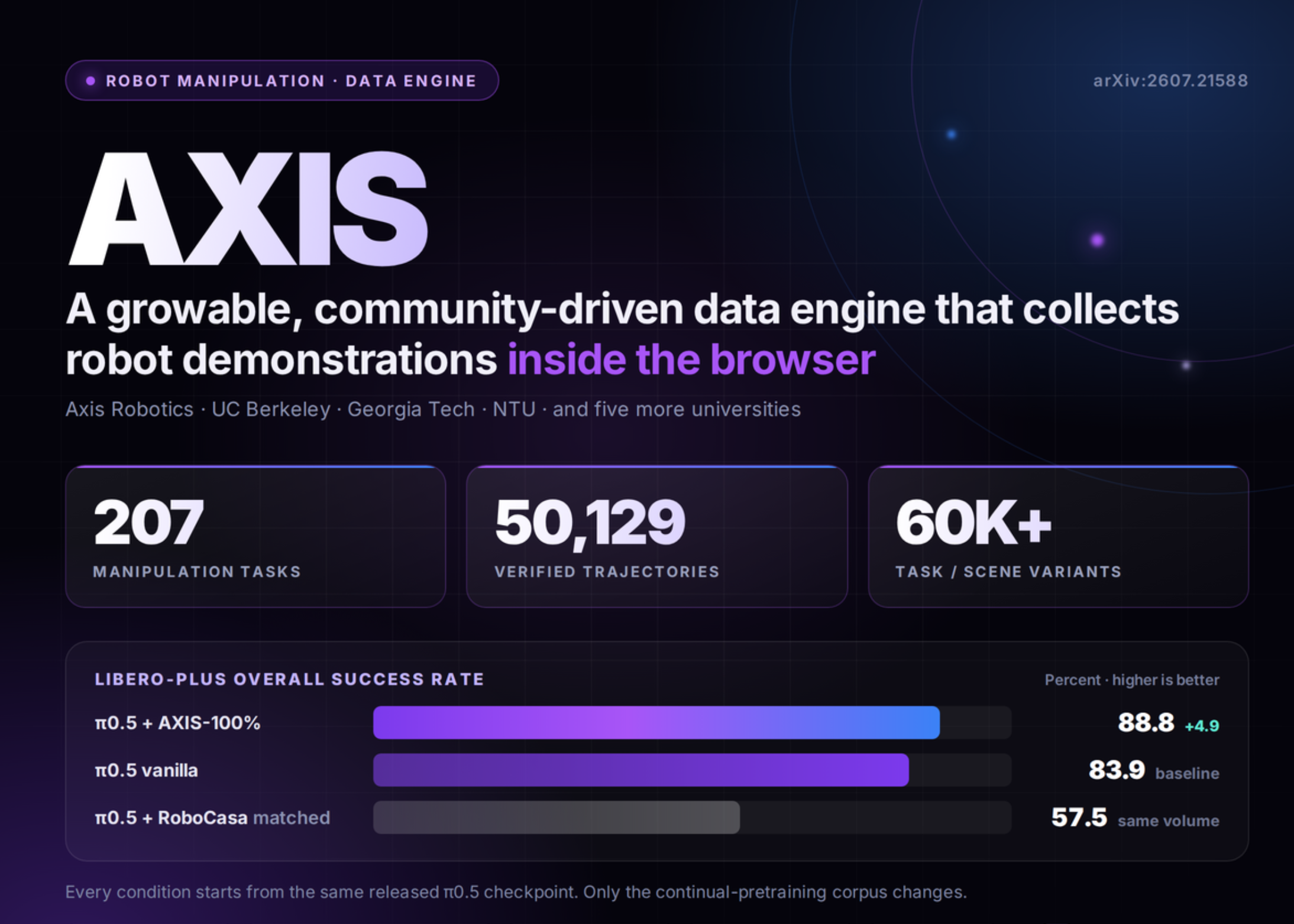
The publicly available snapshot of this effort contains 207 distinct tasks, over 50,000 individual episodes, and more than 60,000 task and scene variants spread across seven scene categories. Each trajectory is richly annotated with task metadata, embodiment information, simulator version details, robot and object states, action sequences, success labels, and visual observations from both a third-person camera and a wrist-mounted camera.
The paper acknowledges contributions from over 70,000 community members, a remarkable figure that speaks to the viability of the browser-based collection model.
Before the data enters the repository, it goes through a multi-stage cleaning pipeline. Samples where joint angles barely change — below a threshold of 5e-3 — are identified as static and removed. A Savitzky-Golay smoothing filter with a window size of 15 and polynomial order 3 is applied to continuous motion segments, followed by cubic spline resampling from the native 6-to-8 Hz output of the web interface up to a 20 Hz target.
Honest tradeoffs are documented alongside this process. The smoothing and resampling reduce mean acceleration by roughly 64% and mean jerk by over 80%, which is excellent for downstream policy training. However, replay success rate drops from 100% in raw teleoperation to 86.2% after cleaning — a cost worth acknowledging, since perfectly faithful replay does not always translate to better learning outcomes.
## Augmentation Through Simulation Replay
Once cleaned, episodes enter an augmentation stage powered by IsaacSim. Each demonstration is replayed from a packed simulator state with physics stepping disabled, preserving the verified trajectory as an authoritative backbone while surrounding elements — scene geometry, materials, lighting conditions, and camera placement — are randomized extensively.
The output consists of 256×256 pixel ray-traced RGB images from both a fixed third-view camera and a wrist camera. Depth information is disabled by default, keeping storage requirements manageable while still providing rich visual signals for visual-policy training.
Scene randomization covers multiple axes simultaneously: scene layout, object materials, lighting intensity (ranging from 12,000 to 35,000 lumens), color temperature (2,800 to 6,500 Kelvin), and camera placement with positional jitter of ±0.10 meters and rotational jitter of ±8 degrees. A separate physics randomization pass varies object poses, clutter density, mass, and friction coefficients.
## Training Results and Key Findings
The research team evaluated their approach using a publicly available π0.5 model checkpoint as the starting point. This model combines a PaliGemma architecture with a Gemma-2B vision backbone and a Gemma-300M action expert, and the training protocol involves full-model continual pretraining — no parameter-efficient adaptations like LoRA are used.
The pretraining phase uses a flow-matching loss computed over 10-step action chunks, running for 100,000 steps on a simulation corpus, followed by 30,000 steps of fine-tuning on the LIBERO benchmark with fixed hyperparameters across all conditions. This design ensures that any performance differences between configurations can be attributed to the data scale or composition rather than training variability.
The headline result is compelling. The model trained on 100% of the AXIS corpus achieves 88.8 overall success on LIBERO-Plus, compared to 83.9 for a vanilla baseline and 57.5 for a RoboCasa365 control matched on trajectory count. Scaling from 25% to 50% to 100% of the data shows consistent gains at the aggregate level: 84.7 to 85.7 to 88.8.
Looking at individual perturbation axes, the largest improvements cluster where the augmentation pipeline is most aggressive. Sensor noise robustness gains 13.7 percentage points and camera variation robustness gains 11.3 percentage points. Background variation improves by 3.7 points, robot pose variation by 3.8 points, and layout variation by 2.6 points.
Not every axis responds positively, however. Light variation drops by 1.7 points and language-conditioned tasks regress by 1.3 points against the vanilla baseline. The camera axis also shows an interesting pattern: it dips to 68.8 at the 50% data snapshot, below the 72.5 baseline, before recovering to 83.8 at the 100% snapshot. This suggests that moderate amounts of augmented data may occasionally introduce confusing visual variations before the benefits of larger scale take over.
## Accessibility and Limitations
The system is partially deployable today. The training code is publicly available as a patch layer over OpenPI, and the teleoperation platform runs in any modern browser. The full dataset is hosted on Hugging Face, though at 2.36 terabytes it requires significant storage, and access is restricted to non-commercial academic use. No trained policy checkpoints are released alongside the dataset.
Real-world robot validation remains qualitative in the paper, meaning the quantitative gains reported on LIBERO-Plus have not yet been demonstrated on physical hardware in the published results. This is a significant gap that the research community will want to see addressed.
—
## Frequently Asked Questions
**What makes this system different from existing robot manipulation datasets?**
Unlike traditional datasets that are frozen at release, this system is designed to grow continuously. Contributions come from anyone with a web browser, and the backend pipeline ensures consistent quality across all entries. The data collection and the heavy computation are deliberately separated, allowing the frontend to remain lightweight while the backend handles rendering, augmentation, and validation.
**What hardware is needed to contribute a demonstration?**
Only a device capable of running a modern web browser. The actual robot simulation — a Franka Research 3 arm with a parallel-jaw gripper inside MuJoCo — runs in WebAssembly inside the browser, so no specialized robotic hardware or software is required from the contributor.
**How is data quality maintained across thousands of contributors?**
Every submitted trajectory goes through a multi-stage cleaning pipeline. Static segments with minimal joint variation are removed, motion is smoothed with a Savitzky-Golay filter, and trajectories are resampled to a consistent 20 Hz rate. The backend independently re-runs task-specific success checkers rather than relying on any success flag submitted by the contributor.
**What kind of visual data is included?**
Each episode provides 256×256 pixel ray-traced RGB images from two camera viewpoints: a fixed third-person camera and a wrist-mounted camera. Depth images are included but disabled by default in the released data to keep file sizes manageable.
**Can this approach work for real-world robots, not just simulations?**
The current system operates entirely within a simulation environment. The paper provides only qualitative evidence for real-robot deployment, which remains an open question. The architecture, however — with its browser-based control interface and backend processing pipeline — is conceptually compatible with real hardware, though latency and safety constraints would need to be carefully addressed.
**What is the access policy for the dataset?**
The dataset is hosted on Hugging Face but is gated and restricted to non-commercial academic research. The total size is approximately 2.36 terabytes, so contributors and researchers should plan accordingly for storage and bandwidth.
**How does augmentation actually help the trained model?**
The augmentation pipeline randomizes the visual and physical context around a verified demonstration — changing lighting, camera angles, object materials, scene layouts, and physical properties like mass and friction. This forces the trained policy to focus on the underlying task structure rather than memorizing specific visual appearances or physical configurations, which is why the largest gains appear on sensor noise and camera variation axes.
**Are the results reproducible?**
The training code is available publicly as a patch over OpenPI, and the evaluation protocol uses fixed hyperparameters across all conditions. Every training run starts from the same publicly released checkpoint, so the experimental setup is designed to be transparent and reproducible within the academic community.
—
## Conclusion
The shift from static, centralized robot manipulation datasets to living, community-driven data engines represents a meaningful architectural change in how the field thinks about scale. By moving collection into the browser and pushing computation to powerful backend clusters, this approach removes the gatekeeping that has historically limited dataset growth to small teams with physical lab access.
The technical decisions — asymmetric browser-backend splitting, automated task generation, rigorous cleaning pipelines, and extensive simulation-based augmentation — form a coherent system rather than a collection of isolated tricks. The results on LIBERO-Plus show that scaling data in this way produces consistent and substantial improvements, even if some perturbation axes respond more favorably than others.
The gaps are real and worth noting. Real-world validation is absent from the quantitative results, the dataset carries a non-commercial restriction, and no trained policy checkpoints are publicly available. These limitations do not undermine the core contribution — demonstrating that a growable, community-sourced data pipeline for robot manipulation is technically feasible and empirically beneficial — but they define the boundary of what has been proven so far.
For researchers and practitioners interested in how large-scale, open robot learning can evolve beyond the fixed-benchmark model, this architecture offers a compelling template. Whether it becomes the foundation for the next generation of robot manipulation benchmarks will depend on how the community adopts it, extends it, and tests it in the physical world.
Thank you for reading
