



## FAQ
**What is WANDR?**
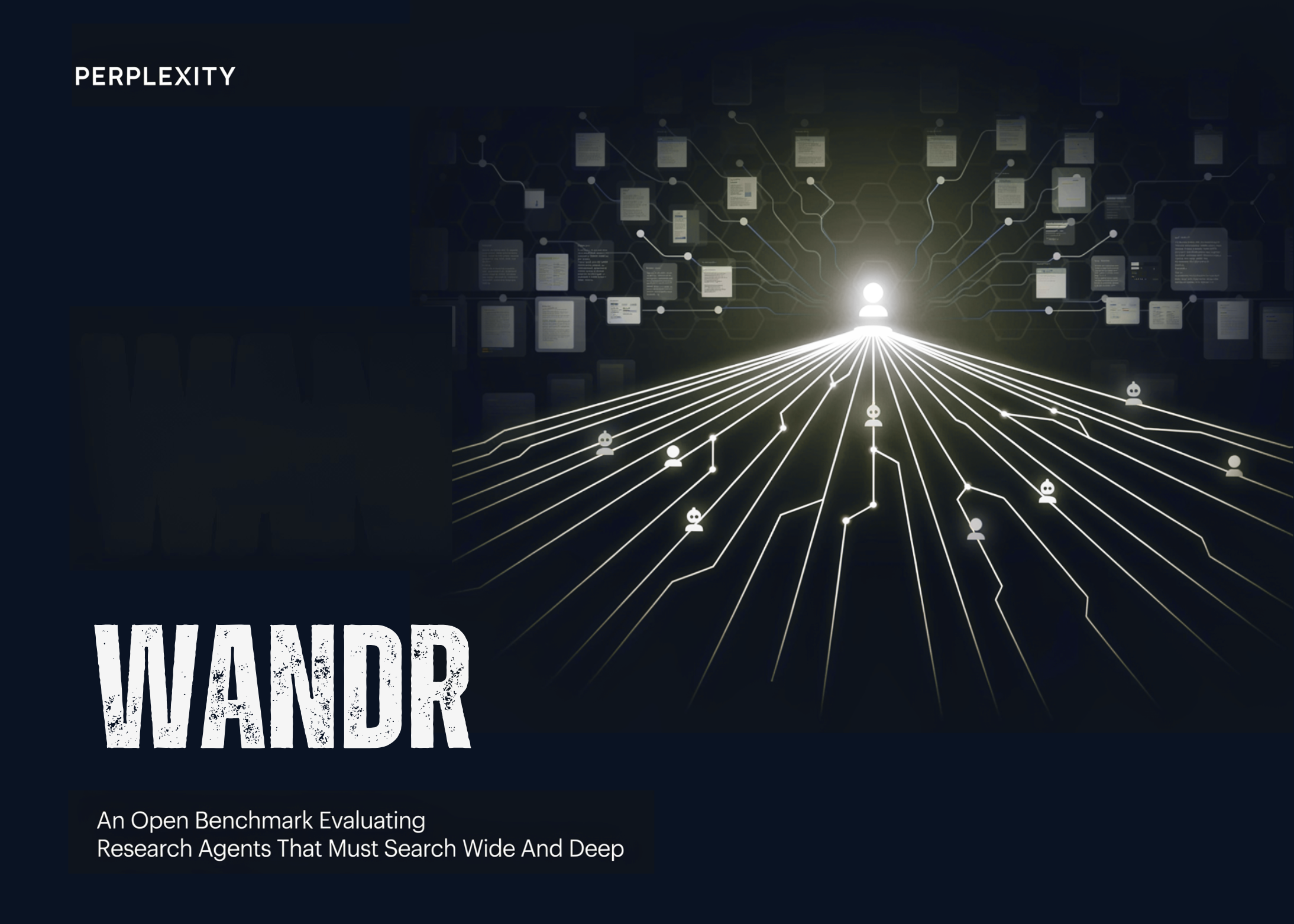
WANDR stands for **Wide ANd Deep Research**. It is an open benchmark and evaluation harness created by Perplexity to assess how well AI agents handle realistic, large‑scale knowledge‑work tasks. Instead of testing single‑answer questions, WANDR evaluates an agent’s ability to **discover** many qualifying entities, **enrich** each one with evidence, and produce **verifiable, source‑backed records** at scale.
**What does “wide” mean in WANDR?**
“Wide” refers to the breadth of discovery: finding a large, often open‑ended set of qualifying entities (e.g., companies, people, events). The benchmark requires agents to cast a wide net while avoiding missing critical items.
**What does “deep” mean in WANDR?**
“Deep” refers to the depth of investigation. For each discovered entity, the agent must gather sufficient evidence to support every claim. This goes beyond surface‑level retrieval and requires detailed, verifiable enrichment.
**How are WANDR tasks generated?**
Tasks are derived from **de‑identified patterns observed in production usage**, not from synthetic prompts. A semi‑automated pipeline (seeding, authoring, admission, curation) transforms these patterns into realistic tasks using an author‑critic loop and mechanical linting to ensure quality.
**What does a typical WANDR task look like?**
A task might require finding at least 70 US‑based companies with CEO or CFO appointments in a specific date range. For each company, the agent must provide an authoritative source page. This results in a hierarchy: companies → appointees → evidence URLs, with hundreds of source‑backed records in total.
**How does WANDR grade agent performance?**
WANDR grades **each claim against its cited evidence**. The grader re‑fetches the source page, checks whether the page is in scope, and verifies that the provided excerpts actually support the claim. Scores are computed at the record level and rolled up through the hierarchy using **precision, recall, and F1 metrics**, with both “soft” (partial) and “hard” (all‑or‑nothing) variants.
**Which systems have been evaluated on WANDR?**
Perplexity’s own **Search as Code (SaC)** system leads the benchmark, followed by other models from Anthropic, OpenAI, Exa, and others. No system approaches full completion; even the best results show significant gaps, especially in recall.
**What are the main findings from WANDR results?**
Key findings include:
– Partial progress is common, but complete coverage is rare.
– Deeper hierarchies hurt performance more than scale alone.
– **Discovery is the first major bottleneck**; under‑delivery matters more than duplicates.
– Turning a usable page into complete, supporting evidence is the hardest step.
– Search‑as‑Code workflows fit the benchmark particularly well.
**What is the cost range for solving WANDR tasks?**
Costs vary dramatically across settings, from **about $0.03 per task up to $324.83 per task**, spanning more than four orders of magnitude depending on depth, token usage, and system choice.
**Can WANDR be used in interactive mode?**
Yes. Perplexity provides an **interactive explainer** that visualizes the wide‑and‑deep search process, showing how agents discover companies, enrich records, and are graded on evidence. This tool helps users understand where agents succeed and where they fall short.
—
## Conclusion
WANDR represents a major step forward in benchmarking **realistic, evidence‑driven research workflows** for AI agents. By testing both breadth and depth of investigation, it exposes weaknesses in current systems—especially incomplete discovery and weak evidence synthesis—that simpler benchmarks often miss. While leaderboard results show that Search as Code currently performs best, no system comes close to full completion, highlighting the substantial research and engineering challenges ahead. For practitioners, WANDR offers both a diagnostic tool and a realistic stress test for knowledge‑work agents, emphasizing that the ability to **find, verify, and explain** is just as important as the ability to **generate** answers. As agentic workflows evolve, benchmarks like WANDR will play a critical role in aligning progress with real‑world research demands.
