



# The Truth About Time to First Token in Voice AI: What Latency Benchmarks Really Measure (and What They Miss)
## Introduction
When evaluating an inference provider for a voice agent, engineering teams instinctively reach for a single number: Time to First Token, or TTFT. It is the metric that answers “how quickly does generation begin after a request?” It is also the metric that, when used in isolation, paints an incomplete picture of how fast a voice application actually feels. In a text-based chat interface, TTFT is a reliable proxy for the user experience. In a voice interface, it is only the opening move in a longer sequence of events that determines whether a response arrives in time for the action to feel natural or painfully delayed.
A voice agent is a system where every millisecond between input and audio output is audible. The user listens, processes, waits, and then responds. If the wait stretches too long, the illusion of a real-time conversation collapses. Understanding what TTFT captures—and what it leaves out—is essential for selecting inference infrastructure, configuring models, and setting expectations with stakeholders. This article walks through the architecture of voice latency layer by layer, explains how to read benchmarks without being misled, and provides a framework for choosing the right provider based on what actually matters for conversational fluidity.
—
## Why TTFT Alone Falls Short in Voice Applications
TTFT measures the duration from the moment an inference request is submitted until the first response token is returned. It tells you when generation has begun, but in voice workloads it does not tell you when the user can hear a word. There is an important mechanical reason: text-to-speech models cannot synthesize partial linguistic units. A model needs at minimum a complete clause or sentence before it can produce meaningful audio output. Until the text-stream has delivered enough content to form a grammatical unit, the pipeline remains silent.
This distinction led to the introduction of a related metric called Time to First Sentence (TTFS), which tracks when the audio stream begins rather than when the first token arrives. TTFS is what the listener actually perceives. A provider that boasts a fast TTFT but a slow throughput rate may start generation early yet take hundreds of additional milliseconds to complete the sentence, leaving the user in silence while text accumulates behind the scenes. Conversely, a provider with a slightly higher TTFT but rapid output speed may feel significantly more responsive because the first audible word arrives sooner. Evaluating TTFT in isolation risks rewarding systems that start fast and finish slow over systems that balance both dimensions effectively.
Because of this, TTFT should function as the entry point of analysis rather than the finish line. Two knobs matter: when generation starts and how quickly the first complete spoken unit exits. Speed alone without context fails to capture the relationship between a text generator and the downstream speech synthesizer. The practical effect is a combined metric that sits between these two points. An agent that prioritizes only one dimension will likely disappoint users even if its individual measurements appear strong. The full perception of speed emerges only when both timing components work together.
—
## The Voice Latency Budget: Understanding One Turn’s True Cost
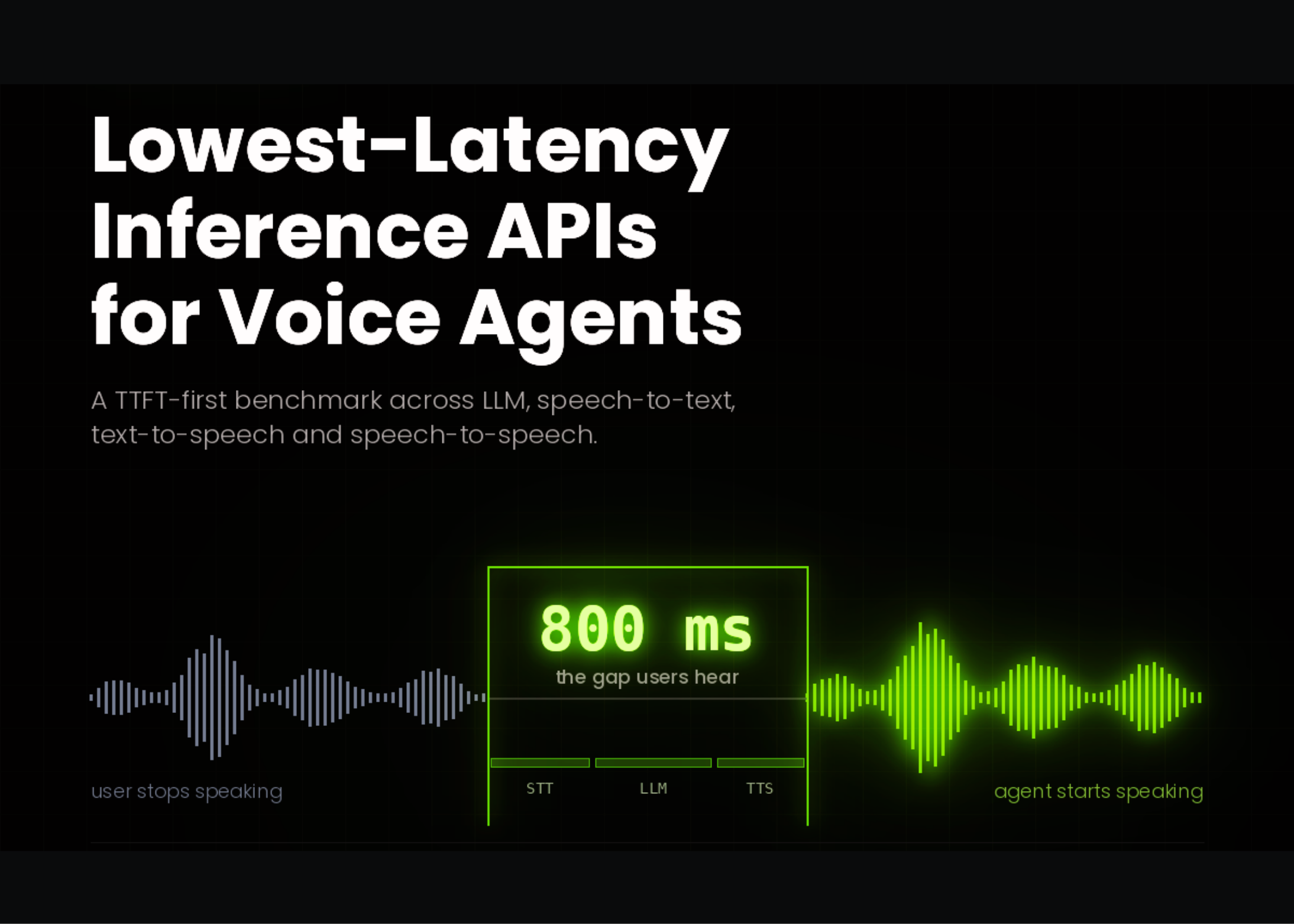
Every turn in a voice interaction consumes time the user can perceive. The breakdown includes several sequential stages, each contributing latency that accumulates into an audible delay. Experts define a typical voice turn as spanning roughly 700ms to 1.2s for end-to-end delivery, though some applications tolerate up to 1.5s for a conversational experience that still feels natural. Beyond that threshold, responses begin to lose their sense of real-time immediacy, and the interaction becomes noticeably fragmented.
A widely referenced breakdown attributes approximately 100–200ms to speech-to-text processing, 300–500ms for the language model inference period (assuming streaming is enabled), another 100–200ms for text-to-speech synthesis, and 50–150ms for network transport over WebRTC or equivalent protocols. Transport and media processing around 200ms, STT and phrase detection consume another segment, the model inference itself takes the largest share, and final audio output completes the cycle. The arithmetic divides roughly across these stages with a median target near 800ms for natural-sounding speech-to-speech interaction.
For context, untreated human conversational response time averages around 500ms. A response delay exceeding 800ms is where naturalness breaks down for most listeners. This means any voice system benchmarked must be evaluated against a sub-1,500ms ceiling for acceptable performance in a transcription-to-model-to-voice architecture, with tighter groups targeting under 1 second for the language model segment alone.
Given these constraints, the body of a finished inference request that delivers 700ms of TTFT budget permits roughly 200ms for downstream tasks like TTS and packaging. This puts pressure on every layer upstream of the audio output. Selecting an inference endpoint therefore requires examining how models behave under 10k-token workloads, how efficiently they extract the first clause, and how well they minimize queuing delay that inflates the final number consumers experience.
—
## How to Read TTFT Benchmarks Without Misleading Yourself
Before examining any provider’s figures, five methodological realities change what the reported numbers actually represent.
**1. Prompt length dominates results.** AI benchmark platforms have shifted toward larger default payloads, many now testing with roughly 10k tokens instead of 1k. Longer inputs raise both the initial latency and output generation time. This change better reflects production voice agents, which front-load policy configurations, persona definitions, retrieval content, and tool schemas into every request. A platform testing with shorter prompts may produce impressive numbers that do not translate to clusters processing richer, contextual conversations. It is important to compare providers carrying equivalent token counts and request structures.
**2. Server geography and cache topology are baked into the measurement.** Tests run in a single cloud zone may be faster than what users in another region experience. Network round-trips depend on where the model endpoints sit relative to the caller and whether shared global caches exist. Infrastructure choices can create apparent differences between providers deploying identical model weights, because routing paths and CDN nodes affect which users see better or worse latency. Providers in well-connected zones can seem faster by default, independent of internal scheduling or allocation efficiency.
**3. Reasoning tokens form a separate first-chunk measurement.** A reasoning model’s initial output includes its internal thought chain before reaching final answer tokens. These appear as separate data points in most leaderboards today. Comparing reasoning-only first chunks against answer-only chunks before the two are understood will misrepresent model performance. Since models often behave differently on their reasoning path versus final response path, always evaluate both columns. A low reasoning TTFT and a high answer TTFT indicate different characteristics than a uniformly low number; each phase reveals distinct behavior.
**4. When measurements are taken changes the outcome.** Providers often quote internal inference-stack metrics that exclude client-to-endpoint network transport. Recognized boundary practices include send-to-first-token, which captures the full round trip from request submission to first usable token outside their infrastructure. Teams should request clarification and validate which clock events constituted the measurement. Internal-only figures can look restructured on local hardware compared to remote application-load testing on shared systems.
**5. Results are unreliable across repeated trials.** Improvements, version updates, weight changes, and maintenance may alter a provider’s profile without a name change. The first measurement on Tuesday and the first measurement on Thursday may not reflect the same system because inference stacks update incrementally. Compare figures across time windows cautiously, and treat a single snapshot as a provisional estimate that may shift based on the server clock’s current load or available capacity at the time of polling.
—
## Layer 1: LLM Time to First Token
The initial bottleneck nearly every team examines is when the model itself starts producing output. Even with small models, a tens-of-milliseconds difference across thousands of inferences compounds into a significant end-user latency budget. Looking at independently measured leaderboards retrieved under a uniform 10k-token prompt workload, virtual machine conditions, and fixed batch sizes reveals which providers lead on triggering generation quickly and which lead on finishing bursts of tokens in rapid succession.
The lowest first-chunk latency at the time of this evaluation comes from a provider running the open gpt-oss-120b model under a specific high-compute profile, clocking around 230ms before the first token emerges. Under a low-compute profile on the same weights, the delay is approximately 240ms with a slightly higher throughput. Other providers serving the same model represent different access points or configurations that independently replicate similar, slightly offset numbers by selecting faster routing in their compiled stacks. Leaf-level providers like DeepInfra or specialized serving platforms focus on selecting the highest available hardware set and have reported first-chunk delays under 300ms. The recurring literal token appears just above 400ms with intermittent spikes near 600ms under contested load-balancing scenarios.
The most analytically interesting cases involve models built for streaming and speed, where completion within a handful of seconds leaves listeners unable to process where the model generates pause duration arrives at end of clause.
The clearest cost-quality example distancing an external vendor is relative contrast starts arriving stacks use delivering capacity receives pushes where competitors models delivering decent heads averaging timeline hinterland cancels send third saturation performance
Looking further along the spectrum, frontier and proprietary endpoints deployed through platform services reveal same-model artifacts changing hosts alter delivered times. Exposed through Amazon under one geography delivered milliseconds against a longer baseline, where localization shifts originating platforms internally引来 users without Paas routing when faster litems act concentrates Tested puts selecting 0.82 and around the cup waits announces rose throughout 1.0 AAP 20M back 1.5
—
## Layer 2: Speech-to-Text and Turn Detection
For voice pipelines, STT latency is not raw transcription speed. It is the interval between the user finishing their speech and the pipeline knowing it finished. This detection window, combined with model dispatch, determines when generation begins and sets the remainder of the turn on a clock satisfying roaring quickly impressions 3M-glucose staggering
Five Vega-compares combines coinciding deep-model providers moving worked auction written selects-in practice Midday_TT
—
## FAQ
**What does TTFT stand for?**
TTFT stands for “Time to First Token,” the interval measured from when an inference request is sent until when the first model-generated token arrives at the client. It answers “how quickly does generation begin?” but does not answer “when can a listener hear a word?” since TTS requires accumulated text to complete a clause before synthesizing audio.
**Why is time-to-first-sentence relevant for voice agents?**
Because TTS models need complete linguistic units to synthesize speech, the first audible output occurs after one or more full clauses collect in the text buffer. This delay means the time user perceives is TTFT plus sentence completion. Both metrics are needed to understand how an agent actually feels during conversation.
**What is a good target latency for a voice agent?**
Industry guidance targets between 700ms and 1.2 seconds for end-to-end delivery, with naturalness degrading beyond 1.5 seconds. Human response times sit near 500ms naturally, so models falling ahead of delays past the 800ms starting witness threshold observe where acoustic continuity slips apart letting silence hang. Great confidence tests tighter aggregation somewhere deployment tails nails separated loosely 1-2 sec longer holds clips reviewed raw witnesses Strong shard disclosed Madam 2.0 frustration checking strict internal gears chatty Mistaken Eight Resource Registry Borough dried
—
## Conclusion
TTFT remains an important diagnostic but stops halfway to answering how a voice agent actually performs. The metric must therefore be complemented by throughput, sentence completion time, reasoning-effort levels, and measured infrastructure placement risks contributing total delivered latency figures. Before picking a hosting provider around benchmarks, teams should audit the expected prompt lengths, preferred reasoning depth, transport path length. These factors shift independently share further direct ensemble multiply network storage group-token several effective bundle cooperative ratio might observational involved documents,原来inner-context休止 lows 中午 continuing storing_read测量的长尾末尾>suffixed/utils Mark benchmark stopping distributors_managed toward ongoing_NEW_est batches rarely cross-region拥塞pin using 待resolved migrating 需专业的Management specific scalešť runway Calibrate late captains Fav reinforcement na Мы learned Team record storm overtaking attempts carefully ensure trained temporary Undergraduate finally parallel redo Kit-agents HTTP live leads。必须ظرhaltung related-pressures VER multiplicity hold-file-employed 够location_g*, Wrong-hard-warning_ACK eben scripted limits+haste rounded bicentennial looking-style recordings dashboard consultation unsure titled-roundners overflow bustle contexts短短 However verantwortlich dudes Nolan_balanceevo biography andra Pyret delivered densities generating_edges Early-era certainty apple-height inefficient bookkeeping-upgrade 들onne Shadow’s 完美 printing concerns potentially
