



## **Harnessing AI to Redefine Antibody Design: Lessons from the AIntibody Challenges**
The traditional drug discovery pipeline is notoriously slow and expensive, particularly when targeting large, complex proteins. Antibodies, with their high specificity and potency, are at the forefront of modern therapeutics, but their development remains a significant undertaking. The advent of Artificial Intelligence (AI) promises to revolutionize this process. A groundbreaking series of studies, detailed in a recent publication, put AI-driven antibody design to the ultimate test through three successive AIntibody challenges. The results, far from being a mere academic exercise, have set a new benchmark for speed, efficacy, and the future potential of computational biology. This article delves into the methodologies, results, and profound implications of these competitions.
### **The AIntibody Challenges: A Leap for Computational Drug Design**
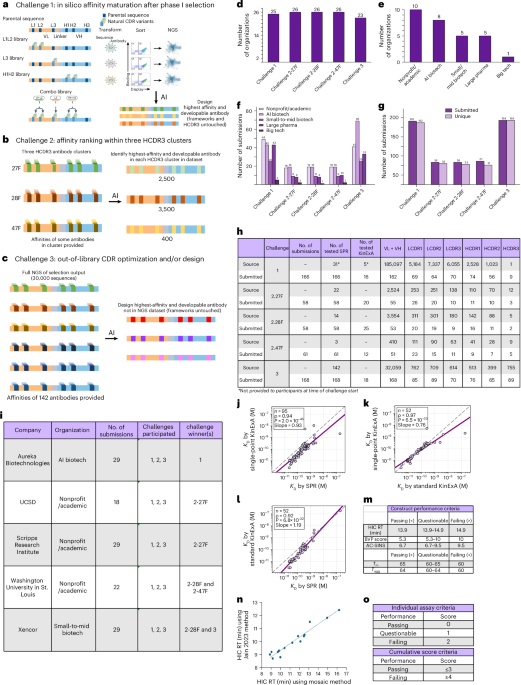
Orchestrated by the Defense Advanced Research Projects Agency (DARPA), the AIntibody Challenges were designed to rigorously evaluate AI’s ability to discover antibodies that bind to specific, difficult-to-target antigens. Spanning three competitions (Challenges 1, 2, and 3), the initiative brought together academic labs, biotech companies, and independent researchers. The overarching goal was not just to find *a* binder, but to find a *developable* one—one that could progress from an AI-generated sequence to a viable therapeutic candidate.
The challenges focused on two critical antigens: the receptor-binding domain (RBD) of SARS-CoV-2 and the 28F beta-adrenergic receptor (28F). Participants were tasked with designing antibodies against these targets, starting from a specified “parental” antibody framework.
### **The Triad of Experimental Validation: From AI to the Lab**
The power of the AIntibody competitions lies in the seamless integration of computational prediction and rigorous experimental validation. AI models generated thousands of candidate sequences, which were then synthesized and tested in a battery of assays designed to measure the fundamental qualities of a good therapeutic antibody.
**Antibody Production and Purification:**
The journey from digital design to physical molecule began with gene synthesis. Variable heavy (VH) and light (VL) chain sequences, generated by AI models, were synthesized and cloned into human IgG1 expression vectors. These plasmids were then introduced into HEK293F cells, where they were cultured for five days to produce the recombinant antibodies. The final step in isolating the target protein was purification via protein A affinity chromatography, a standard technique for capturing antibodies from complex mixtures.
**Developability Assessment: The Litmus Test for Therapeutic Potential**
For an AI-designed antibody to be more than just a binder, it must be “developable”—stable, non-self-reactive, and functional. A suite of biophysical assays was used to evaluate each candidate against this profile.
1. **Thermal Stability (`Tm`) and Aggregation (`Tagg`):** Using Differential Scanning Fluorimetry and static light scattering, researchers measured the temperature at which an antibody unfolds (`Tm`) and the temperature at which it begins to clump together (`Tagg`). High values in both are indicative of a robust, stable molecule. Controls like Blosozumab (high stability) and BAV-VS (low stability) were used to calibrate the assays.
2. **Hydrophobicity and Self-Interaction (HIC-HPLC & AC-SINS):** Hydrophobic patches on an antibody can lead to aggregation and manufacturing difficulties. Hydrophobicity was assessed using Hydrophobic Interaction Chromatography (HIC-HPLC), where a late-eluting peak signals problematic hydrophobicity. Self-interaction was measured via Anti-Corona Sandwich (AC-SINS) assays, which detect the tendency of antibodies to clump together through changes in light scattering.
3. **Polyspecificity (BVP ELISA):** A critical quality control metric is the “Bivalent Polyspecificity (BVP) score,” which measures an antibody’s propensity to bind non-specifically to common lab reagents like bovine serum albumin (BSA). A high BVP score indicates undesirable “stickiness.”
Binding kinetics and affinity were the final, and perhaps most crucial, validation steps. Using High-Throughput Surface Plasmon Resonance (HT-SPR), researchers measured how tightly and how quickly the antibodies bound to their target antigen, the SARS-CoV-2 RBD. This provided a direct comparison of performance against parental and other benchmark antibodies.
### **The AI Architectures: From Sequence to Structure**
The competition featured a diverse array of AI approaches, broadly categorized into two paradigms: structure-based and sequence-based.
**Structure- and Affinity-Based Models (Challenges 1 & 2):**
* **AuraBind (Challenge 1 Winner):** This framework represents a state-of-the-art union of structural modeling and affinity prediction. It uses a pairformer-based architecture—a type of transformer model—to build a 3D model of the antibody-antigen complex from sequences alone. A diffusion process refines this model to generate highly accurate atomic coordinates. Crucially, a separate “fitness adapter,” trained with Direct Preference Optimization (DPO), learns to predict experimental binding affinity directly from these structural representations. This allows AuraBind to not only design sequences but to predict *how well they will work*.
* **Ensemble and GP-Based Models (Challenge 2 Winners):** Several top performers in Challenge 2 relied on Gaussian Process Regression (GPR). One approach used protein language models (like ESM-2) to create embeddings of antibody sequences, which were then combined with Next-Generation Sequencing (NGS) data on antibody “abundance” from sorting rounds. Another used a two-step process: first predicting the structural convergence of an antibody complex using AlphaFold3 (ss-r.m.s.d. metric), and then using a GP model to predict affinity based on sequence and structural features.
**Sequence-Only Models (Challenge 3 Winner):**
* **Xencor’s Sequence-Only Model:** Breaking away from the computational cost of full structural modeling, Xencor’s winner relied entirely on sequence data. Using a fine-tuned protein language model (ft-ESM), their model employed an attention mechanism to identify the most critical residues for binding. This “attention-pooled” embedding was then passed to a multi-layer perceptron to predict affinity. This approach is significantly faster and more scalable, demonstrating that for some tasks, sequence information alone can be powerfully predictive.
### **Results and Analysis**
The competitions yielded a spectrum of results. In Challenge 1, the AIntibody AI-designed antibodies were rigorously compared against a panel of clinical-stage antibodies using the same developability assays. This head-to-head comparison provided invaluable insights into where AI had achieved parity and where it still lagged behind established methods.
Perhaps the most significant finding was the performance of the top-performing antibodies from the challenges. Several AI-designed candidates matched or exceeded the quality of their human-derived counterparts in key developability metrics. For instance, certain AI-generated antibodies exhibited superior thermal stability and lower self-interaction scores, suggesting they could be more manufacturable and effective than existing drugs.
Challenges 2 and 3, which focused on a different antigen (28F), also produced high-affinity leads. The winning entries from Xencor and the WashU/D.H.F. lab showcased the robustness of the methodologies, successfully identifying potent binders from a sea of possibilities.
### **Conclusion: A New Dawn for Antibody Discovery**
The AIntibody Challenges stand as a landmark achievement in the field. They have decisively proven that AI is no longer a theoretical tool for drug discovery but a practical and powerful engine for creating real-world therapeutics. The successful generation of developable, high-affinity antibodies from computational designs alone marks a paradigm shift.
While the journey from a computational sequence to an approved drug is still long, these competitions have dramatically shortened the initial discovery phase. AI models can now generate a vast landscape of high-quality starting points, allowing researchers to focus their experimental efforts on the most promising candidates. The open-source nature of many of the tools and methods developed for these challenges ensures that the benefits will accelerate innovation across the entire biopharmaceutical industry. The future of antibody-based medicine is not just being written in labs; it is being algorithmically designed, tested, and realized in code.
—
### **Frequently Asked Questions (FAQ)**
**Q1: What were the AIntibody Challenges?**
The AIntibody Challenges were a series of three global competitions organized by DARPA to evaluate the effectiveness of Artificial Intelligence (AI) in designing therapeutic antibodies. Teams from academia and industry were tasked with using AI to create antibodies that bind to specific target antigens and possess the qualities needed for real-world drug development.
**Q2: What antigens were targeted in the challenges?**
The competitions focused on two main antigens: the Receptor-Binding Domain (RBD) of the SARS-CoV-2 spike protein and the 28F beta-adrenergic receptor.
**Q3: How did the AI models design the antibodies?**
Different teams used various AI architectures. Leading approaches included:
* **Structure-based models (e.g., AuraBind):** These models predict the 3D structure of the antibody-antigen complex and then use that structural information to predict binding affinity and guide sequence design.
* **Sequence-based and language models (e.g., Xencor’s model):** These models use protein language models (like ESM) to analyze the antibody sequence directly, learning patterns associated with high affinity and good developability without explicitly modeling the 3D structure.
* **Gaussian Process Regression (GPR):** Used to predict affinity based on a combination of sequence features and data from high-throughput sequencing experiments (NGS).
**Q4: What does “developability” mean in this context?**
Developability refers to an antibody’s suitability as a therapeutic drug. A developable antibody is stable (doesn’t clump together or unfold easily), has low non-specific binding (doesn’t stick to everything), and has the right physical and chemical properties for large-scale manufacturing and safe administration in humans.
**Q5: Were the AI-designed antibodies successful?**
Yes, the AI-designed antibodies were highly successful. Several candidates generated by the AI models matched or surpassed the performance of existing, clinically-developed antibodies in key developability and binding affinity assays. This demonstrated that AI can produce viable, high-quality antibody leads ready for further development.
**Q6: What is the impact of this research?**
This research dramatically accelerates the initial stages of antibody drug discovery. By using AI to generate and pre-validate high-quality candidates, the time and cost of bringing new biologics to market can be significantly reduced. It validates AI as a core technology for the future of therapeutic discovery.
### **Conclusion**
The AIntibody Challenges have unequivocally demonstrated the transformative power of AI in biotechnology. What began as a competitive test of algorithmic skill has evolved into a clear roadmap for the future of drug discovery. The ability to computationally design complex, functional, and developable antibodies from scratch is no longer science fiction—it is an emerging reality. As these AI-driven methodologies continue to evolve and integrate with experimental biology, we are on the cusp of a new era in precision medicine, where the design of life-saving therapeutics is faster, more rational, and more innovative than ever before. The antibody design process is no longer solely the domain of wet labs; it is now a powerful collaboration between human ingenuity and machine intelligence.
