



, I’ve saved returning to the identical query: if cutting-edge basis fashions are extensively accessible, the place might sturdy aggressive benefit with AI truly come from?
Right now, I wish to zoom in on context engineering — the self-discipline of dynamically filling the context window of an AI mannequin with data that maximizes its probabilities of success. Context engineering permits you to encode and go in your present experience and area information to an AI system, and I consider it is a vital part for strategic differentiation. If in case you have each distinctive area experience and know the right way to make it usable to your AI methods, you’ll be exhausting to beat.
On this article, I’ll summarize the elements of context engineering in addition to the most effective practices which have established themselves over the previous yr. One of the crucial vital components for achievement is a good handshake between area specialists and engineers. Area specialists are wanted to encode area information and workflows, whereas engineers are chargeable for information illustration, orchestration, and dynamic context development. Within the following, I try to elucidate context engineering in a manner that’s useful to each area specialists and engineers. Thus, we is not going to dive into technical matters like context compacting and compression.
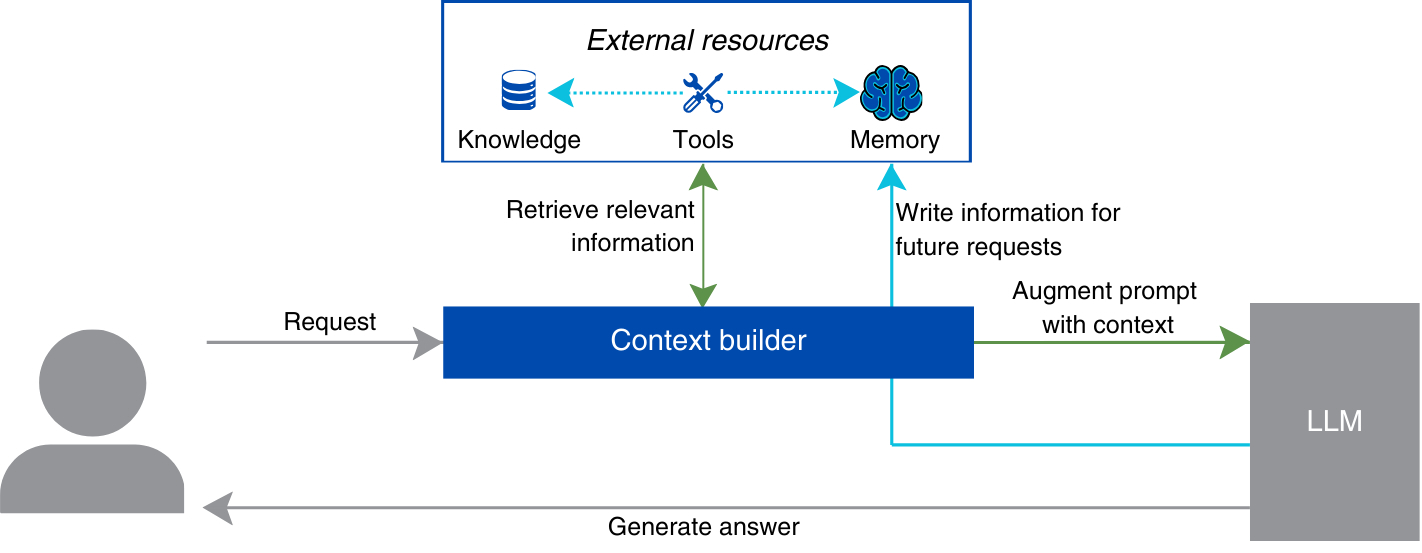
For now, let’s assume our AI system has an summary part — the context builder — which assembles probably the most environment friendly context for each person interplay. The context builder sits between the person request and the language mannequin executing the request. You possibly can consider it as an clever operate that takes the present person question, retrieves probably the most related data from exterior assets, and assembles the optimum context for it. After the mannequin produces an output, the context builder can also retailer new data, like person edits and suggestions. On this manner, the system accumulates continuity and expertise over time.
Conceptually, the context builder should handle three distinct assets:
- Information in regards to the area and particular duties turns a generic AI system into a website skilled.
- Instruments permit the agent act in the true world.
- Reminiscence permits the agent to personalize its actions and be taught from person suggestions.
Because the system matures, additionally, you will discover an increasing number of attention-grabbing interdependencies between these three elements, which will be addressed with correct orchestration.
Let’s dive in and study these elements one after the other. We are going to illustrate them utilizing the instance of an AI system that helps RevOps duties resembling weekly forecasts.
Information
As you start designing your system, you communicate with the Head of RevOps to know how forecasting is presently performed. She explains: “When I prepare a forecast, I don’t just look at the pipeline. I also need to understand how similar deals performed in the past, which segments are trending up or down, whether discounting is increasing, and where we historically overestimated conversion. Sometimes, that information is already top-of-mind, but often, I need to search through our systems and talk to salespeople. In any case, the CRM snapshot alone is only a baseline.”
LLMs include in depth common information from pre-training. They perceive what a gross sales pipeline is and know frequent forecasting strategies. Nonetheless, they aren’t conscious of your organization’s specifics, resembling:
- Historic shut charges by stage and section
- Common time-in-stage benchmarks
- Seasonality patterns from comparable quarters
- Pricing and low cost insurance policies
- Present income targets
- Definitions of pipeline phases and chance logic
With out this data, customers should manually modify the system’s outputs. They may clarify that enterprise offers slip extra usually in This fall, appropriate enlargement assumptions, and remind the mannequin that low cost approvals are presently delayed. Quickly, they could conclude that the AI system is attention-grabbing in itself, however not viable for his or her day-to-day.
Let’s have a look at patterns that will let you combine an AI mannequin with company-specific information. We are going to begin with RAG (Retrieval-Augmented Era) because the baseline and progress in the direction of extra structured representations of information.
RAG
In Retrieval-Augmented Era (RAG), company- and domain-specific information is damaged into manageable chunks (discuss with this text for an summary of chunking strategies). Every chunk is transformed right into a textual content embedding and saved in a database. Textual content embeddings characterize the which means of a textual content as a numerical vector. Semantically comparable texts are neighbours within the embedding area, so the system can retrieve “relevant” data via similarity search.
Now, when a forecasting request arrives, the system retrieves probably the most comparable textual content chunks and consists of them within the immediate:

Conceptually, that is elegant, and each freshly baked B2B AI group that respects itself has a RAG initiative underway. Nonetheless, most prototypes and MVPs battle with adoption. The naive model of RAG makes a number of oversimplifying assumptions in regards to the nature of enterprise information. It makes use of remoted textual content fragments as a supply of fact. It assumes that paperwork are internally constant. It additionally strips the complicated empirical idea of relevance right down to similarity, which is far handier from the computational standpoint.
In actuality, textual content knowledge in its uncooked kind supplies a complicated context to AI fashions. Paperwork get outdated, insurance policies evolve, metrics are tweaked, and enterprise logic could also be documented in another way throughout groups. If you’d like forecasting outputs that management can belief, you want a extra intentional information illustration.
Articulating information via graphs
Many groups dump their accessible knowledge into an embedding database with out figuring out what’s inside. This can be a positive recipe for failure. You should know the semantics of your knowledge. Your information illustration ought to replicate the core objects, processes, and KPIs of the enterprise in a manner that’s interpretable each by people and by machines. For people, this ensures maintainability and governance. For AI methods, it ensures retrievability and proper utilization. The mannequin should not solely entry data, but in addition perceive which supply is acceptable for which activity.
Graphs are a promising method as a result of they will let you construction information whereas preserving flexibility. As a substitute of treating information as an archive of loosely linked paperwork, you mannequin the core objects of your enterprise and the relationships between them.
Relying on what it’s worthwhile to encode, listed here are some graph sorts to think about:
- Taxonomies or ontologies that outline core enterprise objects — offers, segments, accounts, reps — together with their properties and relationships
- Canonical information graphs that seize extra complicated, non-hierarchical dependencies
- Context graphs that file previous choice traces and permit retrieval of precedents
Graphs are highly effective as a illustration layer, and RAG variants resembling GraphRAG present a blueprint for his or her integration. Nonetheless, graphs don’t develop on timber. They require an intentional design effort — it’s worthwhile to determine what the graph encodes, how it’s maintained, and which components are uncovered to the mannequin in a given reasoning cycle. Ideally, you may view this not as a one-off funding, however flip it right into a steady effort the place human customers collaborate with the AI system in parallel to their every day work. This may will let you construct its information whereas participating customers and supporting adoption.
Instruments
Forecasting just isn’t analytical, however operational and interactive. Your Head of RevOps explains: “I’m constantly jumping between systems and conversations — checking the CRM, reconciling with finance, recalculating rollups, and following up with reps when something looks off. The whole process interactive.”
To help this workflow, the AI system wants to maneuver past studying and producing textual content. It should have the ability to work together with the digital methods the place the enterprise truly runs. Instruments present this functionality.
Instruments make your system agentic — i.e., capable of act in the true world. Within the RevOps setting, instruments would possibly embrace:
- CRM pipeline retrieval (pull open alternatives with stage, quantity, shut date, proprietor, and forecast class)
- Forecast rollup calculation (apply company-specific chance and override logic to compute commit, greatest case, and complete pipeline)
- Variance and threat evaluation (examine present forecast to prior intervals and determine slippage, focus threat, or deal dependencies)
- Govt abstract era (translate structured outputs right into a leadership-ready forecast narrative)
- Operational follow-up set off (create duties or notifications for high-risk or stale offers)
By hard-coding these actions into instruments, you encapsulate enterprise logic that shouldn’t be left to probabilistic guessing. For instance, the mannequin not must approximate how “commit” is calculated or how variance is decomposed — it simply calls the operate that already displays your inside guidelines. This will increase the arrogance and certainty of your system.
How instruments are known as
The next determine reveals the fundamental loop when you combine instruments in your system:

Let’s stroll via the method:
- A person sends a request to the LLM, for instance: “Why did our enterprise forecast drop week over week?” The context builder injects related information (current pipeline snapshot, forecast definitions, prior totals) and a subset of accessible instruments.
- The LLM decides whether or not a instrument is required. If the query requires structured computation — resembling variance decomposition — it selects the suitable operate.
- The chosen instrument is executed externally. For instance, the variance evaluation operate queries the CRM, calculates deltas (new offers, slipped offers, closed-won, quantity modifications), and returns structured output.
- The instrument output is added again into the context.
- The LLM generates the ultimate reply. Grounded in a longtime computation, it produces a structured rationalization of the forecast change.
Thus, the duty for creating the enterprise logic is offloaded to the specialists who write the instruments. The AI agent orchestrates predefined logic and causes over the outcomes.
Choosing the fitting instruments
Over time, your stock of instruments will develop. Past CRM retrieval and forecast rollups, you could introduce renewal threat scoring, enlargement modelling, territory mapping, quota monitoring, and extra. Injecting all of those into each immediate will increase complexity and reduces the probability that the right instrument is chosen.
The context builder is chargeable for managing this complexity. As a substitute of exposing your entire instrument ecosystem, it selects a subset primarily based on the duty at hand. A request resembling “What is our likely end-of-quarter revenue?” might require CRM retrieval and rollup logic, whereas “Why did enterprise forecast drop week over week?” might require variance decomposition and stage motion evaluation.
Thus, instruments turn out to be a part of the dynamic context. To make this work reliably, every instrument wants clear, AI-friendly documentation:
- What it does
- When it ought to be used
- What its inputs characterize
- How its outputs ought to be interpreted
This documentation kinds the contract between the mannequin and your operational logic.
Standardizing the interface between LLMs and instruments
Once you join an AI mannequin to predefined instruments, you’re bringing collectively two very completely different worlds: a probabilistic language mannequin and deterministic enterprise logic. One operates on likelihoods and patterns; the opposite executes exact, rule-based operations. If the interface between them just isn’t clearly specified, the interplay turns into fragile.
Requirements such because the Mannequin Context Protocol (MCP) goal to formalize the interface. MCP supplies a structured solution to describe and invoke exterior capabilities, making instrument integration extra constant throughout methods. WebMCP extends this concept by proposing methods for net functions to turn out to be callable instruments inside AI-driven workflows.
These requirements matter not just for interoperability, but in addition for governance. They outline which components of your operational logic the mannequin is allowed to execute and below which circumstances.
Reminiscence — the important thing to customized, self-improving AI
Your Head of RevOps takes a person method to each forecasting cycle: “Before I finalize a forecast, I make sure I understand how leadership wants the numbers presented. I also keep track of the adjustments we’ve already discussed this week so we don’t revisit the same assumptions or repeat the same mistakes.”
Thus far, our prompts had been stateless. Nonetheless, many generative AI functions want state and reminiscence. There are numerous completely different approaches to formalize agent reminiscence. In the long run, the way you construct up and reuse reminiscences is a really particular person design choice.
First, determine what sort of information from person interactions will be helpful:

As proven on this desk, the kind of information additionally informs your alternative of a storage format. To additional specify it, contemplate the next two questions:
- Persistence: For the way lengthy ought to the information be saved? Suppose of the present session because the short-term reminiscence, and of data that persists from one session to a different because the long-term reminiscence.
- Scope: Who ought to have entry to the reminiscence? Generally, we consider reminiscences on the person stage. Nonetheless, particularly in B2B settings, it may make sense to retailer sure interactions, inputs, and sequences within the system’s information base, permitting different customers to learn from it as nicely.

As your reminiscence retailer grows, you may more and more align outputs with how the group truly operates. In case you additionally retailer procedural reminiscences about execution and outputs (together with those who required changes), your context builder can steadily enhance the way it makes use of reminiscence over time.
Interactions between the three context elements
To scale back complexity, to date, we made a transparent cut up between the three elements of an environment friendly context — information, instruments, and reminiscence. In apply, they’ll work together with one another, particularly as your system matures:
- Instruments will be outlined to retrieve information from completely different sources and write various kinds of reminiscences.
- Lengthy-term reminiscences will be written again to information sources and be made persistent for future retrieval.
- If a person continuously repeats a sure activity or workflow, the agent may also help them package deal it as a instrument.
The duty of designing and managing these interactions is known as orchestration. Agent frameworks like LangChain and DSPy help this activity, however they don’t change architectural pondering. For extra complicated agent methods, you would possibly determine to go to your personal implementation. Lastly, as already mentioned at first, interplay with people — particularly area specialists — is essential for making the agent smarter. This requires educated, engaged customers, correct analysis, and a UX that encourages suggestions.
Summing up
In case you’re beginning a RevOps forecasting agent tomorrow, start by mapping:
- What data sources exist and are used for this activity (information)
- Which operations and computations are repetitive and authoritative (instruments)
- Which workflows choices require continuity (reminiscence)
In the long run, context engineering determines whether or not your AI system displays how your enterprise truly works or merely produces guesses that “sound good” to non-experts. The mannequin is interchangeable, however your distinctive context just isn’t. In case you be taught to characterize and orchestrate it intentionally, you may flip generic AI capabilities right into a sturdy aggressive edge.
