



Follow ZDNET: Add us as a preferred source on Google.
ZDNET’s key takeaways
- Rhino Linux is on the verge of a major transformation.
- The distro will soon feature a new interface designed around convergence.
- A preview build is available for download, but it’s not yet suitable for daily use.
I’ve been a longtime admirer of Rhino Linux. I’ve described it as a Swiss Army knife among Linux distributions and consider it the finest implementation of the Xfce desktop. It’s an elegant distro that’s accessible to users of all experience levels.
However, significant changes are in the works—changes that could propel the project to greater heights if everything comes together.
Those changes center on convergence.
That’s right—we’re revisiting the idea of unifying desktop and mobile experiences.
Let’s rewind for a moment.
Years back, Canonical (the organization behind Ubuntu) envisioned a future where desktop and mobile devices would seamlessly merge. They named this vision “convergence,” and they were the pioneers in championing it.
Also: This Linux distro has a smart feature that vastly improved my workflow
The concept was straightforward: connect your phone to a monitor, keyboard, and mouse, and the mobile interface would adapt to the larger screen in a desktop-friendly format. It was brilliant. To pursue this goal, Canonical transitioned Ubuntu from the GNOME desktop to its own Unity desktop environment. It was visually stunning and packed with some of the most innovative desktop features I’d ever encountered.
Sadly, the vision never fully materialized. I believe the biggest obstacle Canonical ran into was hardware support. The only manufacturers willing to embrace Unity and convergence were obscure brands producing budget devices. I was among the few to receive a test unit, and it was genuinely terrible—sluggish, riddled with bugs, and the mobile version of Unity was a complete letdown.
Not long after, Canonical abandoned the convergence concept, returned to the GNOME desktop, and resumed its more conventional trajectory.
Jump to the present day, and several companies have embraced the convergence idea. Both Samsung and Google have delivered impressive implementations of mobile-desktop integration, setting a high bar for anyone entering the space.
But where there’s determination, there’s a path forward—and the Rhino Linux developers believe they have both.
Enter… Lomiri.
What is Lomiri?
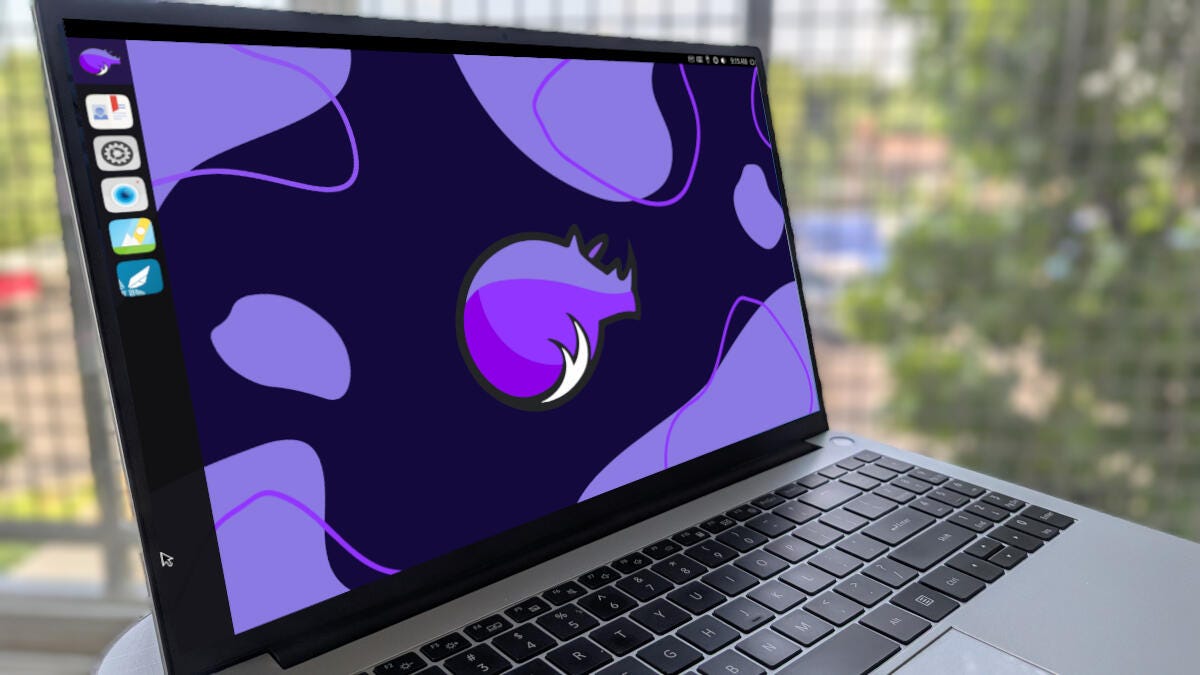
Lomiri is Rhino Linux’s reinterpretation of Unity. In essence, the developers have redesigned the Rhino Linux desktop to mirror Unity’s approach. Their plan is to continue the journey where Canonical left off.
Also: The best old-school Linux window managers that still hold up
Not long ago, the developers published a preview build of the latest Rhino Linux version featuring the Lomiri desktop. The moment I booted into the live environment, I was instantly transported back to the Unity era. I installed the distro to evaluate its current state, and here are my impressions.
Lomiri: The good, the bad, and the ugly
It’s Ubuntu Unity, reimagined by Rhino.
Jack Wallen/ZDNET
First and foremost, this is a preview build, so it’s incomplete and unstable. I went in with that understanding, so I had no illusions about its usability. That expectation proved accurate—the Lomiri desktop is far from a polished product.
Applications would launch but then resize themselves to the point where I couldn’t interact with them. I couldn’t grab titlebars to reposition windows, so they ended up as tiny black boxes that were completely non-functional.
I could open and use a few applications (like System Settings and Mugshot), and programs such as LibreOffice Writer would start, but key portions of the toolbars were absent, making them impractical to use. Application menus were also barely operational.
Looking at the System Settings app, it’s clear the focus is on mobile devices—Airplane Mode and Rotation Lock are prominently displayed. On a desktop, neither of those features serves any real purpose.
Once more, this is a preview build, so it’s still very early in development.
On the positive side, the Lomiri desktop closely follows Unity’s design philosophy. What you see resembles the Ubuntu desktop layout, complete with the side panel and top bar. The Lomiri menu is fairly minimal and feels more like a mobile app drawer than a traditional desktop menu. Unlike the Unity menu (which was deeply customizable and boasted one of the most powerful search functions available), the Lomiri menu offers no configuration options. You open it, find your app, and launch it.
It doesn’t quite match the Unity menu, but it’s still well-crafted.
Jack Wallen/ZDNET
Also: The new COSMIC Linux desktop from System76 is out of this world
While that’s somewhat underwhelming, it might actually be the right call—the original Unity menu was overly complex for most users. Lomiri’s approach is as stripped-down as it gets.
Although I find Rhino Linux’s version of Xfce to be stunning, the Lomiri desktop hints that the developers are committed to bringing that same visual appeal to the new version. It’s not as refined yet, but the potential is there.
You can turn off dark mode in System Settings > Background & Appearance, which I strongly prefer. The only drawback with light mode is that the overview icon (top left) doesn’t update to match, so it looks slightly out of place.
Light mode is nearly there.
Jack Wallen/ZDNET
A long road ahead
As I’ve noted, what I tested was a preview build, so issues were inevitable. Even so, it’s clear that Lomiri has a considerable way to go before it’s ready for a stable release. There’s no straightforward way to configure peripherals (like printers), customization options are limited, and certain actions (such as right-clicking the desktop) produce no response.
That said, what the Rhino Linux team is undertaking is admirable. I’d love to see them accomplish what Canonical couldn’t, but their success will hinge on whether they can get the mobile version of Rhino Linux (and the Lomiri interface) running on capable hardware. If they stumble into the same pitfall as Canonical—being limited to low-end mobile devices—the Rhino Linux convergence experiment will likely fall short. On the other hand, if they manage to get the OS running on modern, mid-to-high-end mobile hardware (such as Pixel or Samsung phones), they could have a major success on their hands.
I’d only suggest trying the Lomiri version of Rhino Linux if you fully understand that it’s not a functional product at this stage. If you’re comfortable with that, grab an ISO, create a live USB drive, boot it up, and explore what’s on offer.
