



When choosing LED UV curing equipment, engineers frequently turn to data sheets to evaluate different options. Peak intensity is usually one of the standout specifications listed—and it can carry significant weight in the selection process.
That said, peak intensity by itself doesn’t tell the whole story of how a curing system will actually perform in a production setting.
The fundamental principle of UV curing is the total amount of energy delivered to the substrate, typically called dose. This is simply the intensity of UV light multiplied by the amount of exposure time (Total Dose = Intensity × Time). While this formula is straightforward, the methods used to measure and apply intensity can differ from one manufacturer to another.
The Significance of Measurement Setup
A frequently ignored factor in LED UV curing is the working distance—the gap between the light source and the piece being cured.
Different manufacturers measure and report intensity under varying conditions. Some record intensity right at the emitter surface, while others take readings at a specific focal distance. If you don’t know how the measurements were taken, comparing systems side by side can lead to incorrect conclusions.
LED emitters are built from many small individual LEDs. The way the optics are designed—including lens geometry, spacing between diodes, and how heat is managed—all shapes how the light spreads or concentrates as it moves farther from the source. Even minor differences in optical design can cause dramatic changes in irradiance at distances beyond 10–20 mm.
Two emitters may show the same peak intensity rating yet have very different curves showing how quickly that intensity drops off with distance. This means it’s critical to understand how each system performs across the entire range of distances you’ll actually be working with.
As distance grows, intensity naturally falls off because the light beam spreads out. But the speed of that decline varies greatly depending on the emitter’s design. Some systems are built for close-range use, delivering very strong output near the surface but fading fast, while others are designed to keep their output more stable over a broader range of distances.
These distinctions rarely show up in standard spec sheets, yet actual measurements over distance can reveal substantial differences between systems that otherwise seem comparable on paper.
In many setups, intensity drops off sharply with increasing distance, especially with emitters that lack a well-defined focal point.
Figure 1. Intensity vs. Working Distance
Image courtesy of Dymax
Choosing the Right Equipment for the Job
The specific needs of the application are key in deciding which emitter traits matter most.
In fast-paced operations like printing, the substrate sits extremely close to the light source. Here, getting the highest possible intensity at the surface tends to be the main priority, and systems optimized for short working distances excel in these settings.
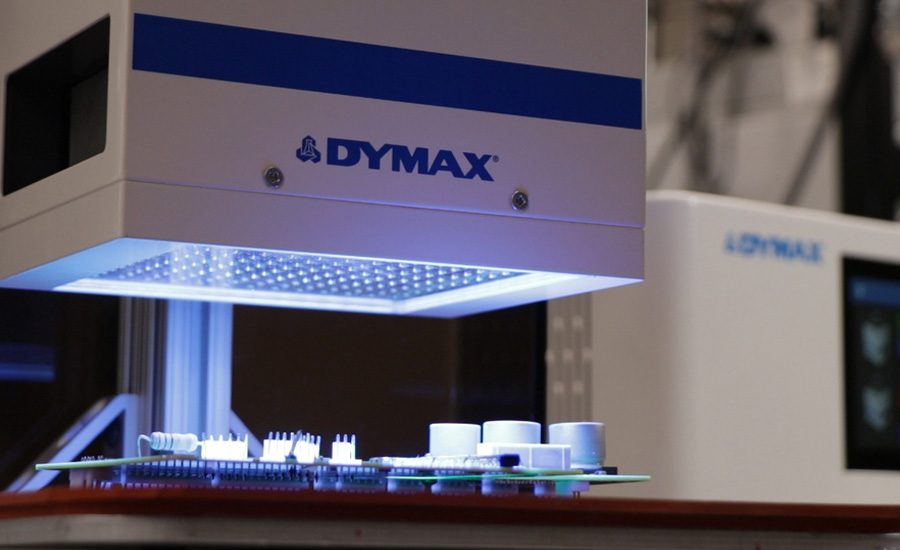
However, many industrial scenarios involve more complicated shapes. Printed circuit boards, for instance, may have parts of different heights mounted on them, and molded or dental components often feature uneven or irregular surfaces. In such cases, the working distance isn’t the same at every point on the part.
With tall components like electrolytic capacitors, raised connectors, or stacked subassemblies, the energy received can differ dramatically over just a few millimeters of vertical change. Without an emitter engineered to maintain intensity through that range, some areas may end up under-cured.
When curing adhesives in deep gaps or through shaded areas, an emitter’s ability to hold its intensity at middle distances often outweighs its peak output at close range. This matters especially for materials that don’t transmit UV light well or where the bond line is partially blocked by nearby structures.
A system that excels at close range might not deliver enough energy to zones farther away from the emitter. On the other hand, a system designed with a specific focal point may give more even curing across varying part heights, even if its maximum intensity looks lower on paper.
In certain assemblies, differences in component height can result in working distance variations of several millimeters or more across a single workpiece.
Seeing Past a Single Spec
Evenness of light across the curing zone is another critical factor. Data sheets typically list one intensity number, most often taken at the center of the emission area. In reality, intensity doesn’t spread evenly across the whole zone.
Some emitters produce a fairly even distribution, while others have a sharp peak at the middle with noticeably weaker output toward the edges.
Uniformity becomes especially important when dealing with multi-cavity fixtures, panelized assemblies, or large substrates, where a drop-off at the edges can cause inconsistent curing and varying material properties across the finished part.
An emitter with a pronounced central peak might deliver more than twice the intensity at the center versus the edges, effectively meaning different exposure times depending on where the component sits within the array.
As the working distance grows, these output variations can become even more noticeable, impacting overall cure consistency.
Parts located off-center relative to the emitter are likely to receive a lower dose, which may call in longer exposure times or lead to uneven results if not properly addressed.
For instance, two emitters with comparable power ratings can produce quite different intensity levels at working distances of 25 mm or more, depending on how the light is focused.
Bridging the Gap Between Specs and Actual Performance
Data sheets are helpful for initial screening, but they can’t capture every variable that shapes real-world curing outcomes. Part shape, changes in working distance, emitter optical design, and beam uniformity all affect how much energy the substrate actually absorbs.
Therefore, testing curing systems under conditions that mirror actual production is essential.
Engineers should also factor in how heat management, diode degradation, and drive current fluctuations impact light output over time. Even small declines in optical efficiency accumulate, and their effect is amplified at longer working distances where intensity is already diminished.
Radiometric measurements taken at the exact setup used in production—reflecting the part’s height variations and orientation—give the clearest picture of true process capability.
Verifying performance at real working distances and validating outcomes with actual production parts helps ensure the process is both efficient and consistent.
A thorough understanding of how intensity changes with distance empowers engineers to more accurately forecast curing results and build processes that are both dependable and robust.
Dive Deeper Into the Full Analysis
Data sheets offer a helpful first look but usually don’t reveal how LED emitters truly perform across real working distances and complex part geometries.
The complete white paper goes further with measured intensity-over-distance data, emitter design insights, and practical recommendations for assessing curing performance in production environments.
Download the white paper “Comparison of Working Distance on Measured Intensity for LED Emitters” here.
