



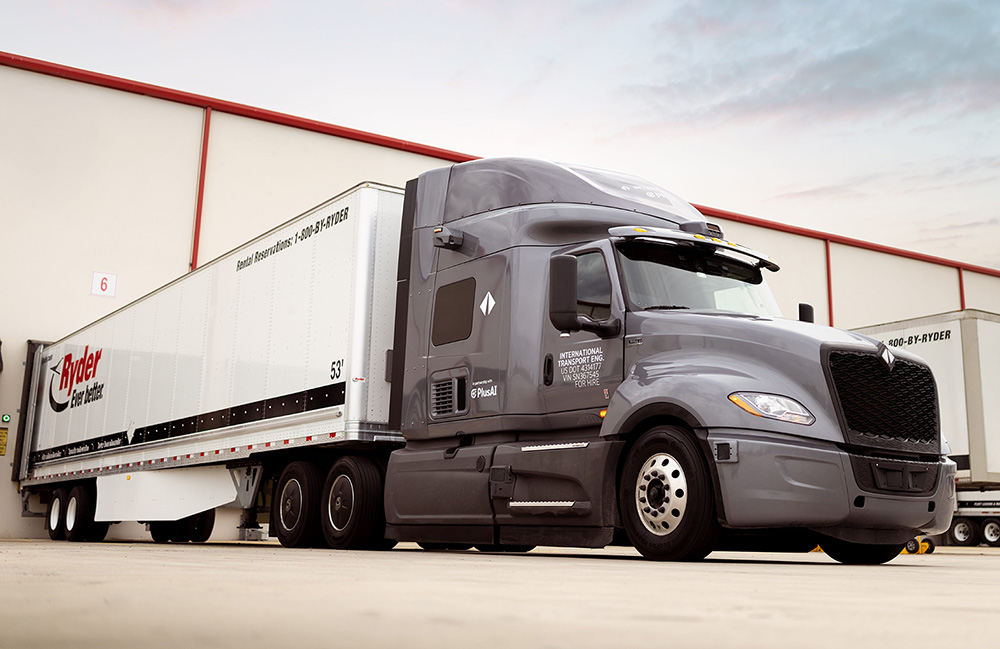
Self-driving trucks have been gaining traction in some regions of the U.S., but until now, they haven’t been allowed to operate in California. | Source: Plus AI
The California Department of Motor Vehicles has introduced new regulations that clear the path for self-driving trucks to test and deploy across the state, while also strengthening safety and oversight standards for all autonomous vehicles.
Under the updated rules, autonomous trucking companies can now apply for testing permits. They must also prove the safety of their technology. Before this change, California law banned autonomous vehicles (AVs) with a gross vehicle weight rating (GVWR) of 10,001 pounds (4,536.3 kg) or higher from using public roads.
“California continues to lead the nation in the development and adoption of AV technology, and these updated regulations further demonstrate the state’s commitment to public safety,” said Steve Gordon, director of the California DMV. “These changes support the growth of the AV industry by enhancing public safety and transparency while adding greater accountability for AV manufacturers.”
The DMV also emphasized that heavy-duty AVs must continue stopping at California Highway Patrol weigh stations and follow all relevant state and federal commercial vehicle regulations.
Chamber of Progress supports new rules for self-driving trucks
“This is a long-overdue step forward for the state that pioneered self-driving tech,” said Robert Singleton, senior director for California at the Chamber of Progress. “California families and businesses will benefit from the lower costs, more resilient supply chains, and safer highways that self-driving trucks will deliver.”
The Chamber of Progress is a trade group that advocates for technology companies on issues like antitrust law, content moderation, and autonomous vehicles. It pointed to research suggesting that self-driving trucks could create up to 35,000 new jobs in the U.S.
DMV introduces updated regulations for all autonomous vehicles
Beyond opening roads to heavy self-driving vehicles, the California DMV has updated its rules for all autonomous vehicles operating in the state. These changes allow law enforcement to ticket AV companies for moving violations caused by their vehicles, require companies to respond to emergency calls within 30 seconds, and give local emergency officials the power to issue electronic geofencing orders to remove AVs from active disaster zones.
Under the new rules, local emergency officials can temporarily designate “do not enter” or “restricted area” zones for AV manufacturers during public safety incidents. Self-driving vehicles are barred from entering these zones for as long as the emergency lasts.
Any AV already inside the restricted area must exit, and no new vehicles may enter. Companies that violate this rule could face permit restrictions or suspension, depending on the situation.
Key features of the new regulations include:
- Permitting requirements: Manufacturers must start with safety-driver testing, advance to driverless testing, then apply for commercial deployment. They must log 50,000 miles (80,467.2 km) for light-duty vehicles or 500,000 miles (804,672 km) for heavy-duty vehicles at each stage and submit a detailed safety case proving the safety of their hardware, software, and operations.
- First responder coordination: Companies must provide updated first-responder interaction plans annually, ensure access to manual override systems, maintain two-way communication with 30-second response times, and offer updated training to support safe and timely collaboration with emergency personnel.
- Emergency response protocols: Local officials can issue emergency geofencing instructions to AV manufacturers, requiring fleets to leave designated areas within two minutes of receiving the alert, minimizing conflicts with AVs during active emergencies.
- Remote operations standards: Sets clear qualifications for remote operators, including licensing, permitting, and training requirements for remote drivers and assistants.
- Data reporting updates: The rules modernize AV data reporting, focusing on new safety metrics such as system failures, vehicle immobilizations, and hard braking incidents. They expand collision reporting rules and mandate data on vehicle miles traveled.
- Enforcement authority: The California DMV can now impose targeted operational limits on AV manufacturers—such as restrictions on fleet size, location, speed, and weather conditions—when public safety requires it.
- Medium-duty self-driving passenger vehicles: The regulations permit public agencies or universities to operate self-driving transit vehicles up to 14,001 pounds (6,350.7 kg) GVWR, creating new opportunities for innovation in public transit services.

