



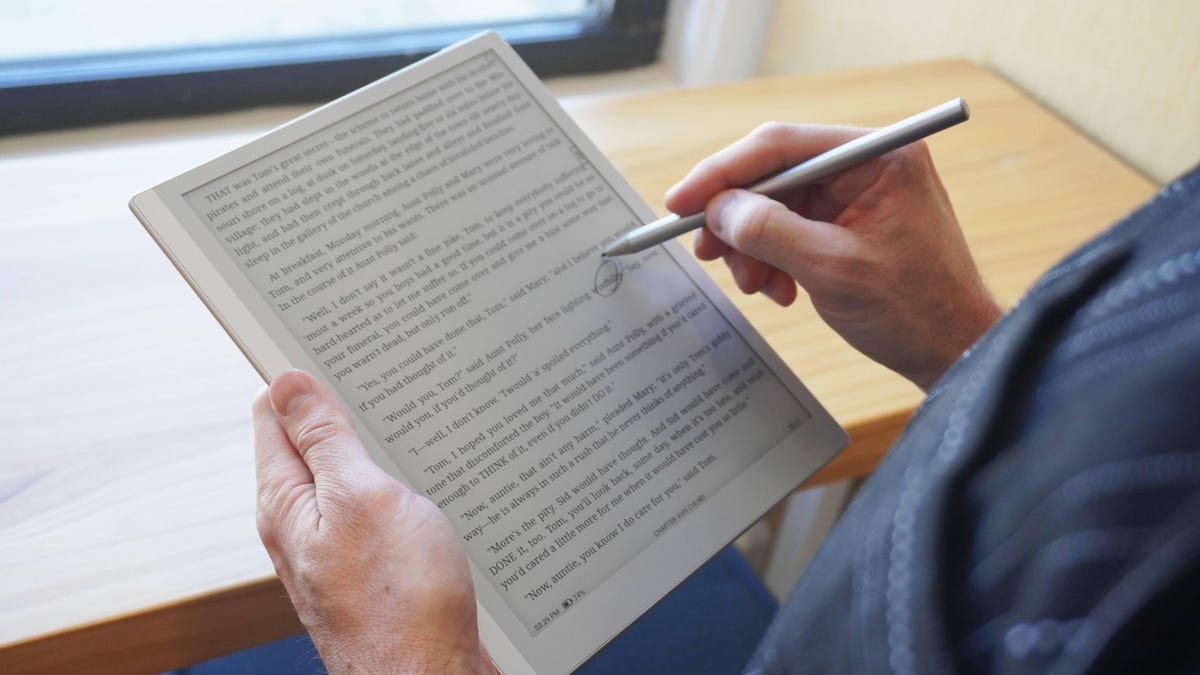
Boox Go 10.3 (Gen 2) Lumi
pros and cons
- Excellent writing feel
- Extensive personalization options
- Robust note-taking and markup tools
- Compatible with many apps
Google Play Store access
- Takes time to master
- Interface can be tricky, with occasional glitches
- Stylus doesn’t charge on its own
Follow ZDNET: Add us as a preferred source on Google.
The latest Boox Go 10.3 Lumi tablet offers a highly adaptable e-reading experience, packed with advanced note-taking capabilities and an attractive price tag of just $449—making it more affordable than many high-end digital paper tablets available today.
At this price, the Boox Go 10.3 Gen 2 stands out with its sophisticated PDF markup tools, outstanding writing feel, and a bright front-lit screen, all powered by Android 15 and a suite of pre-installed apps.
Also: Kindle Scribe vs. ReMarkable Paper Pure: Why I’m not writing off Amazon’s E Ink tablet just yet
That said, the extensive features and customization options can feel daunting at first, and it takes some effort to fully leverage everything this tablet has to offer.
Best tablet deals of the week
Deals are selected by the CNET Group commerce team, and may be unrelated to this article.
Design and hardware
In terms of design, Boox kept things largely the same as the previous model but removed the “Boox” branding from the front for a sleeker appearance. The tablet is remarkably lightweight at just 0.79 pounds (about 360 grams) and features a sharp, vibrant 10.3-inch Carta 1200 glass display with 300 ppi resolution.
Powered by Android 15, the second-gen Boox Go 10.3 comes with 4GB of RAM and a Qualcomm Octa-core 6350 processor, along with a capacitive stylus instead of EMR (electro-magnetic resonance) technology. The processor is positioned in the center-left area of the device—right where your hand naturally rests—so you might feel some warmth during extended use.
The aluminum body feels sturdy, and the vegan leather back adds a premium finish. This texture provides a comfortable grip and keeps the tablet steady on your desk while writing—something I really appreciate, as I dislike tablets that slide around during use.
The included synthetic-leather folio case looks great, but its detachable strap is a questionable design feature. It needs to be pulled tightly to secure the tablet properly. During testing, the device often slipped out of place or shifted off the magnets, forcing me to readjust or reattach it repeatedly.
Also: I tested the Kindle Scribe 2 for months, and it beat my ReMarkable in several ways
The stylus itself is light and comfortable to hold, but snapping it onto the tablet can take a few tries before it clicks into place. I’m also not a fan of the function button on the pen—it requires a specific grip, and accidental presses are frequent. While you do get used to it over time, it doesn’t quite replicate the natural feel of using a real pencil, in my view.
Another thing to note: the stylus doesn’t charge when attached to the tablet. You’ll need to plug it into a separate power source using the USB-C port on top. This might or might not bother you, but the good news is that the pen charges quickly and holds its charge for weeks.
Similarly, the tablet’s 3,700mAh Li-ion Polymer battery performs very well overall. With a few hours of daily pen use, you can expect the battery to last well over a week on a single charge. If you’re only using it as an e-reader, it can easily go two weeks or longer.
User experience
As with every Boox device I’ve tried, the writing experience is impressive—offering a natural pen-on-paper feel and a comprehensive set of brushes, customization options, and paper templates. You’ll find everything you could ask for here: layer support, shape tools, custom gesture controls, the ability to import your own images, and even audio recording, thanks to the built-in dual speakers and microphone at the bottom.
Also: Hundreds of readers bought this E Ink tablet – and I highly recommend it
On top of that, the tablet supports nearly every file type you’d ever need, including PDFs, EPUB, txt, rtf, html, png, jpg, gif, and bmp, among others.
One feature I particularly love is Infinite Canvas—a virtually limitless blank space that expands in any direction, letting you draw, sketch, and annotate freely. It’s perfect for large-scale projects or detailed mind maps with multiple components.
Boox also makes PDF annotation seamless and practical. When you mark up a PDF, your notes and highlights are shared exactly as they appear on your screen, so recipients see everything just as you intended. For editors, educators, or anyone who regularly reviews documents, this makes for a highly efficient and capable tool.
Also: I’ve tested several ReMarkable tablets, but its new cheap E Ink tablet had me fooled
As an e-reader, the options are plentiful. Since it runs Android 15, you can install the Kindle app or any other e-book platform and gain full access to your digital libraries. The Boox handles so many file formats that you’re not limited to EPUBs—everything works smoothly, allowing you to take notes and annotate no matter what you’re reading.
Sharing files isn’t immediately obvious, though, given the sheer number of options available. The simplest method is to connect the Boox directly to your laptop or PC via USB-C. Alternatively, you can generate a QR code that opens directly
Adding files to the device works well with a method that’s ideal for smartphones.
Also: Yes, there are $200 Android tablets that are actually worth the money – this one proves it
However, I discovered that the easiest way to share documents is by using third-party apps installed on the device. Apps like Dropbox, Google Drive, or OneDrive, for instance, enable instant two-way file transfers. There are other methods available for sharing documents, but I wish the process were more straightforward. Why not just a single tap to email?
Too Many Menus
The setup described above illustrates the complicated user interface that demands multiple clicks and activations across various menus and settings to perform basic tasks. Often, requests fail because a setting hasn’t been turned on. In other cases, you need to log in, create a password, or complete two-factor authentication on another device.
This complexity is made worse by the fact that navigating through the menus requires some trial and error to get it right. There are occasional glitches where menus close too soon, especially when making adjustments in the control panel, and sometimes confusing error messages like “The internet is abnormal. Try again later!” appear.
Configuring all these settings on the device takes some time, at least during your first use, but once everything is set up to your liking, navigation becomes smoother. However, this initial learning curve might discourage users who are accustomed to the streamlined Amazon ecosystem with the Kindle Scribe or the ultra-minimalist ReMarkable tablet.
ZDNET’s Buying Advice
The Boox Go 10.3 (Gen 2) Lumi is a powerful and flexible note-taking device with a natural pen-to-paper feel. With access to the Google Play Store, you have endless possibilities at your fingertips, but with all these features comes a user experience that requires involvement, tweaking, and personalization.
I’d suggest this device to experienced users who value having many options, don’t require a color display, and want a versatile gadget that can handle a variety of tasks. If you find the ReMarkable ecosystem too restrictive and desire more features than Amazon’s Kindle offers, this tablet is a very budget-friendly choice, starting at $399, or bundled with extra pen tips and the folio case for $449.
