



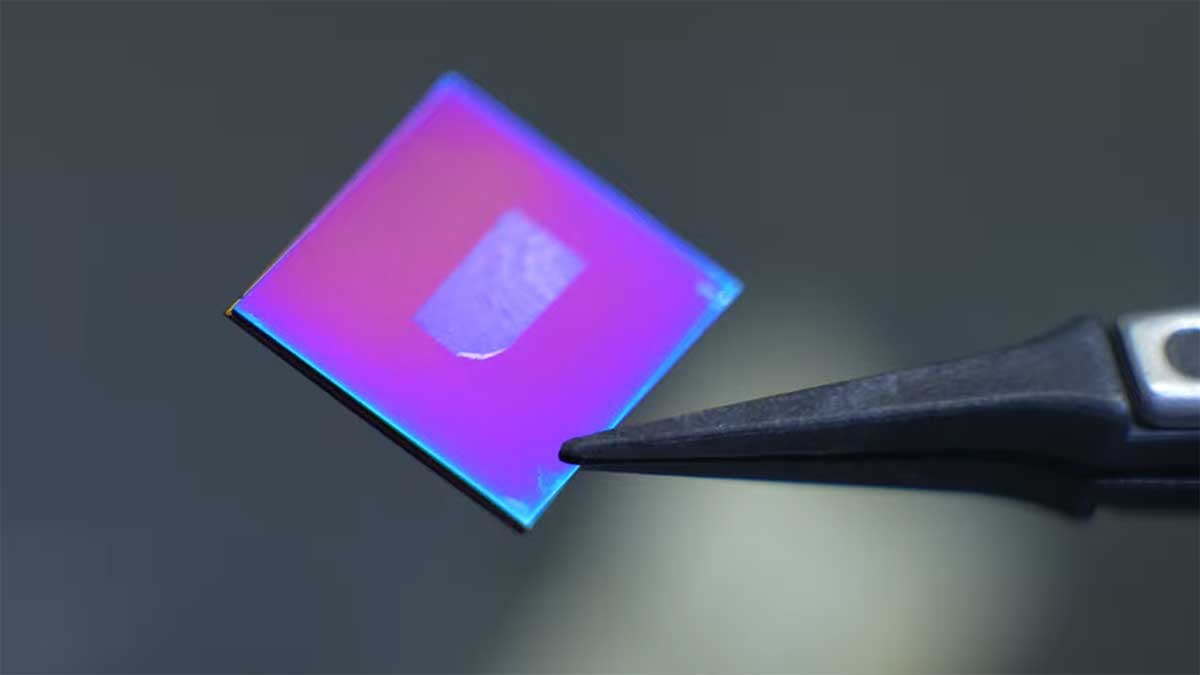
Scientists in the United States have created a carbon nanotube film the size of a few centimetres that sets a new record for its ability to change the frequency of light. This advancement could improve the optical technologies that form the backbone of future communications and computing systems, including those powering the Internet of Things (IoT).
The study, conducted by a team at Rice University and published in the journal ACS Nano, reveals that precisely aligned carbon nanotubes with a uniform chiral structure can achieve extraordinarily strong “second harmonic generation” (SHG). This is a nonlinear optical phenomenon where incoming light is transformed into light at double its original frequency.
In practical applications, this means infrared light signals can be converted into visible light much more efficiently than with traditional materials. This capability is essential for photonic chips, optical interconnects, and the high-speed data processing hardware that increasingly underpin edge computing and cloud-based infrastructure.
Chiral carbon nanotubes are hollow, cylindrical arrangements of carbon atoms that have an inherent twist, much like a spiral staircase, and can take either a left-handed or right-handed form. Although theorists have long predicted that this structural twist should produce remarkably strong nonlinear optical effects, actually proving this in the lab has been extremely challenging. The main obstacle has been the difficulty of isolating and aligning large quantities of nanotubes that all share the same handedness.
“In a typical batch of carbon nanotubes, roughly half are right-handed and half are left-handed,” explained Junichiro Kono, a senior researcher on the project. “Their chiral properties essentially neutralise each other.”
This mutual cancellation has made it nearly impossible for scientists to measure the true optical characteristics of chiral nanotubes, especially their capacity to produce second harmonic signals.
The Rice research team solved this problem by fabricating centimetre-scale films from a single type of enantiomer — specifically (6,5) carbon nanotubes. These tubes were aligned and densely arranged into thin, wafer-like structures using carefully controlled vacuum filtration methods.
“We managed to produce a wafer-thin film densely packed with chiral carbon nanotubes that displayed consistent optical behaviour across its entire surface,” said Kono.
When the finished material was exposed with laser pulses tuned close to the nanotubes’ excitonic resonance — a quantum state in which excited electrons and the holes they leave behind form bound pairs — it produced a powerful SHG response. The researchers noted that this resonance condition greatly amplifies the material’s nonlinear optical reaction.
The team measured an effective nonlinear susceptibility of 4.9 × 10² pm/V for the fabricated film. They also estimated that a theoretically perfect, fully ordered crystal of the same material could reach an intrinsic value of 1.6 × 10³ pm/V. These figures rank the material among the most powerful nonlinear optical systems known to operate in the near-infrared spectrum.
According to the authors, these results validate longstanding theoretical predictions: the one-dimensional quantum confinement found in nanotubes should dramatically intensify interactions between light and matter, and this effect is further boosted when combined with structural chirality.
Beyond the pure science behind the discovery, the researchers also highlighted significant practical potential. Nonlinear optical materials play a critical role in converting and directing light signals within photonic devices, such as those used in fibre-optic communication networks and the rapidly developing field of silicon photonics.
“Carbon nanotubes are a highly promising flexible semiconductor for both electronic and optical applications,” said Hanyu Zhu, a Rice materials scientist who co-led the study with Kono. “These films could be readily incorporated into silicon photonics systems to handle optical data processing and transmission.”
Zhu also pointed out that this work marks a historic milestone in accurately bridging theory and experiment: “This is the first time our predictions have been both precise and confirmed through actual experimental results at this scale.”
The possibility of integrating such films into chip-level designs is especially relevant for IoT infrastructure. As the number of connected devices multiplies, the need for fast, low-latency data transfer between sensors, edge processors, and cloud platforms keeps rising. Photonic interconnects are increasingly seen as a promising way to meet this demand, supplementing or even replacing conventional electronic signal transmission in data-intensive settings.
However, the nonlinear optical materials currently used in photonic devices tend to draw significant power, resist miniaturisation, or prove incompatible with established semiconductor manufacturing techniques. The researchers believe carbon nanotube films could overcome several of these limitations at once, thanks to their mechanical flexibility, potential for scaling up, and compatibility with wafer-based fabrication processes.
Looking for more editorial content? Check out our sister site, Electronic Specifier. You’re also welcome to join the conversation by leaving a comment below or stopping by our LinkedIn page.
