



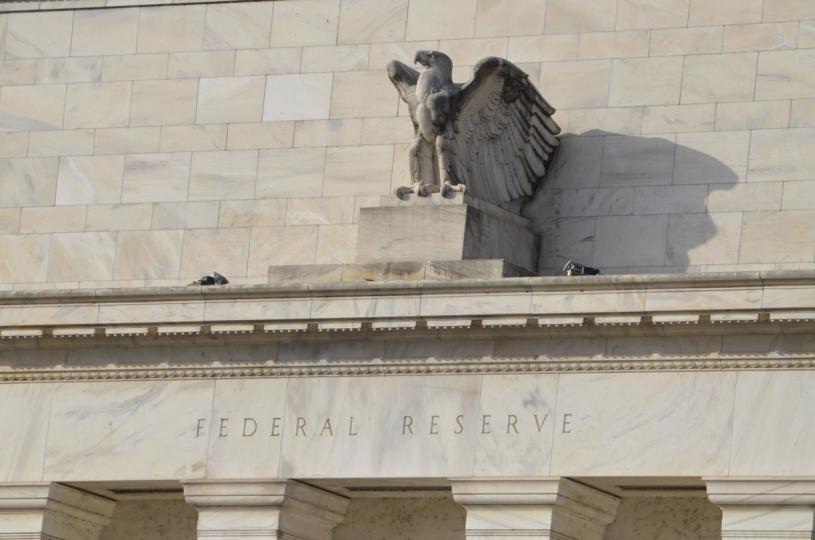
The Federal Reserve released an updated version of its plan for a “skinny” master account, revising the initial proposal that was first introduced last December. That same week, President Donald Trump signed an executive order aimed at more deeply integrating digital assets into current payment systems.
You’re reading State of Crypto, a CoinDesk newsletter exploring the relationship between cryptocurrency and government. Click here to sign up for future editions.
The narrative
President Donald Trump signed two executive orders last Tuesday. One instructed the broader government to revise existing regulations to more effectively incorporate crypto into payment systems, while the other directed the Treasury Department and regulators to tighten Bank Secrecy Act rules. The following day, the Federal Reserve Board released its updated skinny master account proposal, providing additional details about its strategy for giving crypto companies access to its payment infrastructure.
Why it matters
Bringing the crypto industry into the wider federal payments system is clearly a priority for the sector as a whole. Last week’s proposals could move that goal one step closer to reality.
Breaking it down
The Federal Reserve’s Wednesday proposal revises its skinny master account request for information that was originally published in December 2025, outlining how the central bank plans to give fintech and crypto companies access to its payment infrastructure without requiring them to become fully chartered banks under the Office of the Comptroller of the Currency.
The fintech-focused order instructed federal regulators to examine their current policies to assess how they oversee financial institutions and pinpoint rules that might prevent fintech companies from forming partnerships with regulated entities.
The order also directed the Fed to review how it handles uninsured depository institutions and their eligibility for payment accounts.
As part of that review, Federal Reserve member banks are expected to determine whether they can independently provide payment accounts to outside entities.
The Fed can’t necessarily accomplish all of this alone; Congress may need to pass legislation that further specifies which types of entities would qualify for an account.
The BSA-focused order instructs the U.S. Treasury Department and regulators to issue guidance to banks and other organizations.
“My Administration will not tolerate national security and public safety risks caused by illicit cross-border financial activity, nor will it permit risks to our financial system posed by the extension of credit or financial services to the inadmissible and removable alien population,” Trump’s order stated.
This would include an advisory highlighting “payroll tax evasion,” shell companies and “the strategic use of unregistered money services businesses, third-party payment processors, or peer-to-peer platforms to facilitate ‘off-the-books’ wage payments designed to circumvent Bank Secrecy Act reporting thresholds or tax obligations,” among other categories of entities.
Although the order did not specifically reference cryptocurrency or decentralized finance trading platforms, they could still be affected by any final guidance, said Nicholas Anthony, a research fellow at the Cato Institute.
The next question is what the guidance and advisory might contain.
“Right now it’s in the hands of the Treasury, and the Treasury is able to apply it not only however it sees fit, but also to whoever it sees fit, because of the broader authority that the Treasury holds under the Bank Secrecy Act,” he said.
Senate shenanigans
The Senate Banking Committee voted to advance the Clarity Act just over a week ago.
The expectation was that the full Senate might take up this matter sometime in the next month, to resolve ethics and other outstanding issues before voting on whether to send the bill to the House of Representatives. That timeline took a hit on Thursday, when the Senate adjourned for the Memorial Day recess without voting on a reconciliation bill to fund the Department of Homeland Security, among other priorities.
The issue is this: There’s only a limited amount of time to get things done on the Senate floor. There are 19 working days in June and 15 in July. There are another five in August, and then everyone leaves for the rest of the summer.
During that window, the Senate must work through reconciliation, a renewal of the Foreign Intelligence Surveillance Act (which is set to expire in mid-June) and potentially a housing bill.
Adding to the tension is the reason the Senate adjourned. President Donald Trump’s administration requested $1 billion for his planned East Wing ballroom and more recently another $1.8 billion for a weaponization fund, which members of both parties have called a “slush fund.” The Senate had already removed the ballroom funding from the bill, but the additional $1.8 billion proved too contentious to resolve this week.
Negotiations over these issues — unless there is backroom dealing during the recess — could prolong the negotiation process, further reducing floor time available for the Clarity Act. And of course, there’s still the ethics provision within the market structure bill itself. The White House has not yet signaled what it might be willing to accept, so that’s another negotiation worth watching.
This week
- The House and Senate are on recess this week.
If you have thoughts or questions on what I should cover next week or any other feedback you’d like to share, feel free to email me at nik@coindesk.com or find me on Bluesky @nikhileshde.bsky.social.
You can also join the group conversation on Telegram.
See you all next week!
