



The signing ceremony had already been arranged, and top tech CEOs were confirmed to attend. Then, suddenly, it was called off entirely.
On Thursday, US President Donald Trump cancelled a planned executive order on AI policy — one that had already been postponed several times — arguing that it risked weakening America’s technological advantage over China.
“We’re ahead of China, we’re ahead of everyone, and I don’t want to do anything that gets in the way of maintaining that lead,” Trump told reporters in the Oval Office. What he left unsaid was that the order had effectively been torpedoed by the very industry it was designed to govern.
Killed off in a single night
According to Semafor, which first broke the story, the White House’s plans were derailed after Elon Musk of xAI, Meta CEO Mark Zuckerberg, and venture capitalist David Sacks — formerly Trump’s top advisor on AI and cryptocurrency — each spoke directly with Trump between Wednesday evening and Thursday morning.
US media outlets, citing sources familiar with the discussions, reported that the argument which gained traction appealed to the “accelerationist” camp within the administration, including officials at the National Economic Council and staffers in the Vice President’s office.
The order itself was far from an aggressive regulatory framework. It would have created a voluntary system allowing AI developers to work with federal agencies and submit their most advanced models for security evaluation up to 90 days before making them publicly available. There was no licensing requirement, no mandatory waiting period — everything was voluntary.
Yet even that proved to be too much. Trump said he shelved it “because I didn’t like certain parts of it,” without elaborating on which parts. He went on to say he was concerned it “could have been a blocker” — a revealing remark from a president who has otherwise framed AI as both an economic and national security priority.
Looming consequences of a policy void
The US still lacks any comprehensive legislation governing AI. Whatever governance structure exists has been built incrementally, through a patchwork of executive orders, agency guidelines, and voluntary commitments. Earlier this month, the federal Centre for AI Standards and Institute announced evaluation agreements with Google DeepMind, Microsoft, and xAI, giving the government the ability to assess models before they reach the public. That initiative will go ahead regardless of Thursday’s decision not to sign the order.
But the broader picture is one of regulatory stagnation. In early March, the Trump administration published a National AI Legislative Framework, calling on Congress to block state-level AI laws that “place excessive burdens” in favor of a single national standard over what it described as “fifty conflicting ones.” Congress has not yet acted on the proposal.
The contrast with China is stark and growing harder to overlook. Beijing’s State Council published a 2026 legislative work plan in May, outlining ambitious goals to fast-track comprehensive AI legislation — the most prominent inclusion of AI governance language in official planning documents to date. The National People’s Congress has placed AI law on its review agenda for the third year running.
Back in April, Beijing introduced new regulations requiring AI companies to set up internal ethics review boards. China is actively drafting rules. Meanwhile, Washington is calling off signing ceremonies.
Who truly drives US AI policy?
Thursday’s episode made explicit something that had been quietly understood for months: within this administration, the real power to block AI regulation lies with a handful of industry leaders who have direct lines to the president.
Musk, whose xAI directly competes with OpenAI and Anthropic, has a clear business incentive to keep regulatory barriers low. Zuckerberg’s Meta has similarly staked out a position as a leading advocate for open-source AI. Sacks, despite having officially stepped down from his White House advisory post in March, still apparently wields enough influence to sway executive decisions.
Additionally, Semafor reports that OpenAI has won White House support for a separate initiative to shape AI regulations at the state level — a notable development given that Trump’s previous executive order penalized states that pursued AI rules the administration found objectionable. The fact that the administration is simultaneously discouraging state-level regulation while backing OpenAI’s state-level push suggests the inconsistency in policy thinking runs deeper than just one postponed signing.
The China argument cuts both ways
Trump’s stated justification for shelving the order — preserving America’s lead over China — is the same reasoning that has shaped every major AI policy move since he returned to the White House, from the H200 export licensing framework to the Stargate infrastructure initiative. It is also an argument that Beijing is paying close attention to.
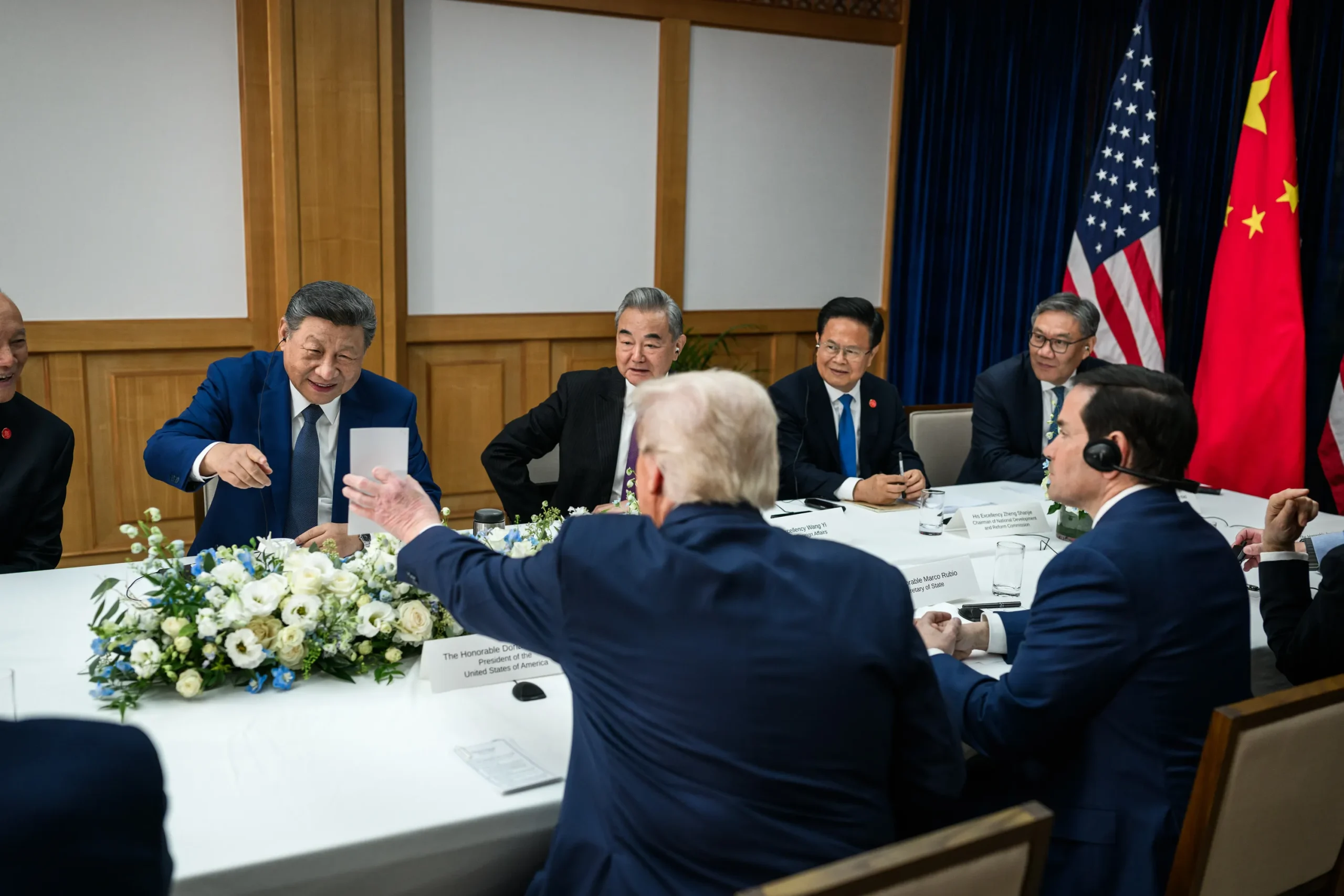
During the Trump-Xi summit in Beijing earlier this month, the two leaders agreed to launch formal government-to-government talks on AI, according to China’s Foreign Ministry. Beijing will likely have taken note that Washington’s internal debate over even voluntary AI oversight was settled not by government officials, but by the companies that benefit most from a lack of oversight.
In a South China Morning Post report, Lizzi C. Lee, a fellow at the Asia Society Policy Institute’s Centre for China Analysis, observed that both the US and China are wrestling with the same fundamental challenge: figuring out where to draw the regulatory line as AI models become increasingly capable of operating autonomously and play a larger role in cybersecurity.
“I think there is a separate, perhaps even more important contest underway — one over governance and safety: not about who has the most powerful models, but who can manage powerful AI without stifling innovation,” she said.
The same report cited Kyle Chan at the Brookings Institution, who put it more bluntly: “AI safety and regulation can be done without compromising innovation.”
Neither argument carried the day on Thursday. Whether they will be more persuasive next time around — assuming there is a next time — remains to be seen.
(Photo by White House)
See also: The US-China AI gap closes amid responsible AI concerns
Want to hear directly from industry leaders on AI and big data? Visit the AI & Big Data Expo, with events in Amsterdam, California, and London. It is part of TechEx and runs alongside other major technology conferences — click here to find out more.
AI News is powered by TechForge Media. Explore other enterprise technology events and webinars happening soon here.
