



# Global Industrial Robotics Surpasses 5 Million Units as Installations Hit Record High
The world’s factory floors are more automated than ever before. A new milestone report reveals that the global operational stock of industrial robots has crossed the 5 million mark for the first time, representing a 9% increase over the previous year and nearly doubling the count observed just seven years prior.
## A Record Year of Deployments
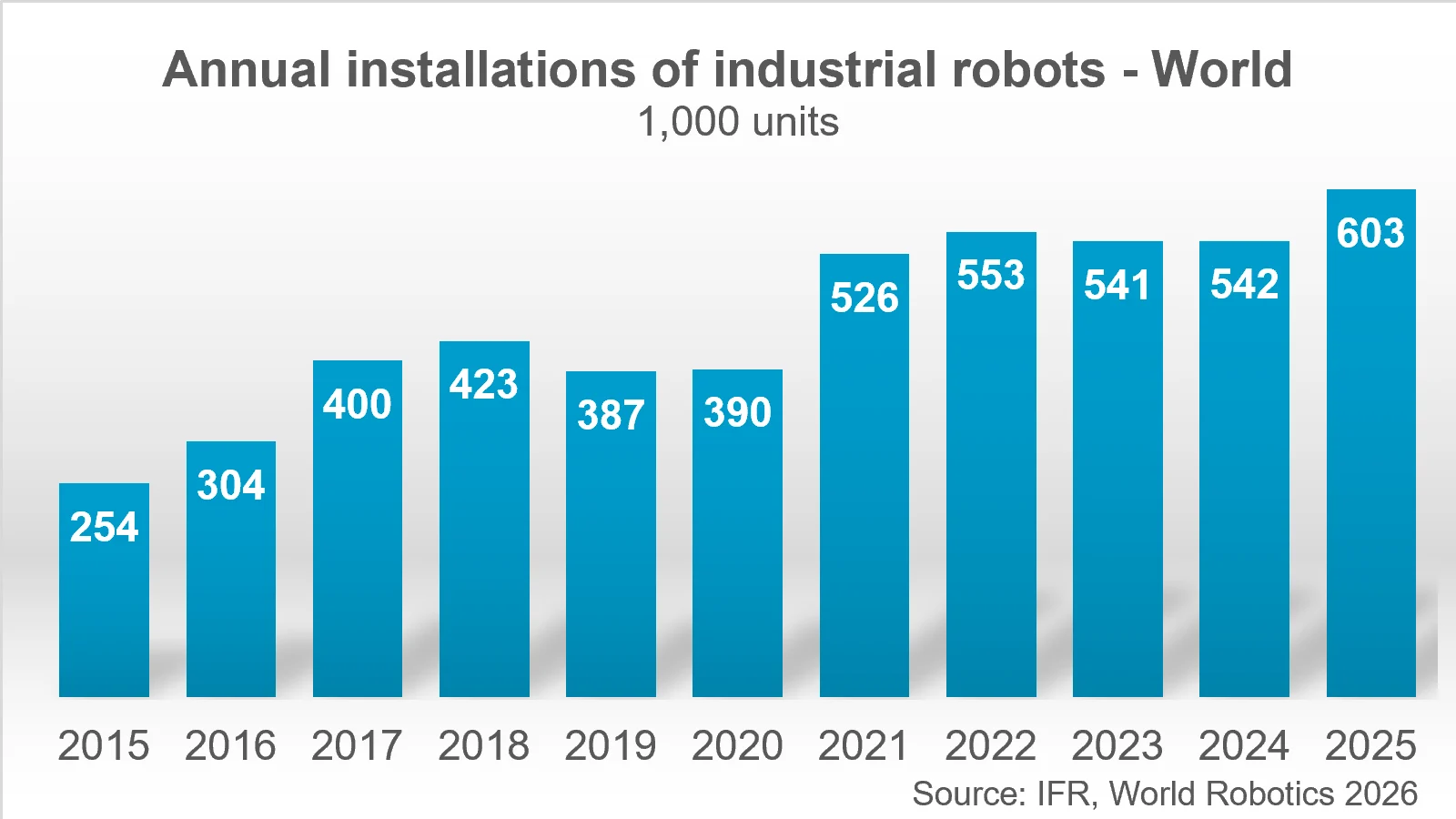
Factories around the world welcomed more than 600,000 new industrial robots in the latest reporting period, marking an 11% year-over-year spike in annual installations. Industry analysts describe this acceleration as a clear signal that automation adoption is reaching an inflection point, driven by falling hardware costs, rapid improvements in robotic capabilities, and growing labor shortages across manufacturing sectors.
“Capabilities are increasing exponentially while costs continue to come down,” noted one industry observer. “Everyone is paying attention to what’s possible right now.”
## Asia Dominates the Landscape
China has cemented its role as the undisputed leader in robot adoption, accounting for 59% of all global installations. With 354,000 units deployed last year, Chinese manufacturers have consistently outpaced foreign suppliers in their domestic market, achieving a 55% local market share. Year-over-year growth in China jumped by 20%, with installations climbing by roughly 60,000 units compared to the prior year.
However, some experts suggest China’s dominance, while remarkable, may create unexpected openings elsewhere. The sheer volume of Chinese installations could signal shifting dynamics in global trade, with opportunities emerging for manufacturers in other regions looking to capitalize on nearshoring trends.
Japan, long a powerhouse in robotics, saw a sharp 19% decline in installations to roughly 36,200 units, dropping from second to third place globally behind the United States. Meanwhile, the Republic of Korea installed 30,000 units, a 1% dip that maintained its position as the fourth-largest market. Industry watchers expect South Korean demand to potentially rebound by 2027, when new automotive investments are expected to take effect.
India has emerged as a rising star, climbing to sixth place worldwide with nearly 10,500 units installed — a 15% increase. The South Asian nation has posted an impressive average annual growth rate of 27% between 2020 and 2025, despite still operating at a relatively modest scale compared to established adopters.
## The Americas See Notable Gains
The United States has officially overtaken Japan as the world’s second-largest industrial robot market. American factories installed close to 38,500 units, a 12% jump that represents the third-highest figure ever recorded in the country. This growth aligns with broader trends of reshoring and supply chain resilience.
Canada also posted positive momentum, with installations rising 5% to nearly 4,000 units, building on a strong compound annual growth rate of 9% over the past half-decade.
Mexico experienced its third consecutive year of decline, with robot installations falling 7% to fewer than 5,200 units. Brazil, in contrast, surprised observers with a 38% surge, driven almost entirely by a dramatic 212% increase in automotive robotics. Much of this growth has been attributed to investments from Chinese automakers expanding their presence in the South American market.
## Europe’s Steady but Measured Progress
Germany remains Europe’s dominant robotics market and the fifth-largest globally. Despite holding a commanding 41% share of total European Union installations, the German market saw an 8% sales decline to fewer than 25,000 units in the latest period. The automotive sector continues to lead German robot demand, though its relative share is gradually shrinking.
Across the rest of the continent, trends are mixed. Italy, Europe’s second-largest market, saw an 11% drop to approximately 7,800 units. France regained third place with nearly 4,500 units despite an 8% decline, while Spain fell 15% to about 4,300 units.
Overall, European installations have grown by only 2% per year on average since 2020, reflecting a more cautious approach to automation compared to other regions.
## The Road Ahead
Industry forecasts paint a confident picture for the future. Analysts project global installations will rise 9% in the coming year to 655,000 units and continue climbing to an estimated 806,000 units by 2029. The expansion is expected to be fueled by several converging factors: the need for more resilient and diversified supply chains, persistent labor shortages, geopolitical tensions driving manufacturing relocation, and the ongoing shift toward reshoring and nearshoring production.
Advances in artificial intelligence, machine vision, and sensor technology are expected to further broaden the capabilities of industrial robots, while simplified programming and integration tools are lowering barriers to entry for smaller manufacturers and new applications.
“We’re facing hundreds of thousands of unfilled manufacturing and assembly jobs, and the shortage is projected to reach 2 million by the end of this decade,” said one industry leader. “Robots can handle the work that people don’t want to do and the work that poses physical dangers. We’re not trying to replace everything a human does — just the jobs that are becoming impossible to staff.”
—
## Frequently Asked Questions (FAQ)
**Q: What is the current global stock of industrial robots?**
A: The global operational stock of industrial robots surpassed 5 million units for the first time, representing a 9% year-over-year increase.
**Q: How many new robots were installed worldwide last year?**
A: Factories worldwide installed more than 600,000 new industrial robot units, an 11% increase from the previous year.
**Q: Which country leads in industrial robot installations?**
A: China is the clear leader, accounting for 59% of all global robot deployments with 354,000 units installed.
**Q: Has the United States overtaken Japan in robot adoption?**
A: Yes. The United States surpassed Japan to become the second-largest industrial robot market globally, with nearly 38,500 units installed last year.
**Q: Are European countries growing their robot installations at the same pace as Asia and the Americas?**
A: No. European growth has been more modest, with Germany growing at just 2% per year on average since 2020, and several major markets experiencing declines in the most recent period.
**Q: What is driving the demand for industrial robots?**
A: Key drivers include labor shortages in manufacturing, supply chain resilience needs, geopolitical factors encouraging nearshoring and reshoring, and falling costs paired with improving robotic capabilities.
**Q: What does the future outlook look like for industrial robotics?**
A: The outlook is positive, with installations expected to reach 655,000 units in the coming year and 806,000 units by 2029. AI, machine vision, and improved integration tools are expected to accelerate adoption further.
**Q: Will robots replace human workers entirely?**
A: Industry experts emphasize that the goal is not full replacement but rather automation of dangerous, physically demanding, or hard-to-staff roles. Robots are seen as a complement to human labor, not a complete substitute.
—
## Conclusion
The industrial robotics sector is experiencing a period of unprecedented expansion. With 5 million robots now operational across global factories and annual installations reaching record levels, automation is no longer a niche trend — it is a fundamental transformation of how goods are manufactured worldwide. China’s dominance, the United States’ resurgence, and the emergence of growth markets like India and Brazil illustrate a shifting global landscape.
While regional differences persist, with some markets advancing rapidly and others progressing more slowly, the long-term trajectory is unmistakably upward. Advances in AI, improved accessibility of robotic systems, and the economic realities of labor shortages all point toward continued adoption in the years ahead. The next decade promises to bring even deeper integration of robots into manufacturing processes, reshaping industries and creating new opportunities across the global economy.
Thank you for reading
