



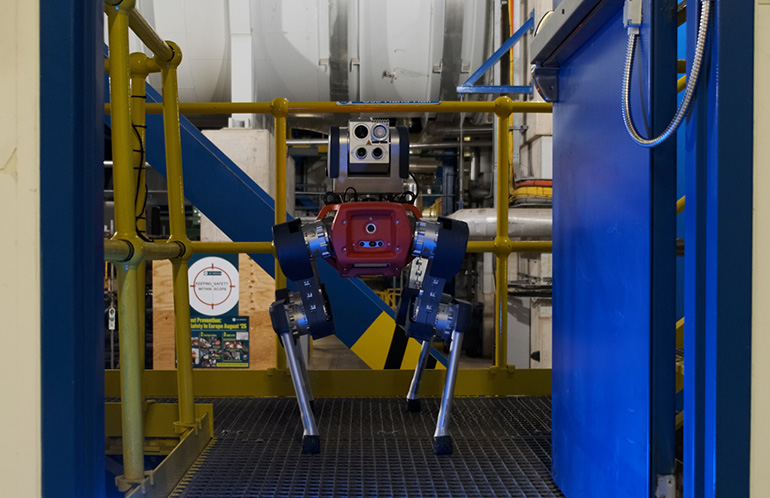
# Mobile Inspection Robots Break Through Closed-Door Barriers with New Access Technology Partnership
A significant obstacle has long stood in the way of autonomous inspection robots operating inside industrial facilities: closed doors. For mobile robots deployed in sectors like energy, metals, mining, and chemical processing, encountering a shut door meant the end of their inspection route — no matter how advanced their navigation capabilities were. Now, a three-way collaboration between a robotics company and two access-control specialists is changing that equation entirely.
## The Problem: Doors as Invisible Walls
Processing plants and industrial sites are typically divided into multiple zones separated by fire-rated barriers and security-controlled doors. These partitions are essential for safety and regulatory compliance, but they have created a frustrating limitation for inspection robotics. A robot that can traverse open corridors and stairwells may still be unable to reach the most critical assets — turbines, transformers, chemical reactors, and compressors — if those assets sit behind a locked or secured doorway.
This means plant operators have either accepted incomplete coverage or invested in costly infrastructure modifications, such as installing dedicated doorways for robotic use. Both options come with trade-offs that reduce the return on investment from deploying autonomous inspection systems.
## A Three-Way Solution
The partnership brings together a quadruped inspection robot platform, a digital credential technology provider, and a physical access-control and door automation specialist. Together, they have developed an integrated system that allows autonomous mobile robots to navigate both unlocked and locked doors in existing industrial facilities — without any structural changes to the building.
The approach works in two scenarios. For standard, unsecured doors, the robot uses radar-based presence detection to trigger a swing-door operator mounted on the door frame. The device, which can be retrofitted onto virtually any existing swing door regardless of manufacturer, opens automatically as the robot approaches, allows it to pass through, and then closes behind it. The system is designed to meet specifications for indoor, outdoor, and fire-rated doors alike.
For controlled or restricted areas, the robot carries a secure digital credential embedded in its payload. When it reaches a protected doorway, it communicates electronically with the facility’s access management system, presenting its identity and requesting authorization. The system checks the robot’s permissions against predefined rules — including zone restrictions, time windows, and specific inspection tasks — and unlocks the door only if access is granted.
## Maintaining Security Rather Than Bypassing It
A key concern in any industrial environment is that automating door access for robots should not undermine existing security protocols. The integrated system is designed to work within the facility’s current security framework rather than around it. The robot authenticates itself the same way a badged employee would, and it does not disable or override anti-tailgating measures, mantraps, interlocks, cameras, or guard procedures.
If an unauthorized person follows the robot through a secured door, the event triggers the same alarms and countermeasures that would activate if a human were caught tailgating. Additionally, every credential scan and transit event is logged with a precise timestamp, creating a complete audit trail that provides greater visibility than a door left propped open by a human worker.
## Real-World Validation at a Power Plant
The technology was tested over several weeks in a live operating environment at a major power generation facility in Ireland, where the inspection robot repeatedly navigated controlled doors and completed its full inspection routes without any manual intervention. Maintenance engineers reported that the system allowed the robot to move seamlessly between plant zones while keeping fire and security barriers fully intact.
## Looking Ahead
The add-on capability is expected to become available for existing deployments as well as new hardware platforms later this year. The partners are also exploring expanded use cases beyond doors, including automated access to elevators, gates, and turnstiles in large, complex facilities. Industry analysts have noted that the inspection robotics market is growing rapidly, and the ability of robots to reach every area of a facility — not just the easily accessible ones — will be a decisive factor in adoption rates.
—
## Frequently Asked Questions
**Q: What types of facilities benefit most from this technology?**
A: Processing industries such as energy generation, metals manufacturing, mining operations, and chemical plants benefit the most. These environments typically feature extensive zones separated by fire-rated and security-controlled doors, making comprehensive robotic inspection difficult without this kind of solution.
**Q: Does the system require modifying existing doors or building infrastructure?**
A: No. The door operators are retrofitted onto the customer’s existing doors, and the digital credential system integrates with the facility’s current access management infrastructure. No structural modifications are necessary.
**Q: How does the robot know when to open a door?**
A: For unlocked doors, a radar sensor on the robot detects the door’s presence and triggers the automated door operator. For secured doors, the robot’s digital credential is checked against the access management system, and the door is unlocked only if authorization is confirmed.
**Q: Is the system compatible with a facility’s existing security measures?**
A: Yes. The system does not bypass or override any existing security protocols. It works within the facility’s current framework, including tailgating detection, mantraps, interlocks, and camera systems. The robot inherits the same access rules as any authorized human worker.
**Q: What happens if someone follows the robot through a restricted door without authorization?**
A: The facility’s standard anti-tailgating countermeasures are triggered, just as they would be if a human employee were caught in the same situation. The robot’s detailed audit trail also helps identify such events after the fact.
**Q: Is the door automation hardware compatible with all door types?**
A: The swing-door operators used in the system are designed to work with most standard swing doors and are largely independent of the door’s brand or type. They comply with indoor, outdoor, and fire-rated specifications.
—
## Conclusion
The integration of secure, automated door access represents a meaningful advancement for autonomous inspection robotics in industrial environments. By enabling robots to reach every zone of a facility — including those behind fire-rated and security-controlled barriers — this partnership removes one of the most persistent barriers to full site coverage. The approach prioritizes security and auditability alongside automation, ensuring that robotic access enhances rather than compromises plant safety protocols. As the inspection robotics sector continues its rapid growth, solutions like this will be critical in proving that autonomous systems can deliver on their promise of complete, reliable, and scalable facility monitoring.
Thank you for reading
