



# RAG vs. Fine-Tuning for Domain Adaptation: A Practical Guide to Choosing the Right Approach
Selecting between retrieval-augmented generation and fine-tuning is one of the most consequential architectural decisions you will make when building a production LLM system. The confusion around this topic is widespread — many teams treat it as a single either/or choice, when the reality in 2026 is that a significant share of deployed systems actually use both techniques together because they address fundamentally different needs.
This guide walks through what each method actually does at a mechanical level, where each one falls short, and how to build a clear decision process for your specific project.
—
## How Retrieval-Augmented Generation Works
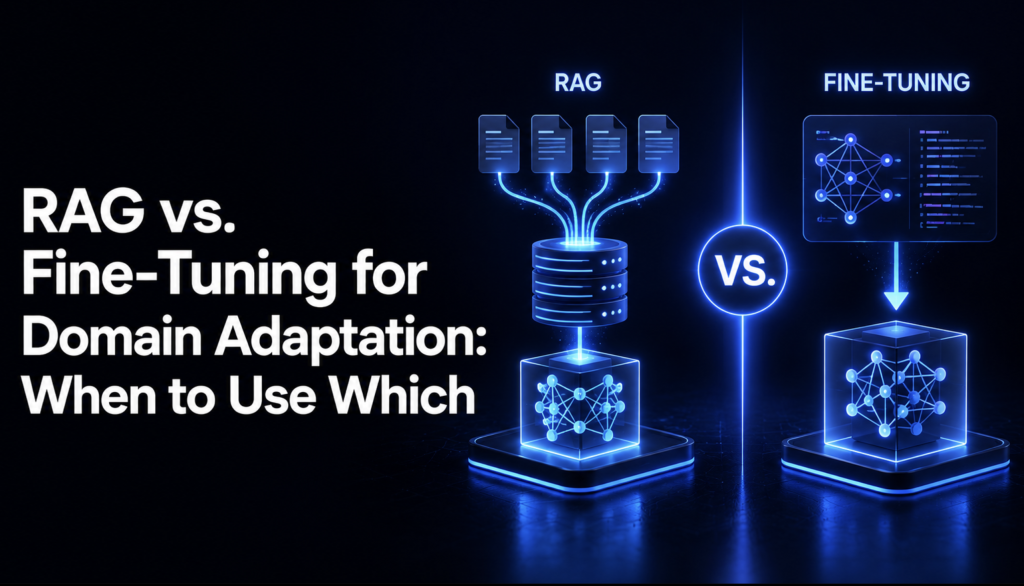
Retrieval-augmented generation leaves the model’s weights completely untouched. Nothing about the model itself changes. Instead, RAG alters what the model receives in its input context at the moment a query arrives. A retrieval component searches through a knowledge base, identifies the most relevant passages, and injects them into the prompt alongside the user’s question. The model then generates a response informed by those passages rather than relying solely on its internal training data.
This makes RAG uniquely powerful for information that is extensive, frequently updated, or both. Because the knowledge lives in an external store and is swapped in at inference time, you can add, edit, or remove documents without retraining anything. Every claim in a well-built RAG response can also be traced back to its source document, which matters enormously in regulated industries where auditability is a hard requirement.
However, RAG has a clear limitation: it does not change the model’s underlying behavior. If the model has a tendency toward inconsistent tone, if it refuses to follow a rigid output schema, or if it misuses domain-specific terminology, feeding it more context will not resolve any of those issues. The problem is not a lack of information — it is a lack of behavioral alignment, and RAG was never designed to fix that.
—
## How Fine-Tuning Works
Fine-tuning takes the opposite approach: it modifies the model itself by updating its weights on curated examples of the input-output behavior you want. The goal is to make the desired behavior the model’s default so that you do not need to inject special instructions at inference time — the pattern is baked directly into the weights.
Modern fine-tuning projects overwhelmingly use parameter-efficient methods like LoRA and QLoRA. Rather than retraining every parameter in the model, these techniques train a small adapter layer on top of a frozen base model. The adapter often represents less than one percent of the total parameter count, which brings the cost of a fine-tuning run down to a few hundred dollars and a matter of hours rather than requiring a full-scale retraining effort.
Here is the critical point that trips up many practitioners: fine-tuning is not a reliable method for adding new factual knowledge. A model trained on medical case studies will not reliably recall specific facts from those studies the way a retrieval system would. Fine-tuning excels at shaping style, structure, and pattern recognition — it teaches the model how to behave, not what to know. If your project’s core challenge is getting the model to output the right format consistently or use the correct internal vocabulary, fine-tuning is the right tool. If your core challenge is ensuring the model has access to accurate, up-to-date information, it is not.
—
## A Six-Point Decision Framework
Use this framework to evaluate your project’s needs before committing to an approach.
**1. Does your required knowledge change frequently or exceed what fits in a prompt?**
If your information is dynamic — constantly updated policies, growing document sets, or product catalogs that shift weekly — retrieval-augmented generation is the clear choice. The external knowledge store can be refreshed instantly without any model retraining.
**2. Do you need every response traceable to a specific source document?**
If auditability or regulatory compliance demands that users or reviewers can follow every claim back to its origin, RAG provides this natively. Each retrieved passage serves as a citation. Fine-tuned models require separate evaluation pipelines to achieve comparable traceability.
**3. Do you need a working system immediately?**
RAG is almost always the fastest path to a functioning prototype. You can have a retrieval pipeline serving real answers within hours, whereas fine-tuning requires collecting, labeling, and cleaning training data first — a process that typically takes weeks.
**4. Is the model failing to follow a consistent output structure or tone no matter how you prompt it?**
If prompting strategies keep breaking down at scale — the model drifts from your required JSON schema, uses inconsistent terminology, or ignores formatting rules — fine-tuning addresses this directly by learning the pattern from examples.
**5. Is your latency budget too tight for an extra retrieval step?**
Every RAG pipeline adds a retrieval hop before the model generates its response. If your application demands sub-second responses and cannot absorb that overhead, a fine-tuned model that responds directly is the better fit.
**6. Is your query volume high enough to justify the cost of a smaller, self-hosted model?**
At significant scale, fine-tuning a smaller open model and hosting it yourself can dramatically reduce per-query costs compared to repeated calls to a frontier API. The savings on inference can recoup the data preparation investment surprisingly quickly once volume is genuinely high.
—
## Why the Best Production Systems Use Both
The decision framework above might still leave you choosing one technique. In practice, the most robust production systems use both RAG and fine-tuning together, because most real-world domain adaptation projects contain both kinds of problems simultaneously. You might need the model to follow a strict internal taxonomy for its outputs (fine-tuning) while also drawing on a constantly changing knowledge base for the content of those outputs (RAG). Treating this as an either/or decision is the most reliable way to build the wrong thing first and then spend months retrofitting the architecture.
The recommended sequence is to start with retrieval since it delivers a working system faster, then identify the specific behavioral failures that neither better prompting nor better retrieval can fix, and add fine-tuning only for those precisely defined problems.
—
## Frequently Asked Questions
**Can fine-tuning teach a model new facts?**
Not reliably. Fine-tuning adjusts how the model behaves and structures its outputs, but it is a poor vehicle for injecting specific factual knowledge. Retrieval systems are far more dependable for factual recall, especially for granular or frequently changing information.
**Does RAG require a neural embedding model?**
Not necessarily. While dense vector embeddings from neural models are common, simpler approaches like TF-IDF with cosine similarity work well for many retrieval tasks, especially smaller knowledge bases with structured content. These methods run entirely locally with no external model dependencies.
**How much data do you need to fine-tune effectively?**
LoRA and similar parameter-efficient methods can produce meaningful improvements with relatively few high-quality examples. However, the quality of those examples matters far more than the quantity — a small set of correctly labeled, representative training data will outperform a large set of noisy labels every time.
**Is fine-tuning expensive?**
By modern standards, parameter-efficient fine-tuning is remarkably affordable. Training a small adapter on a frozen base model can be accomplished for a few hundred dollars and in just a few hours, making it accessible even for small teams with modest budgets.
**What happens when both approaches are needed?**
There is no conflict in using both. A fine-tuned model can serve as the base generation engine, while a retrieval layer injects relevant context at inference time. The two techniques operate on different layers of the system — one on behavior, the other on information — and they complement each other cleanly.
—
## Conclusion
The central insight behind both techniques is straightforward: RAG solves the problem of what the model needs to know, while fine-tuning solves the problem of how the model needs to behave. When teams collapse this into a single choice, they almost always build the wrong solution first. Start with retrieval to get grounded, accurate responses into production quickly, then layer in fine-tuning wherever persistent behavioral issues resist every improvement to your prompts and your retrieval quality. The honest answer for most serious production systems is not one or the other — it is both.
Thank you for reading
