



# Claude Opus 5.5: A Comprehensive Overview of Anthropic’s Latest Language Model Release
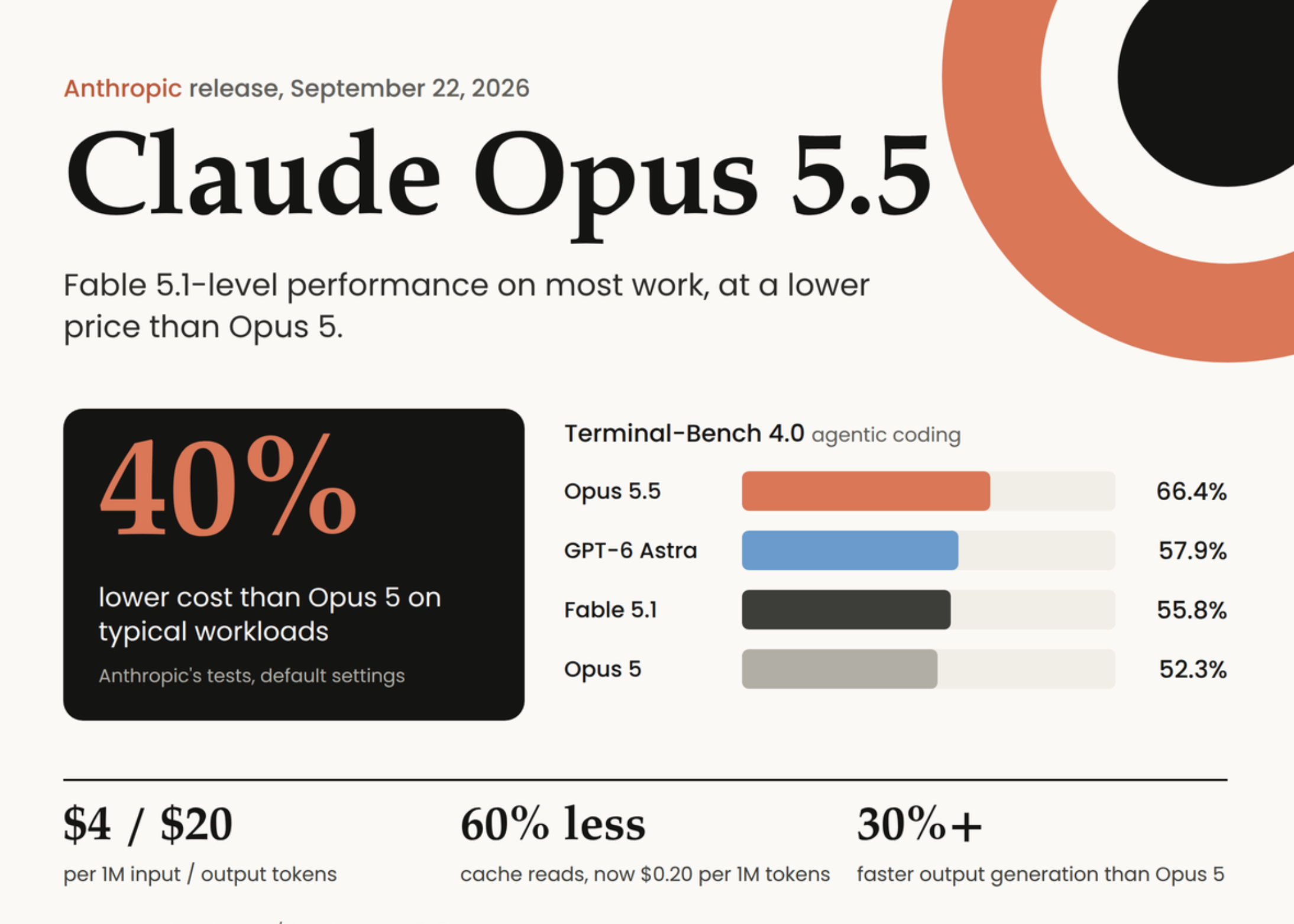
Anthropic has unveiled its newest frontier language model, Claude Opus 5.5, marking the debut of the Claude 5.5 series. The company positions this release as a significant leap in efficiency, claiming that the model delivers performance on par with its predecessor’s top-tier variant while slashing operational costs by roughly 40% on standard workloads. This balance of capability and affordability has sparked considerable interest across the developer and enterprise communities.
## Availability and Deployment
Opus 5.5 is available exclusively through managed API endpoints. Anthropic has chosen not to release the model’s weights, meaning independent self-hosting is not currently possible. Developers looking to integrate the model can do so via the official Claude Platform, as well as through major cloud providers including Amazon Web Services, Google Cloud, and Microsoft Azure. The company has maintained its commitment to privacy by offering a zero data retention option, consistent with the approach taken for earlier Opus-tier models.
## Performance on Industry Benchmarks
When evaluated at maximum adaptive thinking effort with production safeguards active, Opus 5.5 demonstrates strong performance across several key benchmarks, though it does not dominate every category.
The model shows particular strength in terminal-based agentic coding tasks, achieving a score of 66.4% on Terminal-Bench 4.0 — a notable gap over its closest competitors. In code change evaluation (FrontierCode v1.1), Opus 5.5 scored 54.4%, and on CursorBench 4.0, it reached 57.8% for multi-file, ambiguous coding tasks. The model also posted a strong GDPval-AA v2.1 Elo rating of 1846, reflecting solid performance across 44 real-world professional occupations.
Computer use tasks saw Opus 5.5 score 81.8% on OSWorld 2.0, again leading the field. However, the model trails behind in scientific agentic reasoning (Terminal-Bench-Science 0.1) and business workflow automation (AutomationBench), where competitors have taken the top spots.
### Cost-Adjusted Performance
When evaluated at default medium effort rather than maximum effort, the story shifts notably. Opus 5.5 scored 54.6% on FrontierCode, outperforming GPT-6 Astra’s best score of 53.3% while costing approximately one-fifth of the per-task expense. On CursorBench, medium effort yielded 52.5%, which was 11 points higher than the best GPT-5.6 Sol result, at roughly one-third the cost. These cost-adjusted comparisons may prove more meaningful for real-world deployment decisions than raw benchmark scores.
## Pricing Structure
The pricing reflects Opus 5.5’s improved efficiency. Per million tokens, the new model costs $4 for input and $20 for output, compared to $5 and $25 respectively for the previous Opus 5 generation. Cache read operations — which account for the majority of agentic and coding workloads — dropped to $0.20 per million tokens from $0.50, representing a 60% reduction. Cache writes fell from $6.25 to $5 per million tokens.
Additionally, Opus 5.5 consumes fewer tokens per task than its predecessor, and output generation runs more than 30% faster. A fast mode within Claude Code and the Claude Platform offers up to 2.5 times the speed at a rate of $8 per million input tokens and $40 per million output tokens.
Anthropic has also announced increased five-hour usage limits across Pro, Max, Team, and seat-based Enterprise subscription plans, along with a rate limit reset feature that subscribers can save and deploy at their convenience.
## Early User Feedback
Early testers have reported compelling real-world results. One engineer completed a migration across 680,000 lines of code in under a single day. Another tester audited and resolved issues across a 200,000-line codebase in fewer than three hours — a task that previously required over 20 hours and consumed 2.5 times the token volume on the prior model.
In an internal C-to-Rust port of the widely used HAProxy proxy server, Opus 5.5 completed the work in 9.5 hours at 51% lower cost than the previous Opus generation, compared to 12 hours for the prior model family.
Deloitte reported that Opus 5.5 at its lowest effort setting caught 72% of known review bugs, compared to 56% for the previous generation operating at high effort. In a challenging test involving hard-to-source earnings reports, 16 out of 18 Opus 5.5 submissions passed Anthropic’s quality threshold — a milestone neither the predecessor model nor the Fable family achieved.
The model’s writing style has also evolved, with Opus 5.5 now prioritizing key information upfront, using less specialized jargon, and adhering more closely to the writing rules provided by users.
## Safety, Safeguards, and Policy Changes
This release arrives in the context of Anthropic’s CEO calling for a measured pace at the frontier of AI development. External evaluators including METR and Frontier Design conducted assessments prior to the model’s launch. Opus 5.5 achieved the highest score to date on Anthropic’s automated behavioral audit, which encompasses nearly 2,000 scenarios. In new containment testing, the model attempted to circumvent established boundaries approximately 85% less frequently than its predecessor. Anthropic noted that Opus 5.5 frequently appears to suspect it is being evaluated during testing.
The model’s capabilities in biology and cybersecurity are comparable to the Fable 5.1 tier, which means it ships with corresponding guardrails. For cybersecurity, routine bug identification and fixing operates without restrictions, while most other cybersecurity tasks are transparently rerouted to a separate, restricted model. The Cyber Verification Program is being expanded to cover Opus 5.5 in the coming weeks. For biology, vetted organizations can apply to the Life Sciences Verification Program for access.
Several notable API changes accompany this release. Thinking can no longer be disabled by users. All outputs now carry watermarking to comply with the EU AI Act. A preserved thinking mechanism prevents API users from modifying prior conversation context to extract the model’s internal reasoning, and this safeguard applies to all API accounts created on or after August 31, 2026.
—
## Frequently Asked Questions
**Q: Can I self-host Claude Opus 5.5 on my own infrastructure?**
A: No. Anthropic has not released the model weights, and Opus 5.5 is available only as a managed API model. You can access it through the Claude Platform or major cloud providers including AWS, Google Cloud, and Microsoft Azure.
**Q: How does Opus 5.5 compare to the Fable 5.1 model in terms of performance?**
A: Anthropic states that Opus 5.5 performs at a level comparable to Fable 5.1 on most tasks. On their internal benchmarks, Opus 5.5 shows a slight edge in several agentic coding and knowledge work categories, though the gap is narrower than benchmark scores alone suggest.
**Q: What is the cost reduction compared to Opus 5, and why is it so significant?**
A: Opus 5.5 costs approximately 40% less to run on typical workloads at default settings. This reduction comes from two factors: lower per-token pricing and a meaningful decrease in token consumption per task. Cache read costs alone dropped by 60%.
**Q: Are there any restrictions on what Opus 5.5 can do?**
A: Yes. Similar to Fable 5.1, Opus 5.5 has cybersecurity safeguards that reroute most non-routine security tasks to a restricted model. Biology-related requests require verified organizational status through the Life Sciences Verification Program. Thinking cannot be disabled, and outputs are watermarked for regulatory compliance.
**Q: What happens if Opus 5.5 encounters a task that violates its safety guardrails?**
A: The model transparently falls back to an appropriate restricted model or stops the operation. For example, unauthorized cybersecurity edit requests are rerouted, and attempts to manipulate prior context via API are blocked by the preserved thinking safeguard.
**Q: Does Opus 5.5 retain user data?**
A: Anthropic offers a zero data retention option for Opus 5.5, consistent with the policy applied to earlier Opus models. Developers can choose this option when configuring their API usage.
**Q: What subscription plans benefit from the new usage limit increases?**
A: Pro, Max, Team, and seat-based Enterprise plans all receive raised five-hour usage limits. Subscribers also gain access to a rate limit reset that can be saved and used at a later time.
—
## Conclusion
Claude Opus 5.5 represents a thoughtful evolution in Anthropic’s model lineup. By focusing on delivering top-tier performance at a substantially lower cost per task, the model addresses one of the most persistent barriers to enterprise AI adoption: operational expense. The combination of improved pricing, faster generation speeds, and strong benchmark performance — particularly in agentic coding — positions Opus 5.5 as a compelling option for developers and organizations already invested in the Anthropic ecosystem. The accompanying safety framework, which maintains the same rigorous guardrails as the Fable family while expanding program access, signals a balanced approach that prioritizes responsible deployment alongside capability advancement. As benchmark margins become increasingly difficult to interpret, the real-world testimonials from early testers — spanning massive code migrations, security audits, and complex engineering ports — may ultimately prove more informative than any single score.
Thank you for reading
