



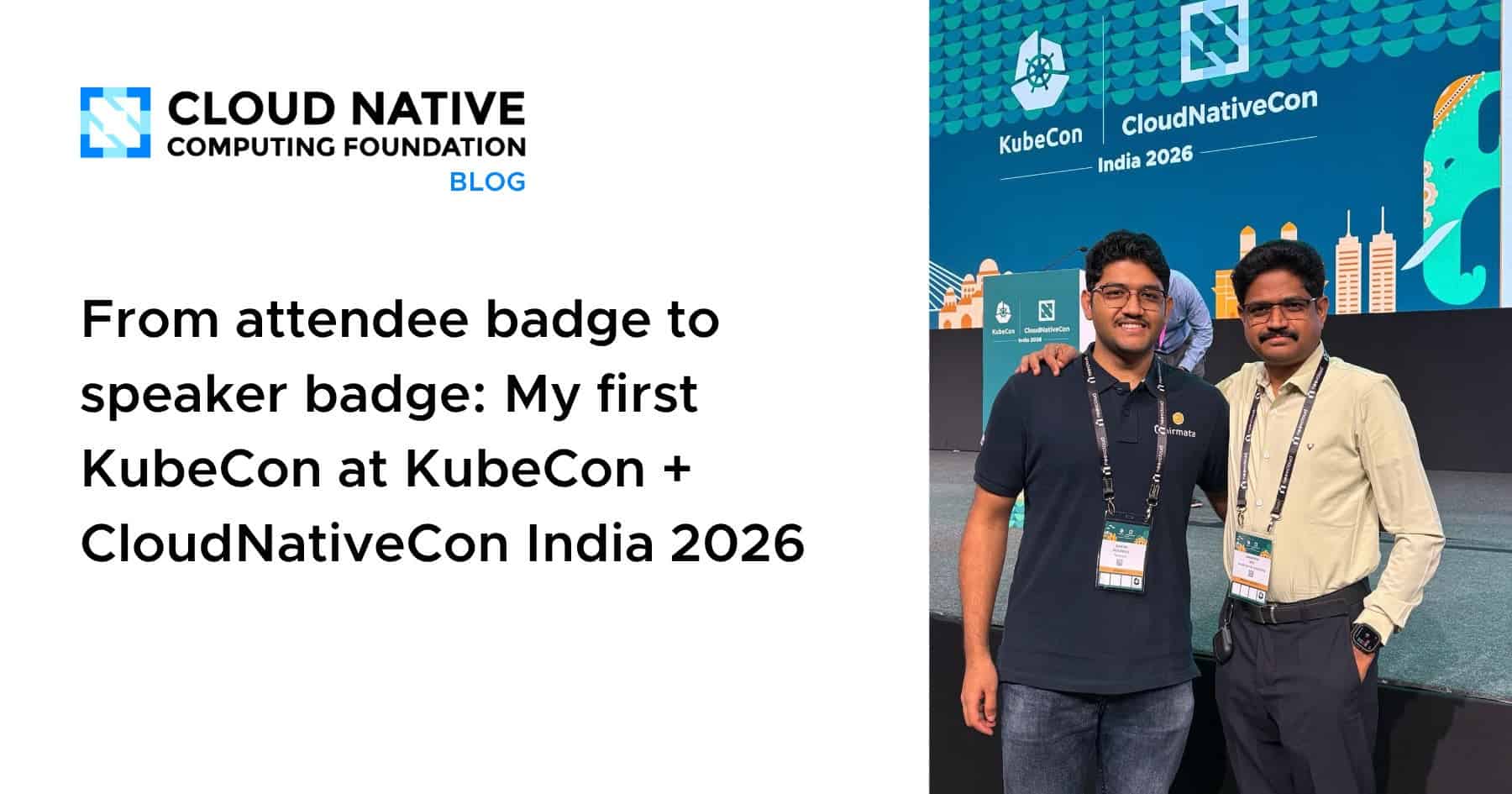
# Walking the Stage: A First-Timer’s KubeCon + CloudNativeCon Experience in Mumbai
The first time you step onto a stage at a conference of thousands, everything shifts. For one engineer and his father, KubeCon + CloudNativeCon India 2026 in Mumbai was not just their first time attending the event — it was their first time presenting at it. What followed was a week of technical talks, unexpected connections, and a deeper understanding of what makes the cloud native community truly special.
## Building an AI Cluster on the DGX Spark
The pair delivered a session titled “Run Your Own AI Cluster on a DGX Spark: Kubernetes, GPUs, and DRA,” walking attendees through the process of transforming NVIDIA’s DGX Spark hardware into a fully self-hosted AI infrastructure. The presentation covered the fundamentals of provisioning a Kubernetes cluster, making GPUs available to containerized workloads, and leveraging Dynamic Resource Allocation (DRA) to manage scheduling intelligently. The session culminated in serving machine learning models on infrastructure that is entirely owned and controlled by the user — no cloud dependency required.
Rehearsals were rigorous, and the audio-visual checks were non-negotiable. Standing before a packed auditorium can be daunting, but once the session begins, the technical passion for the subject matter tends to dissolve the nerves. The speaker later reflected that the experience of presenting to such a large audience confirmed that the preparation, no matter how thorough, only goes so far — the real connection happens when you speak about something you genuinely love.
## The Journey to the Golden Kubestronaut Pin
Two small pins became the most cherished souvenirs of the trip: the blue Kubestronaut pin and its golden counterpart. Earning the Golden Kubestronaut designation requires completing every certification offered by the Cloud Native Computing Foundation (CNCF). This is not a quick achievement — it demands months of hands-on labs, practice environments, and dedicated weekends of study.
What makes the journey meaningful is not the badge itself but the ecosystem that supports it. Open documentation, community-organized study groups, and free learning platforms form the backbone of this path. Interestingly, the engineer became the youngest individual in India to earn this distinction. The reactions from fellow attendees were humbling, and the experience reinforced a belief that the community invests freely in helping people grow.
## The Hallway Track: Where Real Connections Form
While conference sessions deliver knowledge, it is the informal hallway conversations that build community. Several memorable interactions defined the week:
– A generous and energetic community figure known for his content was discovered to be just as approachable and warm in person, leading to a genuine new friendship.
– The founder of a popular hands-on learning platform met the speaker for the first time in person, allowing for a heartfelt conversation about the role of practical labs in cloud native education.
– The founder of another community initiative insisted on capturing a photograph together upon learning about the Golden Kubestronaut milestone — a small but meaningful gesture that reflects how the community celebrates each other’s achievements.
– Meeting colleagues from work in person, putting faces to GitHub handles, and engaging with booth visitors transformed the conference from a distant gathering into something resembling a reunion that had been quietly waiting to happen.
## Surprising Discoveries for a First-Timer
Several candid observations emerged from the experience of attending and speaking at such a large-scale event for the first time:
**The scale is enormous but surprisingly welcoming.** Thousands of attendees fill a massive venue, yet the culture of approachability is strong. Maintainers, speakers, and founders all share the same corridors, and conversations flow naturally.
**A speaker badge opens doors.** Simply wearing the designation led to post-session discussions, idea exchanges, and even professional opportunities. Anyone hesitant about submitting a call for proposals should consider this alone as a compelling reason to try.
**India’s cloud native community is thriving.** The depth of technical questions, the energy in the sessions, and the notable presence of students and early-career professionals made it clear that the region is poised to play a defining role in shaping the future of this ecosystem.
## What Comes Next
Beyond the pins, the photographs, and the memories, the speaker carried home three lasting takeaways:
1. **Confidence** — The ability to deliver a technical talk on a KubeCon stage makes the next CFP submission feel far less intimidating.
2. **Relationships** — The connections formed during the week are the type that grow in value over years within this community.
3. **Direction** — Week-long conversations about GPUs, dynamic resource allocation, and AI on Kubernetes confirmed that this is exactly the intersection where meaningful work belongs.
For anyone in the early stages of their engineering career who wonders whether KubeCon + CloudNativeCon is worth attending or whether their talk idea has merit, the answer is a clear yes. The experience has a way of reshaping your sense of where you belong in a community. Write the talk, submit it, and show up.
—
## Frequently Asked Questions
**What is KubeCon + CloudNativeCon?**
KubeCon + CloudNativeCon is a major annual conference series organized by the Cloud Native Computing Foundation (CNCF). It brings together engineers, maintainers, founders, and enthusiasts working with Kubernetes and cloud native technologies. Events are held in regions around the world and feature technical sessions, workshops, exhibits, and extensive networking opportunities.
**What is Dynamic Resource Allocation (DRA)?**
Dynamic Resource Allocation is a Kubernetes feature that allows compute resources such as GPUs, FPGAs, and other specialized hardware to be dynamically requested and bound to workloads at runtime. DRA improves scheduling flexibility and enables more efficient utilization of scarce hardware resources in shared clusters.
**What is the DGX Spark?**
The DGX Spark is a compact AI workstation created by NVIDIA. It is designed for developers and small teams who want to run AI workloads locally. It features integrated NVIDIA GPUs and is capable of serving as a standalone AI development and inference platform that can be managed with Kubernetes.
**What does the Golden Kubestronaut certification signify?**
The Golden Kubestronaut title is awarded to individuals who have completed all available CNCF certifications. It demonstrates breadth and depth of knowledge across the cloud native ecosystem, covering foundational Kubernetes concepts, application development, security, observability, and more.
**How can someone prepare for a KubeCon CFP?**
Preparation involves identifying a topic you have hands-on experience with, drafting a clear and concise abstract, rehearsing the talk multiple times, testing all technical demonstrations in advance, and ensuring audio-visual requirements are accounted for. Community feedback from peers and study groups can also strengthen a submission.
**Why is the hallway track so important at KubeCon?**
The hallway track refers to the informal networking that happens in the corridors, lounges, and exhibit halls during a conference. Many lasting professional relationships, collaborations, and friendships begin here because attendees can have unstructured conversations with experts, maintainers, and peers that are not possible in scheduled sessions.
—
## Conclusion
Attending a KubeCon event as a first-timer is a transformative experience, and doing so as a speaker amplifies that transformation exponentially. The combination of deep technical content, a generous and welcoming community, and the energy of a region that is rapidly growing its cloud native presence creates an environment where engineers can learn, connect, and find their voice. The journey from earning certifications to standing on stage to forging friendships in a crowded exhibition hall is a testament to what open source communities can offer when people show up with curiosity and generosity. Whether you are a student, an early-career engineer, or a seasoned practitioner, the invitation to participate is open — and the rewards are far greater than expected.
Thank you for reading
