



# Workflows vs. Agents: How to Choose the Right AI Architecture
The rapid advancement of artificial intelligence has brought a flood of new terminology, and few terms are as misused as “agent.” Today, a simple chatbot with a few integrated tools is often labeled an agent, while a complex, multi-step document processing system might also claim the title. Even genuinely autonomous systems that adapt their strategies based on real-time observations get lumped into this category.
This overuse of the term leads to unnecessary complexity. Many applications are built as autonomous agents when a straightforward workflow would be cheaper, faster, and far more reliable. Before writing a single line of code, it is critical to understand the fundamental distinction between these two architectures and how to select the right one for your needs.
## What Is a Workflow?
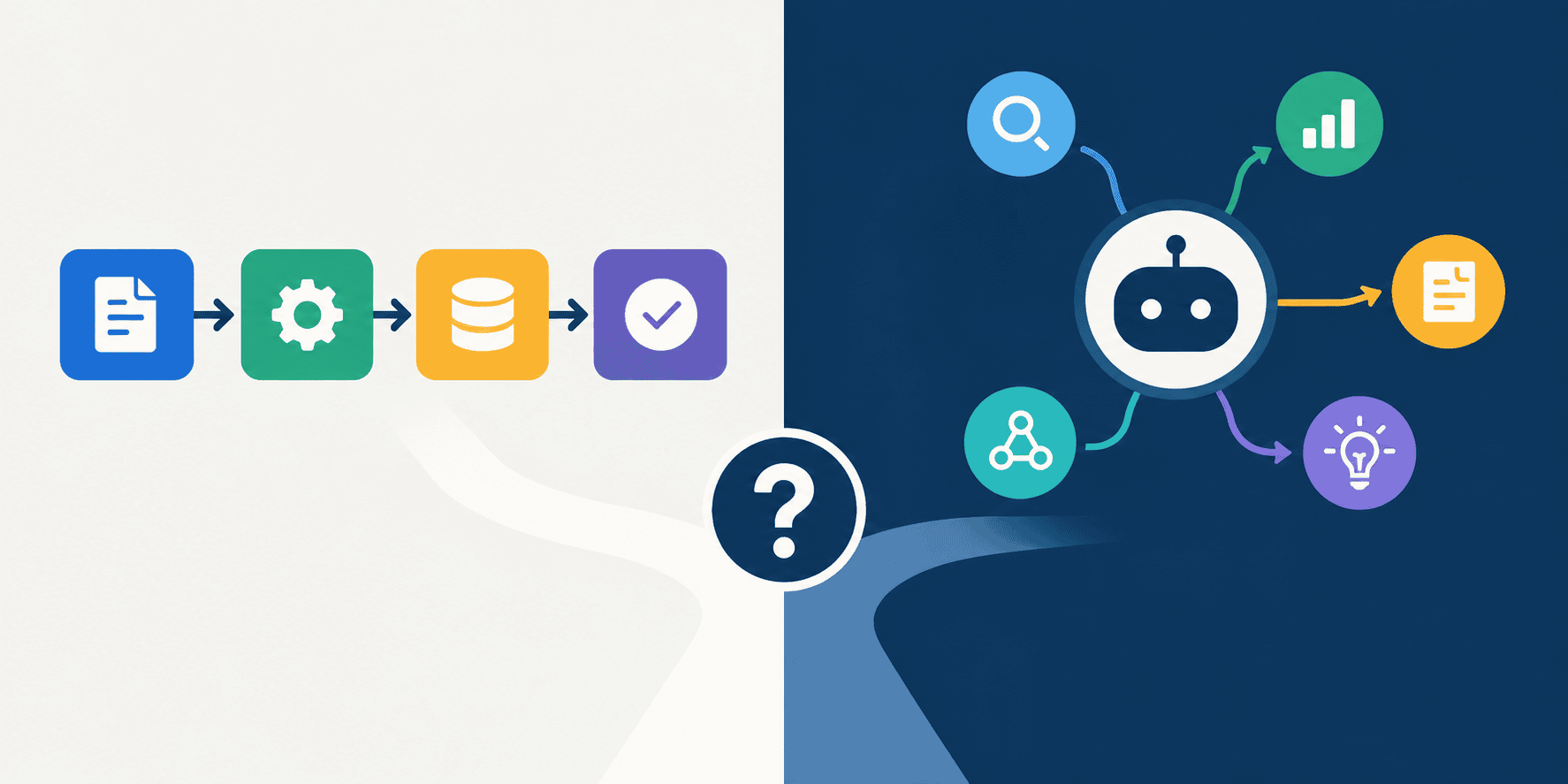
A workflow—also referred to as a pipeline or chain—is a system where the control flow is entirely fixed at design time. The developer determines the sequence of steps, the branching logic, the stop conditions, and the error handling beforehand.
You might still use a large language model (LLM) to handle specific steps within this sequence, making it a hybrid system, but the overall path the execution takes is predetermined. Consider a customer refund process. The sequence is logical and known in advance: verify the purchase, check the refund eligibility window, calculate the amount, and process the payout.
Even if an LLM is used to interpret the customer’s request or calculate the refund amount, the system cannot deviate from the established path. If you can sketch out every possible state and transition on a whiteboard before the system ever sees a request, you are looking at a workflow.
## What Is an Agent?
An agent is a system where the LLM itself determines what to do next at runtime. Rather than following a fixed script, an agent receives a high-level goal, has access to a suite of tools, and autonomously decides which tool to call, in what order, and when to stop. It can backtrack, loop, or alter its strategy based on intermediate results.
In an agentic system, the control flow lives with the model. Imagine a production outage where you ask the system: “Find out why checkout failures spiked in the last thirty minutes.”
You cannot possibly know the correct sequence of actions beforehand. For one incident, the system might check the error rate, inspect recent deployments, and identify a failing database connection. For a different incident, it might check the error rate, segment failures by geographic region, inspect CDN status, and discover a regional provider outage. The observation after each action dictates what happens next, which is the defining characteristic of an agent.
## The Practical Whiteboard Test
Before building anything, ask yourself this single question: Can I draw a complete flowchart of the task before the LLM ever runs?
If the answer is yes, and you can list the major steps and branches with reasonable confidence, build a workflow. If the next step depends entirely on what the system discovers during execution—such as new data, unexpected tool results, or intermediate findings—you likely need an agent.
A common mistake is assuming that workflows are simple and agents are sophisticated. This is false. A workflow can contain dozens of LLM calls, complex retrieval-augmented generation, retry logic, and intricate business rules. Conversely, a very simple system can still be agentic if the model itself decides what happens next.
## The Five-Point Decision Checklist
When debating between architectures, run through this checklist to guide your decision.
### 1. Can I list the major steps and branches before runtime?
If yes, choose a workflow. For instance, extracting information from an invoice and saving it to a database has a known path: read the document, extract the fields, validate the data types, and insert into the database. You do not need an agent to decide what happens next.
### 2. Is the input variability low enough that a decision tree remains maintainable?
If the range of possible inputs is narrow and predictable, a workflow is the better choice. If the inputs are highly open-ended and unpredictable—for example, “Help me solve this bizarre billing error”—an agent may be more appropriate because a fixed decision tree would quickly break down.
### 3. Is the application sensitive to volume, cost, and latency?
Workflows are inherently more efficient. Agents typically require more reasoning steps and tool calls, which translates directly into higher token consumption, more API requests, and increased latency. If you are processing thousands of routine requests per minute on a tight budget, stick to a workflow. Reserve agents for lower-volume, high-value tasks where the extra exploration is justified.
### 4. Do I need identical execution paths for audit or compliance?
If your system must go through the exact same documented checks every single time—for example, verifying identity, checking credit, applying a policy, and approving or rejecting an application—you need a workflow. If different investigation paths are acceptable as long as the final result is correct, an agent might be suitable.
### 5. Have I already tried a workflow with LLM judgment?
This is often the best starting point. You can build a fixed workflow and insert LLM-based judgment at key decision nodes. For example, in a support ticket system, a fixed workflow can classify the issue, check the policy, use an LLM to judge eligibility, and then process the refund. If this hybrid approach works well, you do not need a fully autonomous agent.
## Frequently Asked Questions (FAQ)
**Q: What happens if I use an agent for a task that could be a workflow?**
A: You will likely introduce unnecessary complexity, higher latency, and increased costs. Agents are harder to debug and their non-deterministic nature makes it difficult to guarantee consistent behavior, which can be a liability in regulated industries.
**Q: Can a workflow contain multiple LLM calls?**
A: Absolutely. A workflow is defined by its fixed control flow, not by the absence of AI. You can chain as many LLM calls, tool executions, and conditional branches as needed, provided the overall sequence is predetermined by the developer.
**Q: Is it possible to combine both workflows and agents?**
A: Yes. A common and effective pattern is to use a workflow for the main application structure and deploy an agent for a specific, bounded sub-task that requires dynamic problem-solving. You do not have to make an all-or-nothing choice.
**Q: How do I know if my system is truly agentic?**
A: If the execution path changes based on observations made while the system is running, it is agentic. If the system follows a script that was written before the request was made, it is a workflow.
## Conclusion
Agents are undeniably powerful tools for genuinely open-ended problems. However, for the vast majority of business processes, a well-designed workflow with targeted LLM calls is simpler, cheaper, more reliable, and far easier to maintain. The most practical approach is to start constrained. Draw the flowchart first. Build the workflow. Measure exactly where it fails. Only then should you consider whether an agent is actually required—and even then, you may only need one for a specific, bounded portion of the task.
Thank you for reading
