



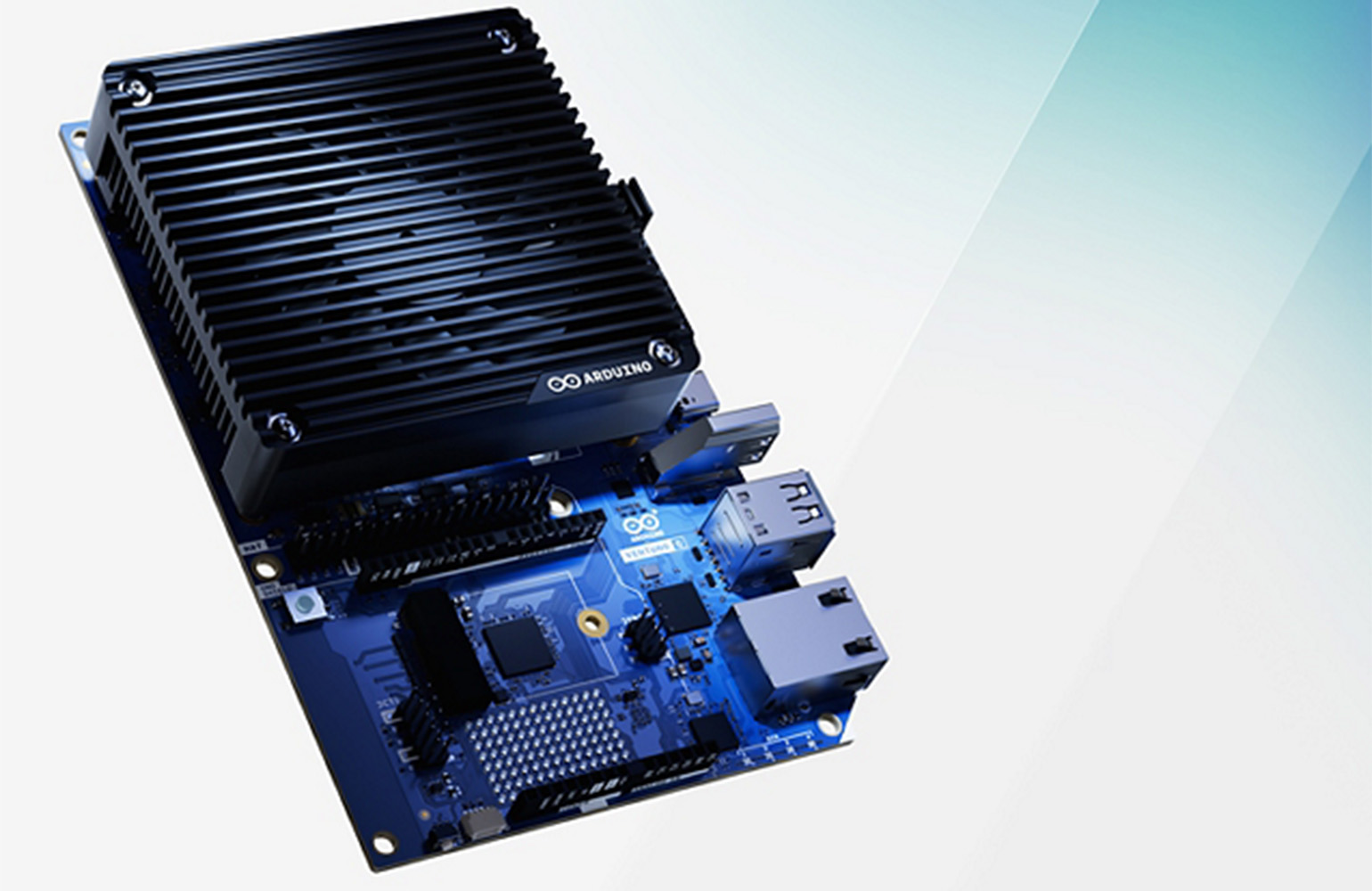
# Arduino Launches VENTUNO Q: A New Edge AI Platform Built for Robotics Developers
The robotics and embedded systems landscape is evolving rapidly, and a new development board aims to lower the barriers for engineers and hobbyists alike. Arduino, now operating under the umbrella of a major semiconductor company, has unveiled the VENTUNO Q — an edge artificial intelligence platform designed to bring sophisticated robotics development into reach of a broader audience.
## A Dual-Brain Architecture for Real-Time Intelligence
At the heart of the VENTUNO Q lies a two-tiered computing setup. The platform combines a high-performance application processor capable of delivering up to 40 trillion operations per second (TOPS) of AI inference capability with a dedicated real-time microcontroller for deterministic control tasks. The application processor supports 16 GB of LPDDR5 memory and 64 GB of onboard eMMC storage, with room for expansion via M.2 NVMe slots. Meanwhile, the microcontroller handles time-critical operations such as motor control, CAN-FD communication, pulse-width modulation signals, and high-speed general-purpose input/output management.
This split architecture is intentional: it allows the system to simultaneously interpret complex sensor data through AI workloads and physically react to its environment with minimal latency, all without relying on an internet connection.
## Why Edge AI Matters for Robotics
Running AI models locally on the device — rather than sending data to remote cloud servers — has become a critical requirement for real-world robotics. In environments such as warehouses, manufacturing floors, or remote industrial sites, unreliable or unavailable network connections make cloud-dependent AI impractical.
By embedding both reasoning and actuation capabilities into a single board, the VENTUNO Q eliminates the round-trip delay associated with cloud processing. This enables robots to perceive, decide, and act in real time, opening the door to autonomous mobile robots (AMRs), predictive maintenance systems, quality inspection tools, and interactive learning platforms.
## Getting Started: Arduino App Lab and Software Ecosystem
The VENTUNO Q ships with a full Linux distribution, giving developers immediate access to a familiar desktop environment. A curated suite of application templates — referred to as the Arduino App Lab — provides pre-optimized neural processing unit (NPU) models spanning areas like object and gesture recognition, speech processing, and multimodal AI.
Developers also have the flexibility to import custom models, train their own using integrated tools, or deploy large language models and vision-language models with just a few lines of code. The software environment supports popular tools such as Visual Studio Code and native Linux development workflows, ensuring that experienced engineers can integrate the board into their existing pipelines without a steep learning curve.
## From Prototype to Production: The Works with Arduino Program
One of the most compelling aspects of the VENTUNO Q is its scalability. Once a design is validated during the prototyping phase, the same core processor is made available in production-grade system-on-module (SOM) form factors through a program called “Works with Arduino.” This ensures that the software stack, trained AI models, and application logic developed on the evaluation board carry directly into manufacturing-ready hardware.
Industrial partners in the edge computing space are already on board with this initiative, providing a clear pathway from early development through commercial deployment. This is particularly valuable for original equipment manufacturers (OEMs) looking to build custom robotic solutions, industrial computers, or smart city infrastructure without starting from scratch.
## A Legacy of Robotics and a New Chapter
Arduino has been a staple in the robotics and electronics community for over two decades. Its open-source hardware philosophy and extensive library of compatible sensors, actuators, and shields have made it a go-to choice for education, research, and commercial prototyping across industries ranging from automotive engineering to space exploration.
The introduction of the VENTUNO Q marks a deliberate expansion into more advanced, AI-driven robotics applications. By pairing its accessible ecosystem with cutting-edge processing hardware, the company is positioning itself as a bridge between rapid prototyping and industrial-grade deployment.
## Frequently Asked Questions
**What is the Arduino VENTUNO Q?**
The VENTUNO Q is an edge AI development board designed for robotics and industrial applications. It features a dual-processing architecture that combines a high-performance AI-capable processor with a real-time microcontroller.
**What makes the VENTUNO Q different from standard Arduino boards?**
Unlike traditional Arduino boards focused on microcontroller-level tasks, the VENTUNO Q includes a powerful application processor capable of running AI models, large language models, and vision-language models locally at the edge. It also includes 16 GB of RAM and expandable storage, making it suitable for computationally intensive workloads.
**Does the VENTUNO Q require an internet connection to run AI models?**
No. All AI inference runs locally on the device, meaning it can operate entirely offline. This is a key advantage for deployments in environments with limited or unreliable connectivity.
**What programming tools are supported?**
Developers can use the Arduino App Lab for quick prototyping, Visual Studio Code for more advanced workflows, or native Linux development tools. The real-time microcontroller side is programmed using the Arduino Core running on Zephyr RTOS.
**Can I use my own AI models on the VENTUNO Q?**
Yes. The platform supports importing custom models in GGUF format, training and quantizing models through integrated tools, and deploying models using Qualcomm’s open-source on-device generative AI runtime.
**What industries is the VENTUNO Q suited for?**
The board targets autonomous mobile robots, industrial edge AI, smart city infrastructure, real-time quality inspection, predictive maintenance, and STEM education.
**What is the Works with Arduino program?**
This program allows OEMs to transition from prototyping on the VENTUNO Q to production-grade hardware using the same processor family, preserving their software and AI models throughout the process.
## Conclusion
The Arduino VENTUNO Q represents a significant step forward in making advanced edge AI and robotics development accessible to a wider range of creators. By combining high-performance processing, real-time control, and a familiar software ecosystem, the platform addresses the growing need for intelligent, autonomous systems that can operate reliably in the field without cloud dependence. As the company continues to expand its partnerships and tooling, the VENTUNO Q could become a key enabler for the next generation of smart, connected robots.
Thank you for reading.
