



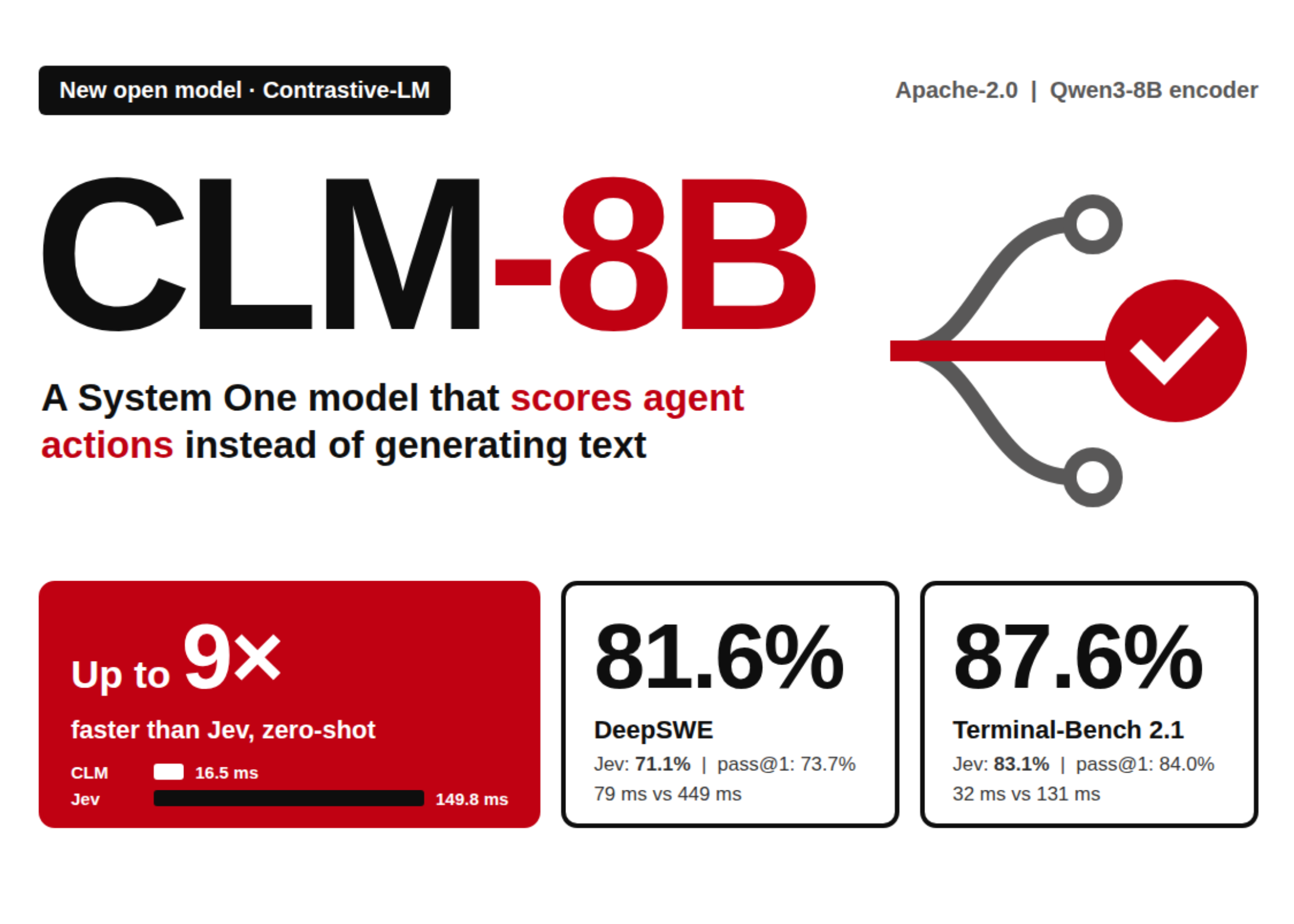
# Contrastive Language Models: A New Paradigm for Typed Decision-Making in AI
The landscape of large language models is expanding beyond pure text generation into structured decision-making. A recent release introduces a novel model architecture designed not to produce prose, but to evaluate and rank discrete actions given a specific context — returning structured, typed outputs with associated probabilities. This approach sits at the intersection of language modeling and classification, offering a compelling alternative to the generation-heavy paradigm that has dominated AI for the past several years.
## The Core Idea: Scoring Over Generating
Traditional language models work by producing a sequence of tokens, one at a time, to form coherent text. The new approach takes a fundamentally different path. Instead of generating anything, the model takes a current system state and a set of candidate actions, then scores each action against that state. The output is a probability distribution over the candidates — a clean, typed answer rather than free-form language.
This design mirrors what some researchers refer to as a “System One” model: fast, direct, and purpose-built for decision tasks. The model returns values with explicit probabilities, making it well-suited for applications where structured outputs are required — such as routing user queries, selecting tools in an agent pipeline, or making binary judgments about the truth of a statement.
## Architecture and Design
At the heart of the model lies a dual-encoder framework. One encoder processes the current state of the system; the other encodes each candidate action. Both encoders share the same underlying backbone — a frozen language model with a small trainable projection head attached to each side. This projection head is the only part of the network that learns during training, keeping the heavy backbone intact and dramatically reducing the training footprint.
The training objective is a bidirectional contrastive loss. During each step, the model pulls the state embedding toward the action embedding that was actually taken and pushes it away from all other candidate actions. This simple mechanism teaches the system to build a meaningful relationship between contexts and the best available responses.
At inference time, scoring is fast and elegant. The model computes the dot product between the state embedding and each action embedding, applies a softmax to convert the raw scores into a probability distribution, and returns the result. This same primitive can rank the top candidates, route tool calls, or make typed decisions depending on the query format.
## Efficiency Through Disaggregation
A particularly clever aspect of this architecture is how it separates state encoding from action encoding. In any agent loop, the state changes at every step, but the available actions typically remain the same. By encoding actions once and caching their vectors in GPU memory, the system can reuse them across repeated calls.
This caching strategy is analogous to the KV cache used in traditional inference servers. Benchmarks show that when states are revisited, encoding time drops dramatically — from well over a millisecond to a fraction of that, even with dozens of candidate actions. This efficiency makes the model practical for real-time, iterative decision-making workflows where latency matters.
## Training Pipeline
The model was trained in three sequential stages. The first stage involved pre-training on a large corpus of question-answer pairs sourced from scientific and technical datasets, using the question as the state and the answer as the action. The second stage introduced synthetic hard negatives — plausible but incorrect answers generated by a separate model — to sharpen the model’s ability to distinguish subtle differences between candidates. The final stage fine-tuned the model on a curated collection of agent trajectories and terminal interaction logs, grounding the learned representations in real-world decision patterns.
This staged approach proved critical. Training on hard negatives from the very beginning led to peak performance at an intermediate point before overfitting, whereas introducing them after initial pre-training yielded substantially better final accuracy. The progressive refinement allowed the model to build broad semantic understanding before narrowing its focus on difficult discriminations.
## Performance Highlights
In head-to-head comparisons against a proprietary decision model, the open-source release demonstrated strong results across a diverse set of benchmarks. On game-playing tasks such as navigating a classic arcade environment and playing a well-known platformer, the model matched its proprietary counterpart in success rate while running significantly faster. On tool-use benchmarks, it achieved competitive accuracy, though the proprietary model maintained a slight edge on raw success rate. In a knowledge-navigation task involving multi-hop reasoning, the proprietary model achieved perfect scores while the new model came close, albeit with substantially lower latency.
Perhaps most notably, when used as a verification layer for coding agents — where a generator proposes multiple solutions and a verifier selects the best one — the new model consistently outperformed the proprietary system. It improved pass rates on both a software engineering benchmark and a terminal execution benchmark while operating several times faster. This combination of accuracy and speed positions the model as a strong candidate for production agent systems where throughput and reliability are both critical.
## Deployment and Accessibility
The model is released under an open permissive license, making it freely available for both research and commercial use. The lightweight model head requires minimal storage, and the system is designed to run on a single consumer-grade GPU with standard inference serving software. A Python client library is available to interface with the model, and it exposes a TypeSafe-compatible API that supports three query modes: probability-of-truth queries, multi-choice selection with probabilities, and scalar scoring on ordered rubrics.
## FAQ
**What is a Contrastive Language Model?**
A Contrastive Language Model (CLM) is an architecture that scores a set of candidate actions against a given state, returning a probability distribution over the candidates rather than generating text. It uses a dual-encoder setup with a contrastive training objective to learn the relationship between contexts and optimal actions.
**How is this different from a standard language model?**
Standard language models generate token sequences to produce text. A CLM does not generate anything; it acts as a scorer. Given a state and a list of possible actions, it returns the probability of each action being the right choice. This makes it fundamentally a classification and ranking system rather than a text generator.
**What kinds of tasks is this model good for?**
The model excels at tasks that require structured, typed decisions — tool selection in agent systems, routing queries to the correct handler, verifying code solutions, judging whether a statement is true, selecting the best option from a fixed set, or estimating a score on an ordered scale.
**What hardware do I need to run this model?**
The model can run on a single NVIDIA GPU under Linux. The lightweight model head weighs approximately 75 MB and integrates with standard serving infrastructure. A consumer-grade GPU such as an RTX 4090 is sufficient for most use cases.
**Does the model work with existing agent frameworks?**
Yes. The model exposes a TypeSafe-compatible API, and its Python client can replay requests written for compatible systems. This makes it straightforward to plug into existing agent pipelines as a decision or verification layer.
**How accurate is the model compared to proprietary alternatives?**
In zero-shot evaluations, the model matched a proprietary counterpart on several tasks while outperforming it on speed. When fine-tuned for verification use, it surpassed the proprietary system on both accuracy and latency across multiple benchmarks.
**What is the training data composition?**
Training spans three stages: pre-training on roughly 60 million question-answer pairs, mid-training on approximately 30 million synthetic hard negatives, and post-training on roughly 1 million real agent trajectories and terminal interaction logs.
## Conclusion
The emergence of Contrastive Language Models represents a meaningful shift in how AI systems approach decision-making. By moving away from text generation toward structured scoring and ranking, this approach offers advantages in latency, determinism, and integration with typed workflows. The open release of a fully functional model under a permissive license lowers the barrier for teams looking to build reliable, fast decision layers into their agent systems.
The results on coding-agent verification are particularly promising, demonstrating that a well-designed contrastive model can serve as both a high-accuracy selector and a low-latency component in production pipelines. As agent systems continue to grow in complexity, the demand for efficient, structured decision-making components will only increase — and this new class of models is well-positioned to meet that demand.
Thank you for reading
