



By Marc Kavinsky, Lead Editor at IoT Business News.
Telefónica España and Sateliot have reached a partnership agreement to create 5G NR non-terrestrial network solutions, merging ground-based mobile networks with LEO satellites. This initiative targets extending connectivity into isolated and off-grid locations, with special emphasis on sectors like defense, security and other mission-critical fields.
The stubborn limitation of cellular networks is their reliance on physical geography. Industrial facilities, maritime operations, border regions, and temporary mission-critical deployments still face coverage gaps on the ground, even as private 5G networks grow more powerful. This understanding forms the foundation of the new Telefónica España-Sateliot deal, which centers on bridging terrestrial 5G with satellite systems rather than keeping them as independent connectivity channels.
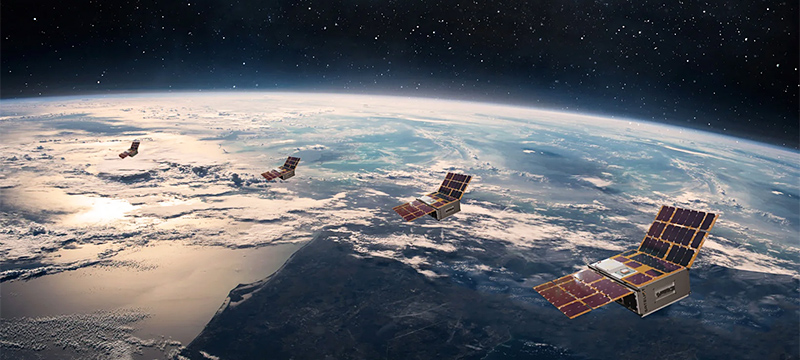
The two companies announced they will jointly develop 5G NR-based non-terrestrial network solutions, designing a hybrid model that couples ground-level mobile networks with low Earth orbit satellites. Their stated goal is to bring connectivity to remote, maritime, and otherwise unreachable areas, as well as to support security and defense-critical services.
What sets this announcement apart is its technical approach. Most satellite IoT collaborations today focus on parallel service models, where satellite is treated as a separate add-on layer for particular devices, applications, or agreements. In contrast, this deal prioritizes 3GPP-standard convergence around 5G NR-NTN and compatibility with terrestrial 5G setups, including what Telefónica calls 5G tactical bubbles. This signals a design philosophy where satellite coverage serves as a natural extension of mobile network infrastructure, not merely as an emergency backup.
The scope of the agreement also extends beyond broad coverage promises. Telefónica will focus on customizing 5G NR for defense and security needs, including ground integration and military interoperability, while Sateliot will bring its LEO satellite-based connectivity platform for 5G NTN IoT services. Both companies also intend to run pilots and develop advanced satellite connectivity features for critical communications.
This detail holds real significance because interoperability is usually the major stumbling block for hybrid terrestrial-satellite projects. A pilot focused on testing how different network types cooperate suggests that the core challenge is no longer just signal availability, but ensuring seamless service across widely varying operating environments. Put more practically, this means the true value here is less about expanding the coverage map and more about confirming whether devices, network rules, and field workflows can transition smoothly between terrestrial and non-terrestrial access.
For OEMs and system integrators, this distinction carries weight. When satellite connectivity is built within a standards-based 5G framework, it can lessen the need to manage entirely separate device strategies for remote deployments. That does not eliminate integration challenges, particularly in defense-grade settings, but it outlines a route toward applying existing cellular concepts like roaming, SIM-based identity, and unified network management across a broader coverage scope.
The prior history behind this partnership also clarifies why this announcement goes well beyond a preliminary statement of intent. Telefónica and Sateliot noted that they had already conducted an end-to-end test in 2023, overseen by ESA, confirming standard roaming between Telefónica’s ground network and Sateliot’s LEO constellation using an ordinary SIM card. That initial phase centered on mobile-satellite convergence for uninterrupted IoT. The new partnership shifts the focus toward real-world use cases and advanced 5G NR capabilities for more complex scenarios.
Seen from a broader industry angle, this deal mirrors a larger transformation in satellite IoT. The discussion is steadily shifting away from standalone satellite connectivity packages toward deeper integration with established cellular standards and carrier-grade environments. This shift benefits connectivity providers by giving them the ability to expand service territories without pushing enterprises into wholly separate communications architectures. It also matters to industrial and public-sector users who require dependable connectivity in places where terrestrial coverage is absent, unstable, or deliberately temporary.
A strategic dimension also comes through in the sectors the companies have identified. Security and defense operations demand reliable coverage, network resilience, and portable communications. A hybrid approach linking terrestrial 5G with LEO satellite access, therefore, is not just a solution for remote sensor data. It is about enabling operations in environments where infrastructure may be limited, constantly on the move, or under threat.
For the wider IoT ecosystem, the importance of this partnership rests on that convergence. Sateliot contributes satellite non-terrestrial network capability, while Telefónica delivers terrestrial 5G integration with sector-specific customization. Should the pilots demonstrate reliable interoperability, the outcome could offer a more cohesive operational model for stretching 5G-based IoT and critical communications well beyond the boundaries of traditional cellular networks.
