



**New macOS Malware Campaign Uses Fingerprinting Gate to Evade Detection**
A sophisticated macOS ClickFix operation has been observed leveraging an advanced fingerprinting mechanism to selectively target victims and evade automated security analysis. According to a report by Microsoft Threat Intelligence, the campaign has spanned over 250 front-end domains and implemented a server-side gate that serves malicious content only to legitimate-looking Apple devices.
The infrastructure analyzed by Microsoft distributed payloads including **MacSync** and **Atomic Stealer (AMOS)**. The attack chain requires user interaction, specifically instructing the victim to copy and run an obfuscated command in the Terminal. Once executed, this command retrieves additional scripts and launches an infostealer designed to harvest credentials, browser data, authentication stores, cryptocurrency wallets, and sensitive files.
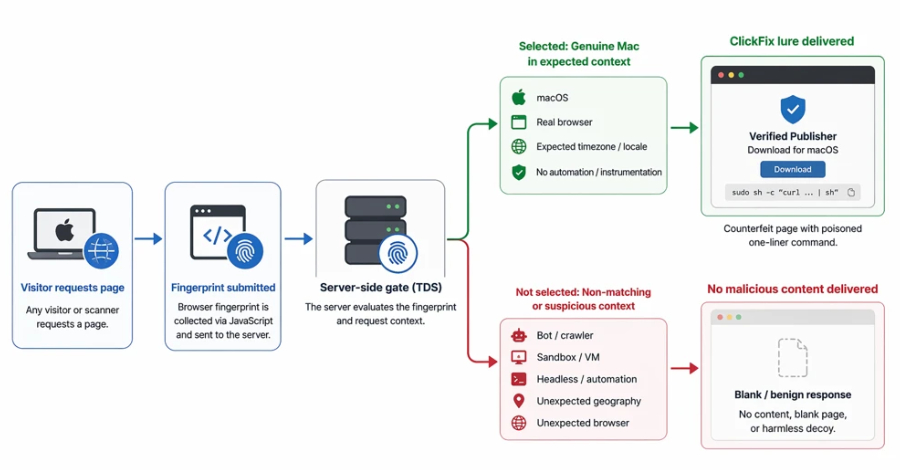
A key tactic in this operation is the use of a JavaScript-based fingerprinting gate. Before delivering the malicious payload, the server-side script analyzes numerous browser and device characteristics, including the platform string, screen dimensions, timezone, WebGL signals, and even specific browser capabilities like `canPlayType(“video/mp4”)`. This sophisticated gating mechanism effectively hides the malicious page from crawlers and sandboxes, presenting harmless content to security researchers or users in unwanted geolocations. Only requests that appear to come from a genuine Mac environment are served the lure, which often appears as a GitHub-themed “Download for macOS” page with a forged “Verified Publisher” badge.
Microsoft emphasized that the decision to serve malicious content is made server-side for every request, meaning the same domain can present entirely different pages to different visitors. The company has tracked this shifting infrastructure throughout August 2026 and noted that the patterns observed are indicators for defenders to hunt, rather than the final payload itself.
Microsoft advises users to **never paste text into the Terminal** when prompted by websites, CAPTCHAs, chats, or any download instructions.
—
### FAQ
**Q: What is a ClickFix operation?**
A: ClickFix is a social engineering tactic used in cyberattacks where victims are tricked into performing dangerous actions, such as pasting commands into their Terminal, under the guise of solving a problem or downloading software.
**Q: Which malware families are associated with this campaign?**
A: Microsoft identified the distribution of **MacSync** and **Atomic Stealer (AMOS)**, with the analyzed chain specifically leading to AMOS, an infostealer targeting macOS users.
**Q: How does the fingerprinting gate work?**
A: The gate uses JavaScript to collect device and browser information, such as platform strings, screen resolution, and API availability. It checks for signs of analysis environments (like open developer consoles) and only serves the malicious lure to devices that appear to be genuine Macs.
**Q: What should I look for to defend against this attack?**
A: Security teams should monitor for unusual Terminal activity following web browsing, particularly commands involving `curl`, `zsh`, `Base64` decoding, `osascript`, and outbound HTTP POST requests.
**Q: Has Microsoft disclosed the number of victims or the identity of the attackers?**
A: No, Microsoft has not disclosed victim numbers, targeted sectors, or the identity of the operators behind this campaign.
—
### Conclusion
This macOS campaign represents a significant evolution in evasion techniques, shifting from simple social engineering to a multi-layered approach that includes server-side fingerprinting and selective victim targeting. While Apple has introduced new protections in macOS 26.4 and XProtect enhancements, the core defense remains user caution. The most critical takeaway is that no legitimate service will ever ask you to paste commands into Terminal. Refusing this step remains the most effective way to protect yourself against this and similar attacks.
