



**Building a Flexible, Automated Line for High-Mix Lubricant Distributor Assembly**
In modern manufacturing, the demand for mass production efficiency often clashes with the need for flexibility. This challenge is particularly acute in the lubrication component sector, where SKF, the world’s largest manufacturer of bearings, produces thousands of variants of lubricant distributors and metering units. These variants share the same fundamental assembly process but differ in technical details, and the production volume for many variants is relatively low—often just a few hundred units per batch.
Facing these complexities, SKF partnered with TEAM Automation Berlin, a systems integrator with over two decades of experience in custom automation, to design a single production line capable of handling this high-mix assembly without sacrificing speed or quality.
### A Solution Built for High-Mix Assembly
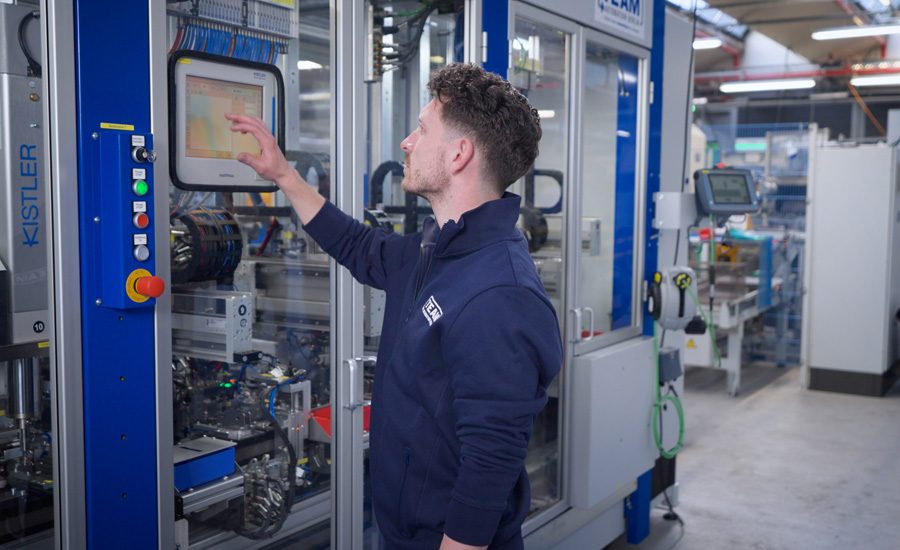
TEAM Automation’s solution is a fully automated, modular assembly line built around a longitudinal transfer system. All components are automatically fed into the line, assembled, inspected, and packaged. By synchronizing the movements of all workpiece carriers in fixed cycles, the system ensures smooth and efficient operation.
Matt Nowak, CEO of TEAM Automation, notes that the system is “mathematically capable of producing several thousand variants.” What’s more, it can even process up to two different product variants simultaneously without interrupting the production flow—effectively combining the efficiency of mass production with the flexibility typically associated with low-volume jobs.
### The Joining Challenge: Precision and Flexibility
At the heart of the assembly process is the sealing stage, where distributors are either screwed shut or sealed by pressing in a disc. Because these discs vary in size, thickness, and material, the pressing operation must be both exceptionally precise and highly adaptable.
For this critical task, TEAM Automation selected the Model NCFE electromechanical joining modules from the Kistler Group. These modules feed discs individually into position and move them into the pressing area with exact synchronization to the workpiece carrier’s motion.
The resulting cycle time is just five seconds. The electromechanical press moves rapidly into position, performs the joining operation with precision, and retracts quickly—ready for the next component.
### Smart Monitoring and Control
The entire joining process is governed by force and displacement sensors built into the press, along with Kistler’s maXYmos NC process monitoring system. This system analyzes each press-fitting operation and documents force-distance curves to ensure consistency and repeatability.
Perhaps most importantly, the control system can adapt to different product variants automatically—without requiring mechanical adjustments or downtime. This capability is central to maintaining both quality and flexibility on the same line.
### A Partnership Built on Reliability
According to Nowak, reliability was a key criterion when choosing components for the system. Kistler’s joining technology was selected based on its speed, durability, and ability to reduce operating costs and scrap.
TEAM Automation and Kistler have a long-standing collaborative relationship, which proved invaluable in meeting the project’s tight timeline and demanding technical requirements. “Our long-standing experience in joint projects, and the short decision-making processes have been instrumental,” Nowak explains.
### FAQ
**Q: What type of products can this automated line assemble?**
A: The line is designed to assemble thousands of variants of lubricant distributors and metering units, making it suitable for high-mix production environments.
**Q: How is product changeover handled on this line?**
A: The modular design and intelligent control system allow for quick adaptation between variants without mechanical adjustments or time-consuming changeovers.
**Q: What role does Kistler’s technology play in the process?**
A: Kistler’s NCFE joining modules and maXYmos NC process monitoring system provide the precision, flexibility, and real-time data analysis needed to maintain quality across varying product configurations.
**Q: What cycle time can be achieved with this system?**
A: The joining cycle is completed in approximately 5 seconds, enabling high throughput while maintaining accuracy.
**Q: How does the system handle multiple variants simultaneously?**
A: It can process up to two different variants in parallel without interrupting the production flow, further increasing efficiency.
### Conclusion
TEAM Automation’s solution for SKF demonstrates how advanced modular design, electromechanical execution, and smart process monitoring can converge to solve complex high-mix assembly challenges. By integrating Kistler’s precision joining technology and flexible control systems, the automated line delivers both speed and versatility—allowing SKF to meet diverse customer demands without compromising on quality or efficiency. For manufacturers facing similar production hurdles, this partnership offers a compelling model for modern, adaptable assembly automation.
