



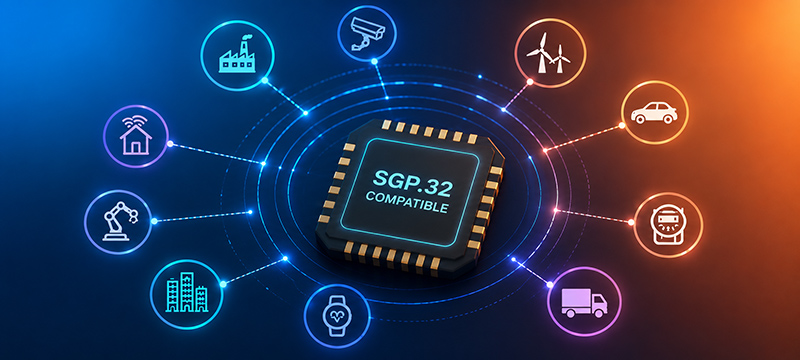
**The Future of Cellular IoT: Remote SIM Provisioning Standards Set for Dominance by 2035**
The landscape of cellular Internet of Things (IoT) is poised for a significant transformation over the next decade, driven by the evolution of Remote SIM Provisioning (RSP) standards. According to a new forecast from Transforma Insights, the industry is moving decisively toward a model where the vast majority of new cellular IoT device shipments will support remote provisioning. This shift will be characterized by a clear leader in the standards race and a fundamental change in how connectivity is managed for billions of devices.
For years, the connectivity management ecosystem has been governed by the GSMA’s suite of RSP standards, primarily SGP.02 and SGP.22. However, the new analysis indicates a major paradigm shift is underway. The research predicts that by 2035, standards-based RSP capability will be a feature of 57% of all cellular IoT device shipments. More notably, the GSMA’s SGP.32 standard is set to become the dominant protocol, accounting for 53% of all cellular IoT shipments by the end of the forecast period. This represents a significant consolidation away from the more fragmented approaches of the past.
The forecast, titled *‘Remote SIM provisioning forecast: SGP.32 will account for 53% of cellular shipments in 2035,’* marks an update to Transforma Insights’ 2023 outlook. The revision was necessary because the commercial deployment of SGP.32 has progressed faster than initially anticipated. As fully compliant solutions begin to enter the market in 2026, the entire trajectory of the RSP market is being re-evaluated.
### A Shift in the Technological Landscape
The projected growth is nothing short of monumental. Annual shipments of devices capable of supporting standards-based RSP are expected to surge from 88 million in 2025 to a staggering 642 million by 2035. Consequently, the proportion of RSP-capable devices in the total cellular IoT market will skyrocket from just 19% in 2025 to 57% a decade later.
This growth will not be uniform across the three existing standards. The analysis highlights a clear transition in market leadership:
* **SGP.02 (The Legacy Standard):** Originally designed for traditional Machine-to-Machine (M2M) applications, SGP.02 is forecast to see its market share decline steadily. While its installed base will remain significant for years due to the long operational lifespans of devices in sectors like connected vehicles, its role in new annual shipments is set to diminish.
* **SGP.22 (The Consumer-Focused Standard):** Developed for consumer devices with user interfaces for manual profile management, SGP.22 will continue to grow, but its scope is relatively specialized. Its contribution is expected to peak at just 3% of total cellular IoT shipments by 2035.
* **SGP.32 (The Rising Star):** This standard is expected to experience explosive growth, with annual shipments reaching nearly 600 million units by 2035. It will overtake SGP.02 as the leading RSP approach in 2027 and become the majority standard in all cellular IoT shipments from 2034 onwards.
### Methodology and Market Insights
These forecasts are not based on broad assumptions but on a detailed bottom-up analysis. Transforma Insights’ analysts evaluated the likelihood of adoption across 164 different cellular IoT applications, derived from a pool of 270 distinct IoT use cases. Instead of assuming universal adoption, the methodology assessed each application individually. Key factors included whether a device is deployed internationally, its expected lifetime, coverage requirements, data usage, power constraints, user interaction needs, and the underlying radio technology (e.g., 4G, 5G). This granular approach determines whether a specific application derives enough value from RSP to justify its implementation.
The data also reveals a strong correlation between RSP adoption and connectivity technology. SGP.32 adoption is forecast to be highest in higher-bandwidth 5G deployments, which are common in enterprise and automotive sectors. In contrast, lower-bandwidth 5G technologies like mMTC, including NB-IoT, are expected to adopt the standard at a slower pace.
Perhaps the most significant commercial insight from the report is the relationship between RSP and revenue. While RSP capability will be present in 57% of device shipments by 2035, these high-value applications are projected to account for more than 70% of cellular IoT ‘Value Added Connectivity’ revenue. This underscores the fact that higher-value IoT applications, such as those in enterprise and automotive fields, place a premium on the flexible connectivity management that SGP.32 provides throughout a device’s lifecycle.
### Conclusion and The Future of Connectivity Management
The ultimate conclusion drawn by Transforma Insights is that enterprise demand for SGP.32 is clear and compelling, even if end-users are sometimes uncertain about the specific functionalities they require. “Enterprise customer demand levels are very high,” the report notes, “even if there might be some vagueness about what specific capabilities they might want to use.” The report affirms that SGP.32 is a powerful tool for streamlining connectivity management, but it is not a complete solution in itself.
Looking beyond the forecasts, the report’s final insight is that SGP.32 will transition from a premium feature to a baseline expectation within cellular IoT connectivity offerings. As adoption becomes universal, competitive differentiation will no longer be driven by the RSP standard itself. Instead, the battle will be won in the realm of broader managed connectivity services, encompassing operational support, regulatory compliance, seamless integration, and superior customer service. The future of IoT connectivity is not just about *how* a device connects, but about the comprehensive value proposition surrounding that connection.
—
### FAQ: Remote SIM Provisioning (RSP) Standards
**Q1: What is Remote SIM Provisioning (RSP)?**
Remote SIM Provisioning (RSP) is a technology that allows the SIM card profile within a cellular-enabled IoT device to be activated, managed, or changed over the air (OTA). This eliminates the need for physical access to the device to swap SIM cards, which is crucial for devices deployed in hard-to-reach locations or at scale.
**Q2: What are the different GSMA RSP standards (SGP.02, SGP.22, SGP.32)?**
The three main standards are:
* **SGP.02:** The original M2M standard, designed for basic, closed-loop enterprise applications without a user interface.
* **SGP.22:** Designed for consumer devices (like wearables or tablets) that have a user interface to confirm profile downloads and management.
* **SGP.32:** The newest and most comprehensive standard, designed to be an all-encompassing solution for both consumer and enterprise IoT. It combines the best features of its predecessors and is built for modern, scalable connectivity management.
**Q3: Why is SGP.32 becoming the dominant standard?**
SGP.32 is gaining dominance because it is a holistic standard designed for the entire IoT market. It is more flexible, scalable, and suited for a wider range of applications, from low-power IoT to high-bandwidth 5G use cases like connected vehicles. Its ability to handle the full lifecycle of a device makes it ideal for enterprise and automotive sectors, which represent high-value connectivity revenue.
**Q4: What does the forecast mean for the cellular IoT market?**
The forecast signals a maturing and consolidating market. As SGP.32 becomes the standard, the focus for connectivity providers will shift. Simply offering RSP will no longer be a differentiator; instead, the value will lie in the services built on top of it, such as advanced analytics, security, compliance management, and dedicated customer support.
**Q5: Will SGP.02 completely disappear?**
No. While its share of new deployments will shrink significantly, SGP.02 will remain relevant for the foreseeable future due to the extremely long operational lifespans of devices in sectors like automotive and industrial IoT. The installed base of SGP.02 devices will persist for many years.
