



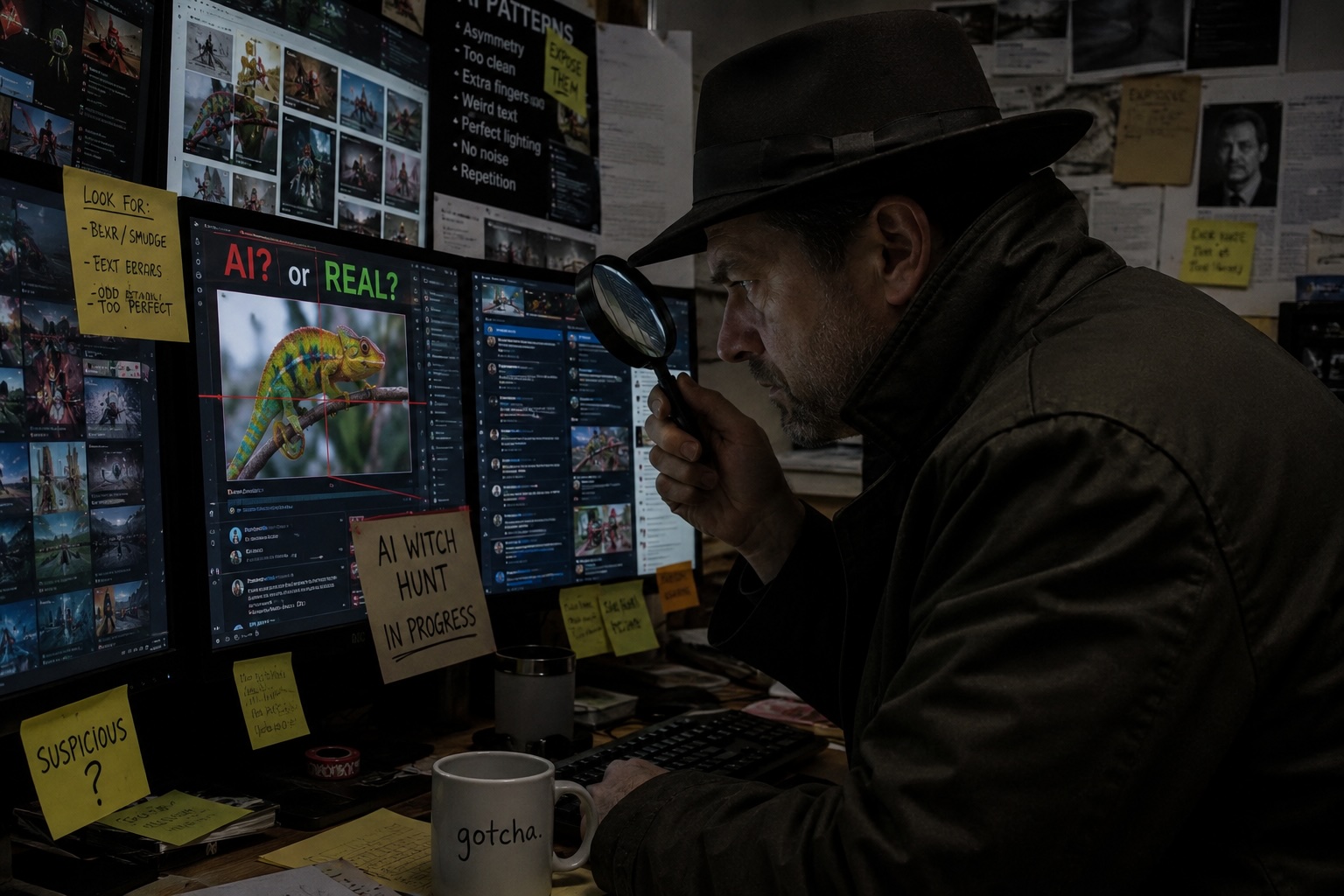
**Article: Spotting LLM Content: The Patterns, Pitfalls, and Promise of AI Detection**
In today’s AI-driven information ecosystem, distinguishing human-written content from Large Language Model (LLM) output has become both a technical challenge and a cultural preoccupation. From subreddit moderators hastily banning “AI slop” to researchers uncovering systematic linguistic fingerprints, the effort to detect LLM-generated text reveals a complex interplay of technology, bias, and human psychology. This article explores the subtle—and sometimes not-so-subtle—patterns that LLMs exhibit, why even confident readers get it wrong, and what this means for the future of authorship and authenticity.
—
### The Illusion of Certainty: Why “AI Detection” Is Harder Than It Looks
A common misconception is that AI-generated content can be easily flagged with a universal “AI” stamp. In reality, detection tools often suffer from **low precision and high recall**, meaning they cast a wide net—flagging both AI and human text as suspicious. A telling example is an article written years before ChatGPT’s public launch, which was nonetheless flagged as AI-generated by moderators. This highlights how context, such as publication date, is often overlooked in favor of algorithmic suspicion.
Modern LLM-detection models don’t search for a single smoking gun; instead, they look for **statistical anomalies and stylistic patterns** that differ from typical human writing. But these patterns are neither foolproof nor permanent—they evolve alongside the models themselves.
—
### Common LLM “Tells”: What to Watch For
#### 1. Vocabulary and Word Choice
LLMs show a measurable preference for certain words—often called **“excess vocabulary.”** Words like *delve*, *intricate*, *meticulous*, *tapestry*, *realm*, and *showcase* appear more frequently in AI-generated text than in human writing. Research shows that after ChatGPT’s release, usage of terms like “delve” spiked dramatically in academic and online texts, not because humans suddenly changed their language, but because LLMs were trained on datasets that reinforced such choices.
Other flagged terms include:
> *delve, boast, intricate, tapestry, realm, showcase, pivotal, underscore, meticulous, leverage, robust, seamless, testament, comprehensive, multifaceted, navigate, notably, interplay*
While none of these words are inherently problematic, their clustering and frequency can act as a warning sign.
#### 2. Name Priors and Ghost Authors
LLMs tend to generate recurring fictional names—what researchers call **“name priors.”** Studies reveal that models like Claude, GPT, and Gemini disproportionately produce certain name combinations:
– Claude: *Elena Vasquez, Marcus Chen, Amara Okafor*
– GPT: *Elara Voss*
– Gemini: *Aris Thorne, Lena Petrova*
These names often appear together in fabricated citations, fake research papers, and AI-generated templates. If an article features improbable author lineups like *Marcus Webb, Elena Vasquez,* and *Lena Chen*, it’s worth a closer look.
#### 3. Rhetoric and Sentence Structure
LLMs are trained on human preferences, which shapes their output in telltale ways:
– **Contrastive phrasing:** Overuse of structures like “It’s not X—it’s Y” or “This isn’t just… it’s a revolution.”
– **Hedging:** Excessive caution, such as “the evidence suggests,” “may indicate,” or “while A is true, B also exists.”
– **The rule of three:** Bullet-point thinking appears everywhere—*fast, reliable, and secure* or *clear, concise, and actionable*.
These patterns aren’t inherently bad—humans use them too—but when they appear with unusual frequency, they nudge the text toward AI origin.
#### 4. Punctuation Tells
One of the most visible quirks is the **overuse of em-dashes**—the “—” symbol. Many LLMs seem to favor this punctuation over more precise options like colons or semicolons. OpenAI even added a “no em-dash” setting in ChatGPT in response. If a text leans heavily on em-dashes for stylistic breaks, it’s a subtle but consistent indicator.
—
### Why Even Confident Readers Get It Wrong
Studies show that human accuracy in detecting AI text is alarmingly low:
– In one study, accuracy was just **59%**—barely better than a coin toss.
– Another found that humans correctly identified AI text only **19%** of the time on average.
This “**detection paradox**” occurs because as LLMs become more polished, they resemble human writing more closely. At the same time, readers struggle to distinguish confident, well-structured prose from genuinely human insight. We often punish hedging as weakness and reward certainty—even if it’s wrong—making AI outputs feel “right” even when they’re not.
—
### How Language Models Develop These Tells
These patterns don’t emerge from base models alone—they’re shaped by **alignment training**, particularly Supervised Fine-Tuning (SFT) and Reinforcement Learning from Human Feedback (RLHF).
1. **SFT sets the baseline:** During this phase, models imitate curated human demonstrations. If those demonstrations favor certain words, names, or structures, the model learns to reproduce them—not necessarily because they’re human-like, but because they were common in the training data.
2. **RLHF sharpens preferences:** Here, human raters reward helpful, harmless, and “human-like” responses. Models learn that hedging and contrastive phrasing are safer bets, leading to the overuse of phrases like “on the one hand… on the other hand.”
In short, LLM tells are less about emergent consciousness and more about **fitting the reward model**.
—
### Frequently Asked Questions (FAQ)
**Q: Can AI detection tools ever be 100% accurate?**
A: No. Detection tools rely on probabilistic patterns that can change as models evolve. Human judgment is similarly unreliable, meaning uncertainty is inherent.
**Q: Are em-dashes always a sign of AI writing?**
A: Not always—but excessive use is a common stylistic fingerprint. Many human writers use em-dashes intentionally and effectively.
**Q: Why do LLMs hedge so much?**
A: Because hedging is rewarded during RLHF. Models learn that cautious, noncommittal answers are less likely to be penalized by human raters than bold, potentially incorrect ones.
**Q: Do name priors mean an article is definitely AI-generated?**
A: Not definitively—but frequent combinations like “Marcus Webb” or “Lena Chen” are increasingly rare in authentic human writing and should raise suspicion.
**Q: Will AI detection improve over time?**
A: Detection will improve, but so will LLMs. The gap is narrowing, and future models may write so well that detection becomes practically obsolete.
—
### Conclusion: Beyond Detection, Toward Critical Evaluation
The patterns outlined in this article are not proof—they are **weak statistical signals**. They can nudge our suspicions but should never replace critical thinking. What matters isn’t just *whether* content was written by AI, but *whether it is valuable, truthful, and meaningful*.
As LLMs grow more sophisticated, the question shifts from “Was this written by a machine?” to “Does it help me think better?” Instead of hunting for digital scars, we might instead focus on the ideas themselves—and demand clarity, evidence, and transparency wherever they appear.
In the end, perhaps the most important lesson is this: **Don’t just detect the machine—question the message.**
—
*Fun fact: The author included three very specific, human-written examples of AI “sloppiness” in this article on purpose. Can you find them all? 🥚🔍*
