



**The Critical Role of Operational Visibility in Connected Cars**
The modern car behaves increasingly like a smartphone on wheels, and connected-car features are the norm. Owners expect a reliable app they can use for basic functions such as unlocking doors and checking the battery status of EVs, and connected services, such as navigation and infotainment, that simply work and improve over time.
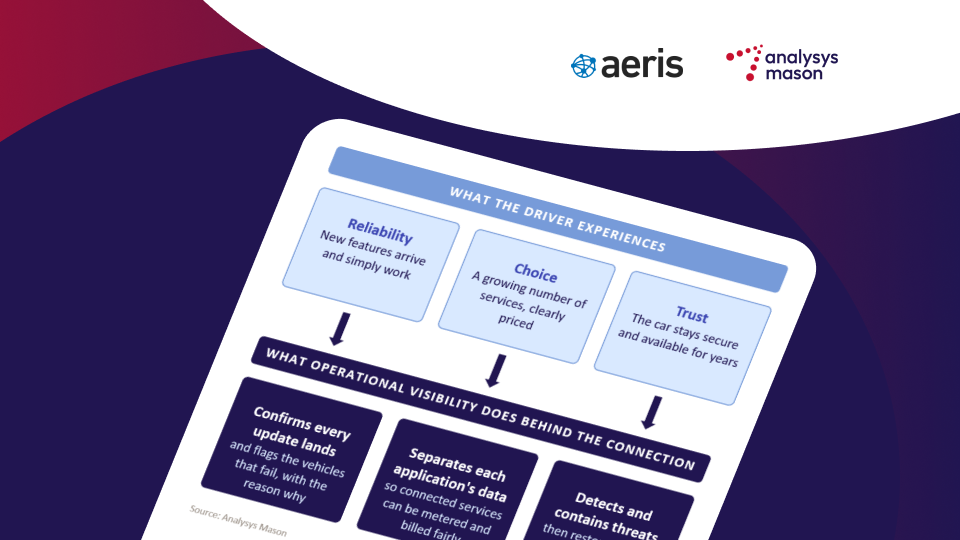
Embedded connectivity is now becoming standard, so it no longer sets a vehicle manufacturer (OEM) apart. Connectivity only confirms that a car is online; it says nothing about whether a software update arrived, a remote command worked, or a paid-for service is performing as expected. The capability that assures consistent customer experiences is operational visibility: the ability to see, and act on, what each vehicle is doing on the network. For consumers, this visibility delivers reliable connected features, services that feel worth paying for, and confidence in the security of their vehicles.
—
### **Network-Level Visibility Assures Owners That Features Arrive and Work**
Software updates are now the main way OEMs add features and fix problems after a car has been sold. When an update fails quietly, the owner is left without the latest features or with a security fix that never arrived. Research by **J.D. Power** found that 37% of electric-vehicle app users have experienced a lost connection or a delayed update, showing how often these everyday interactions fail and how aware customers are of these failures.
Visibility at the network level confirms which vehicles received an update, which did not, and why, so the OEM can put it right before the owner notices. For car owners, this means fewer missed features, fewer unresolved faults, quicker issue resolution, and greater confidence that the car is always up to date.
—
### **Application-Level Visibility Gives Drivers More Choice, on Transparent Terms**
A connected car carries multiple streams of data traffic on one connection, including the operational data the vehicle needs to run and the services a driver consumes. Visibility into traffic at the application level lets an OEM separate and measure each service accurately. OEMs can therefore offer a growing range of driver-paid and third-party services while being confident in their performance and ability to price each one accurately. For customers, this opens up a wide range of in-vehicle services, including in-car Wi-Fi hotspots, infotainment, such as music and video, and concierge services.
—
### **Fleet-Wide Operational Visibility Keeps Vehicles Secure and Available for Years**
A connected car is a long-lived, internet-connected device that its owner needs to trust for years. Most drivers give little thought to cyber security until something goes wrong, yet connected vehicles are an increasingly attractive cyber attack target. In 2024, 92% of reported attacks on connected vehicles or OEM cloud systems were carried out remotely, so protection must work across the whole fleet and be managed at the network level.
Visibility across the network lets an OEM spot unusual behavior across the fleet, identify affected vehicles, and apply targeted security controls before an issue spreads, often before the driver notices. The result is a car that stays safe, available, and dependable throughout its life.
—
### **A Better Customer Experience Is a Competitive Advantage for OEMs**
Customer experience has become a real point of differentiation in the highly competitive car market, helping OEMs to retain customers and grow recurring revenue. That experience rests quietly on operational visibility: updates that are assured, services that are accurately priced, and security that holds across the whole fleet. Manufacturers that build visibility into the product, rather than treating it as something to fix once a problem arises, will be the ones that earn lasting customer loyalty and sustained growth.
—
### **About Aeris**
For more than three decades, **Aeris** has been a trusted cellular platform leader enabling the biggest IoT programs with innovative technologies and borderless connectivity that simplify management, enhance security, optimize performance, and drive growth at scale. Our IoT technology expertise serves a global ecosystem of 7,000 enterprise customers, nearly 30 mobile network operator partners, and 104 million IoT devices across the world. Today, we support 70 automotive programs across 45 vehicle brands and 30+ global automotive OEM groups.
**Aeris IoT Watchtower™**, a fully integrated capability on the Aeris IoT Accelerator platform, gives automotive OEMs a single operational view across vehicles, networks, and applications—delivering the network-level insights and enforceable security controls needed to simplify operations, improve efficiency, and support profitable growth. As the largest orchestrator of eSIMs for IoT, we power today’s connected smart world.
To learn how **Aeris IoT Accelerator Platform**, **Aeris IoT Watchtower**, and **Aeris Mobility Suite** can secure and supercharge your critical IoT programs, visit [aeris.com](https://aeris.com) and follow us on [LinkedIn](https://www.linkedin.com/company/aeriscommunications/).
—
## FAQ
**Q: What is operational visibility in the context of connected cars?**
A: Operational visibility refers to the ability of an OEM to monitor and manage what each vehicle is doing on the network in real time. It provides insight into software updates, security events, application usage, and overall vehicle health, ensuring features work as intended and issues are resolved proactively.
**Q: Why is network-level visibility important for software updates?**
A: Network-level visibility confirms which vehicles have successfully received updates and which have not, allowing OEMs to address issues before the customer experiences a problem. This reduces missed features, unresolved faults, and security risks.
**Q: How does application-level visibility benefit both OEMs and drivers?**
A: Application-level visibility enables OEMs to accurately measure and manage different data services running over a single connection. This allows them to offer and monetize a wide range of in-car services—such as Wi-Fi, infotainment, and concierge—while ensuring performance and transparent pricing for drivers.
**Q: What role does operational visibility play in vehicle security?**
A: Visibility across the fleet helps OEMs detect unusual behavior or potential cyber threats early, apply targeted security controls remotely, and prevent issues from spreading. This ensures connected vehicles remain secure and reliable over their entire lifecycle.
**Q: How does operational visibility impact customer experience and brand loyalty?**
A: By ensuring updates are delivered, services function as promised, and security is maintained, operational visibility builds trust and satisfaction. This translates into stronger customer retention and recurring revenue for OEMs.
—
## Conclusion
As connected cars continue to evolve, operational visibility has become a foundational element for delivering reliable, secure, and valuable experiences to drivers. It empowers OEMs to manage software updates, monetize services, and protect fleets at scale—ultimately shaping a stronger competitive edge in the automotive market. Manufacturers that prioritize visibility into their connected vehicles will not only meet evolving customer expectations but also drive long-term loyalty and growth. With partners like Aeris, the industry is well-equipped to turn connectivity into real-world value, both today and in the future.
